
Low-carb foods are popular among people who want to reduce their carbohydrate intake while still enjoying satisfying meals. But “low carb” does not mean that every food has zero carbohydrates. Many nutritious foods, including vegetables, dairy products, nuts, and berries, contain small amounts of carbohydrates. Understanding the low carb foods chart makes it easier to compare foods, plan meals, and choose ingredients that fit different carbohydrate goals.
Why Low Carb Food Choices Matter
Carbohydrates are found in many foods, including grains, fruits, vegetables, dairy products, beans, and sweets. The amount can vary significantly between foods and serving sizes.
Foods such as meat, poultry, fish, eggs, and many oils contain little or no carbohydrate, while leafy greens and non-starchy vegetables generally provide relatively small amounts.
For people following a low-carb eating pattern, serving size is especially important. A food may be relatively low in carbohydrates per serving but contribute more carbohydrates if eaten in a large quantity.
Standard Low Carb Foods And Carbohydrates
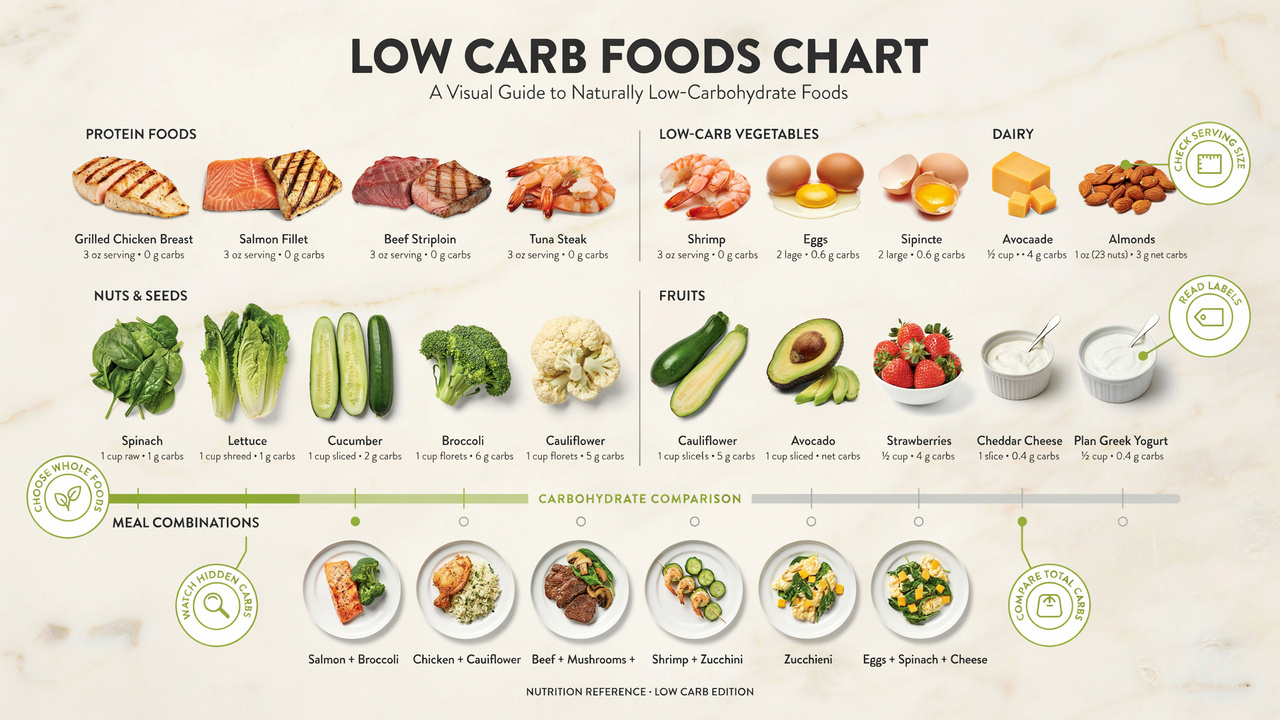
The following chart gives approximate carbohydrate amounts for common foods. Values can vary depending on the specific food, preparation, and serving size.
Low Carb Foods Chart
| Food | Serving Size | Approx. Total Carbs |
|---|---|---|
| Chicken Breast | 3 oz (85 g) | 0 g |
| Salmon | 3 oz (85 g) | 0 g |
| Beef | 3 oz (85 g) | 0 g |
| Eggs | 2 large | About 1 g |
| Tuna | 3 oz (85 g) | 0 g |
| Shrimp | 3 oz (85 g) | About 1 g |
| Spinach | 1 cup raw | About 1 g |
| Lettuce | 1 cup shredded | About 1–2 g |
| Cucumber | 1 cup sliced | About 4 g |
| Broccoli | 1 cup chopped | About 6 g |
| Cauliflower | 1 cup chopped | About 5 g |
| Zucchini | 1 cup sliced | About 4 g |
| Avocado | ½ medium | About 6 g |
| Strawberries | 1 cup sliced | About 12 g |
| Almonds | 1 oz (28 g) | About 6 g |
| Cheddar Cheese | 1 oz (28 g) | About 1 g |
| Greek Yogurt, Plain | ¾ cup | About 6 g |
These are general estimates. Actual carbohydrate content can differ between varieties and brands.
Choosing The Right Low Carb Foods
The best foods depend on your meal and carbohydrate target.
Meat and Poultry: Chicken, turkey, beef, pork, and other unbreaded meats are naturally very low in carbohydrates.
Seafood: Fish and shellfish can provide protein while generally contributing little carbohydrate.
Eggs: Eggs are versatile and contain very little carbohydrate.
Non-Starchy Vegetables: Leafy greens, broccoli, cauliflower, zucchini, cucumber, and mushrooms can add fiber and nutrients without providing large amounts of carbohydrates.
Nuts and Seeds: Almonds, walnuts, chia seeds, and flaxseeds contain carbohydrates but also provide fiber and healthy fats.
Dairy: Cheese and unsweetened dairy products can fit into many low-carb eating patterns, although milk and flavored yogurt contain more carbohydrates.
Low-Sugar Fruits: Berries are often chosen when someone wants fruit while keeping carbohydrate intake relatively moderate.
Low Carb Protein Foods Chart
Many animal-based protein foods contain little or no carbohydrate when they are unbreaded and prepared without sugary sauces.
| Protein Food | Serving Size | Approx. Carbs |
|---|---|---|
| Chicken Breast | 3 oz | 0 g |
| Turkey Breast | 3 oz | 0 g |
| Beef | 3 oz | 0 g |
| Pork | 3 oz | 0 g |
| Salmon | 3 oz | 0 g |
| Cod | 3 oz | 0 g |
| Tuna | 3 oz | 0 g |
| Shrimp | 3 oz | About 1 g |
| Eggs | 2 large | About 1 g |
| Sardines | 3 oz | 0 g |
Preparation matters. Breaded, glazed, or sweetened versions can contain significantly more carbohydrates than plain versions.
Low Carb Vegetable Chart
Vegetables vary widely in carbohydrate content. Non-starchy vegetables are generally easier to include in low-carb meals than potatoes, corn, or large portions of other starchy vegetables.
Low Carb Vegetables
| Vegetable | Serving Size | Approx. Total Carbs |
|---|---|---|
| Spinach | 1 cup raw | About 1 g |
| Lettuce | 1 cup shredded | About 2 g |
| Arugula | 1 cup | About 1 g |
| Celery | 1 cup chopped | About 3 g |
| Cucumber | 1 cup sliced | About 4 g |
| Zucchini | 1 cup sliced | About 4 g |
| Mushrooms | 1 cup sliced | About 3 g |
| Cauliflower | 1 cup chopped | About 5 g |
| Broccoli | 1 cup chopped | About 6 g |
| Cabbage | 1 cup chopped | About 5 g |
| Bell Pepper | 1 medium | About 7 g |
| Asparagus | 1 cup | About 5 g |
Vegetables can be roasted, steamed, grilled, sautéed, or eaten raw depending on the meal.
Low Carb Fruit Chart
Fruit naturally contains carbohydrates because of its natural sugars. However, some fruits contain fewer carbohydrates per serving than others.
| Fruit | Serving Size | Approx. Total Carbs |
|---|---|---|
| Raspberries | 1 cup | About 15 g |
| Blackberries | 1 cup | About 14 g |
| Strawberries | 1 cup sliced | About 12 g |
| Blueberries | 1 cup | About 21 g |
| Kiwi | 1 medium | About 11 g |
| Cantaloupe | 1 cup diced | About 13 g |
| Peach | 1 medium | About 15 g |
| Orange | 1 medium | About 15 g |
| Apple | 1 medium | About 25 g |
| Banana | 1 medium | About 27 g |
Berries are often favored in low-carb meal plans because they generally provide fewer carbohydrates per typical serving than fruits such as bananas, grapes, or dried fruit.
Low Carb Dairy Chart
Dairy products can have very different carbohydrate levels.
| Dairy Food | Serving Size | Approx. Total Carbs |
|---|---|---|
| Cheddar Cheese | 1 oz | About 1 g |
| Mozzarella | 1 oz | About 1 g |
| Parmesan | 1 oz | About 1–2 g |
| Cream Cheese | 2 tbsp | About 2 g |
| Butter | 1 tbsp | 0 g |
| Plain Greek Yogurt | ¾ cup | About 6 g |
| Cottage Cheese | ½ cup | About 5 g |
| Whole Milk | 1 cup | About 12 g |
| Heavy Cream | 2 tbsp | About 1 g |
Flavored yogurt and sweetened dairy products can contain considerably more carbohydrates than plain versions.
Low Carb Nuts And Seeds Chart
Nuts and seeds are popular additions to low-carb meals because they provide fat, protein, fiber, and other nutrients.
| Nut or Seed | Serving Size | Approx. Total Carbs |
|---|---|---|
| Pecans | 1 oz | About 4 g |
| Walnuts | 1 oz | About 4 g |
| Almonds | 1 oz | About 6 g |
| Macadamia Nuts | 1 oz | About 4 g |
| Brazil Nuts | 1 oz | About 4 g |
| Pumpkin Seeds | 1 oz | About 5 g |
| Sunflower Seeds | 1 oz | About 6 g |
| Chia Seeds | 1 oz | About 12 g |
| Flaxseed | 1 oz | About 8 g |
When comparing nuts and seeds, it can also be useful to look at fiber and net carbohydrates, rather than total carbohydrates alone.
Low Carb Snack Chart
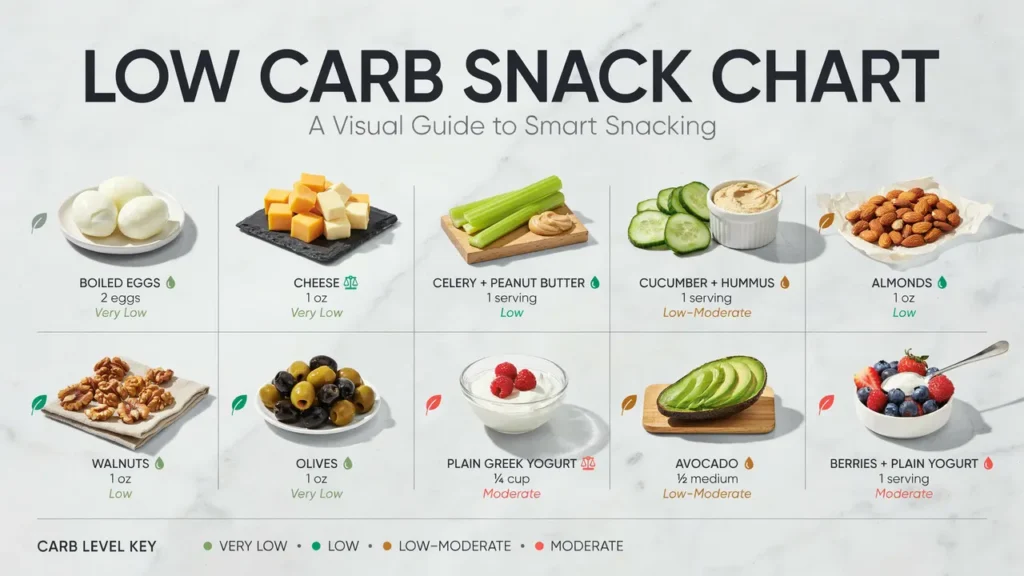
Low-carb snacks can combine protein, healthy fats, and vegetables.
| Snack | Typical Portion | Approx. Carb Level |
|---|---|---|
| Boiled Eggs | 2 eggs | Very low |
| Cheese | 1 oz | Very low |
| Celery + Peanut Butter | 1 serving | Low |
| Cucumber + Hummus | 1 serving | Low–moderate |
| Almonds | 1 oz | Low |
| Walnuts | 1 oz | Low |
| Olives | 1 oz | Very low |
| Plain Greek Yogurt | ¾ cup | Moderate |
| Avocado | ½ medium | Low–moderate |
| Berries + Plain Yogurt | 1 serving | Moderate |
Packaged snacks should be checked carefully because sauces, sweeteners, starches, and added sugars can increase carbohydrate content.
Low Carb Breakfast Foods
Breakfast can be low in carbohydrates without being limited to a single type of food.
Breakfast Chart
| Food | Low Carb Pairings |
|---|---|
| Eggs | Spinach, cheese, mushrooms |
| Omelet | Peppers, herbs, cheese |
| Greek Yogurt | Berries, chia seeds |
| Avocado | Eggs, tomato, herbs |
| Smoked Salmon | Eggs, cucumber, cream cheese |
| Cottage Cheese | Berries, nuts |
| Sausage | Eggs, spinach |
| Chia Pudding | Unsweetened milk, berries |
Choosing unsweetened ingredients is particularly important for keeping breakfast carbohydrates under control.
Low Carb Lunch Ideas
Lunch can be built around protein, vegetables, and flavorful dressings.
| Main Food | Add | Meal Idea |
|---|---|---|
| Chicken | Lettuce, cucumber, avocado | Chicken salad |
| Salmon | Greens, lemon, herbs | Salmon salad |
| Tuna | Celery, lettuce, mayonnaise | Tuna lettuce bowl |
| Beef | Broccoli, mushrooms | Beef vegetable bowl |
| Eggs | Spinach, cheese | Egg salad |
| Turkey | Lettuce, cheese, cucumber | Lettuce wrap |
These combinations can be adjusted according to your carbohydrate target and dietary preferences.
Low Carb Dinner Foods
Dinner can include a wide variety of proteins and non-starchy vegetables.
Grilled Salmon + Broccoli: A simple combination of seafood and vegetables.
Roasted Chicken + Cauliflower: A filling meal without traditional high-carb sides.
Beef + Mushrooms + Spinach: Works well as a skillet-style meal.
Shrimp + Zucchini: A lighter seafood and vegetable combination.
Pork + Cabbage: A simple pairing with plenty of flavor.
Eggplant + Ground Beef: Can be used as the base for a hearty vegetable-focused meal.
Low Carb Food Pairing Chart
Combining low-carb ingredients can make meals more satisfying and flavorful.
| Main Food | Best Pairings |
|---|---|
| Chicken | Broccoli, spinach, avocado |
| Salmon | Asparagus, cucumber, lemon |
| Beef | Mushrooms, spinach, cauliflower |
| Eggs | Cheese, avocado, spinach |
| Shrimp | Zucchini, garlic, herbs |
| Turkey | Lettuce, cucumber, cheese |
| Tofu | Broccoli, mushrooms, cabbage |
| Cauliflower | Cheese, herbs, chicken |
| Avocado | Eggs, tomato, lime |
| Greek Yogurt | Berries, nuts, chia seeds |
Low Carb Alternatives To Common Foods
One popular way to reduce carbohydrate intake is to replace higher-carb ingredients with vegetables or other lower-carb alternatives.
| Higher-Carb Food | Lower-Carb Alternative |
|---|---|
| White Rice | Cauliflower Rice |
| Regular Pasta | Zucchini Noodles |
| Potato Mash | Cauliflower Mash |
| Bread Wrap | Lettuce Wrap |
| Potato Fries | Zucchini Fries |
| Regular Pizza Crust | Vegetable-Based Crust |
| Tortilla Chips | Cheese Crisps |
| Sugary Yogurt | Plain Greek Yogurt |
These alternatives can help change the overall carbohydrate content of a meal, although the exact amount depends on the recipe and serving size.
Low Carb Foods Vs High Carb Foods
Understanding the difference between commonly lower- and higher-carbohydrate foods can make meal planning easier.
| Lower Carb Choices | Higher Carb Choices |
|---|---|
| Eggs | Bread |
| Chicken | Pasta |
| Fish | Rice |
| Cheese | Potatoes |
| Leafy Greens | Cereal |
| Broccoli | Crackers |
| Avocado | Sugary Desserts |
| Nuts | Candy |
| Mushrooms | Sweetened Drinks |
| Cucumber | Many Baked Goods |
This doesn’t mean higher-carb foods are automatically “bad.” Carbohydrate needs and dietary goals vary from person to person.
Low Carb Foods And Net Carbs
You may see the term net carbs used in low-carb diets. Net carbohydrates are generally calculated by subtracting dietary fiber from total carbohydrates.
For example, if a food contains 10 grams of total carbohydrates and 4 grams of fiber, it would have approximately 6 grams of net carbohydrates.
However, labeling rules and how different types of fiber affect the calculation can vary. For consistency, checking total carbohydrate and fiber on nutrition labels is useful.
Tips For Choosing Low Carb Foods
Check serving size: Carbohydrate numbers are based on a specific portion.
Read labels: Sauces, marinades, dressings, and flavored products can contain added sugar.
Choose whole foods: Meat, seafood, eggs, vegetables, nuts, and seeds can make meal planning easier.
Prioritize non-starchy vegetables: They can add volume, texture, and nutrients.
Watch hidden carbohydrates: Breaded meats, sweet sauces, and flavored dairy can contain more carbs than expected.
Compare total carbohydrates: Use nutrition labels or reliable food databases when precise tracking matters.
Common Mistakes When Choosing Low Carb Foods
Assuming low carb means zero carb: Many vegetables, nuts, dairy products, and fruits contain carbohydrates.
Ignoring portion size: Even low-carb foods contribute carbohydrates when eaten in large amounts.
Forgetting sauces: Ketchup, barbecue sauce, sweet chili sauce, and some salad dressings can add significant carbohydrates.
Eating too few vegetables: Reducing carbohydrates does not mean eliminating vegetables.
Relying only on processed “low-carb” foods: Whole foods can provide a broader range of nutrients.
Confusing total carbs with net carbs: These are different measurements and should not be treated as interchangeable.
Low Carb Foods For Meal Prep
Meal preparation can make low-carb eating much easier during busy days.
Meal Prep Chart
| Food | Prep Method | Easy Combination |
|---|---|---|
| Chicken | Grill or roast | Broccoli + avocado |
| Salmon | Bake | Asparagus + salad |
| Eggs | Boil | Spinach + cheese |
| Beef | Cook in skillet | Mushrooms + cauliflower |
| Turkey | Roast | Lettuce + cucumber |
| Cauliflower | Roast | Chicken + herbs |
| Zucchini | Grill | Shrimp + garlic |
| Broccoli | Steam | Beef + cheese |
Preparing proteins and vegetables in advance can make it easier to assemble meals quickly.
Low Carb Foods For Salads
Salads can be naturally low in carbohydrates when they focus on leafy greens, vegetables, protein, and appropriate dressings.
Lettuce: A light base for almost any salad.
Spinach: Adds a mild flavor and soft texture.
Cucumber: Provides freshness and crunch.
Avocado: Adds creamy texture and fat.
Chicken: Provides protein.
Egg: Adds richness and protein.
Cheese: Adds saltiness and creaminess.
Olives: Provide a savory flavor.
Nuts: Add crunch and texture.
Be careful with dried fruit, croutons, sweet dressings, and large amounts of starchy vegetables because they can increase the carbohydrate content.
The Role Of Carbohydrates In Food
Carbohydrates are one of the three major macronutrients, along with protein and fat. They are naturally present in foods such as grains, fruits, vegetables, legumes, and dairy products.
Different people may follow different carbohydrate targets depending on their personal goals, preferences, and dietary needs.
A low-carb eating pattern can therefore look very different from one person to another. Some people simply reduce refined carbohydrates, while others follow much stricter carbohydrate limits.
Frequently Asked Questions
What Foods Are Naturally Low In Carbohydrates?
Foods such as meat, poultry, fish, eggs, many cheeses, oils, leafy greens, and non-starchy vegetables are generally low in carbohydrates.
What Vegetables Are Lowest In Carbs?
Leafy greens, cucumber, celery, mushrooms, zucchini, and some other non-starchy vegetables generally contain relatively small amounts of carbohydrates per serving.
What Fruits Are Lowest In Carbs?
Berries such as strawberries, raspberries, and blackberries are often lower in carbohydrates per serving than fruits such as bananas, grapes, and dried fruit.
Is Rice Low Carb?
Rice is generally considered a high-carbohydrate food, so it is not usually included in strict low-carb eating patterns. Cauliflower rice is a common lower-carb alternative.
Is Potato Low Carb?
Potatoes are relatively high in carbohydrates compared with non-starchy vegetables, so they are generally limited in strict low-carb diets.
Are Eggs Low Carb?
Yes. Eggs contain very little carbohydrate, with approximately 1 gram of carbohydrate in two large eggs.
Is Cheese Low Carb?
Many natural cheeses are relatively low in carbohydrates, although the exact amount varies by type. Processed or flavored cheese products may contain additional carbohydrates.
Is Avocado Low Carb?
Avocado contains carbohydrates, but much of that carbohydrate comes from fiber. A half medium avocado contains roughly 6 grams of total carbohydrates.
Are Nuts Low Carb?
Many nuts contain relatively small amounts of digestible carbohydrates but still provide some total carbohydrates. Almonds, walnuts, pecans, and macadamia nuts are commonly used in low-carb eating patterns.
What Is The Difference Between Low Carb And Keto?
“Keto” generally refers to a much more restrictive carbohydrate intake designed to promote nutritional ketosis. A low-carb diet can have a broader carbohydrate range and does not necessarily aim for ketosis.
Low-carb eating doesn’t have to mean eating only meat and avoiding every food containing carbohydrates. Many vegetables, nuts, seeds, dairy products, and berries can fit into a low-carb meal plan when portion sizes are considered. Understanding the low carb foods chart helps you compare foods, identify hidden carbohydrate sources, and build balanced meals around proteins, non-starchy vegetables, healthy fats, and other foods that fit your individual dietary goals.
