
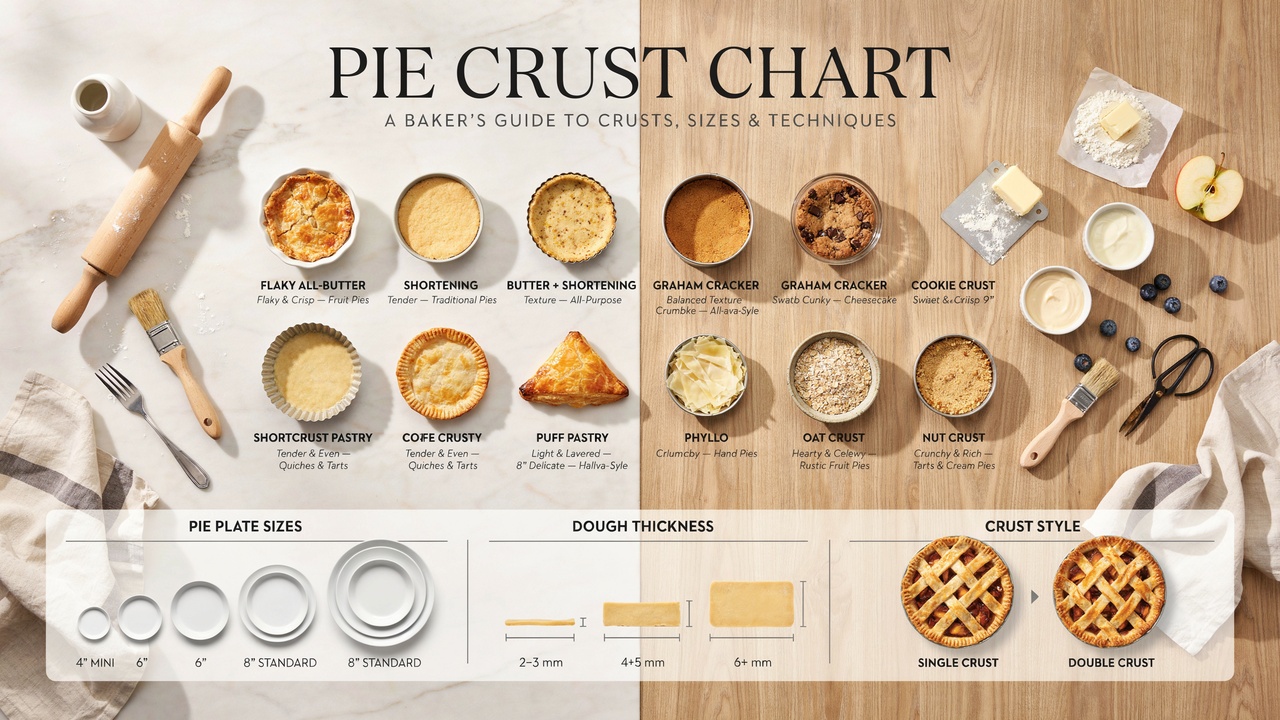
Pie crust is more than just a container for filling—it adds texture, flavor, structure, and visual appeal to every pie. From flaky butter crusts and tender shortcrust to graham cracker and puff pastry crusts, each type works better for certain fillings and baking methods. Understanding the pie crust chart helps home bakers choose the right crust, prepare the correct amount of dough, and create pies with a balanced crust-to-filling ratio.
Why Pie Crust Matters
The right pie crust can completely change the eating experience. A flaky crust provides crisp layers around juicy fruit fillings, while a crumb crust offers a crunchy texture that works especially well with creamy or chilled pies.
Pie crust also needs to be the right thickness. A crust that is too thin may break or become soggy, while one that is too thick can overpower the filling.
For home bakers, knowing the correct crust size is especially useful when choosing between 8-inch, 9-inch, and 10-inch pie plates.
Standard Pie Crust Chart
Pie crusts come in several different styles, each with its own texture and best uses.
Pie Crust Chart
| Pie Crust Type | Main Ingredients | Texture | Best For |
|---|---|---|---|
| All-Butter Crust | Butter, flour, water | Flaky & crisp | Fruit pies |
| Shortening Crust | Shortening, flour, water | Tender & flaky | Traditional pies |
| Butter-Shortening Crust | Butter, shortening, flour | Flaky & tender | All-purpose |
| Graham Cracker Crust | Graham crackers, butter, sugar | Crisp & crumbly | Cream pies |
| Cookie Crust | Cookies, butter | Crunchy | Cheesecake, cream pies |
| Shortcrust Pastry | Flour, butter, sugar | Tender & crumbly | Sweet pies |
| Puff Pastry | Butter, flour, water | Light & layered | Hand pies |
| Phyllo Crust | Thin pastry sheets, butter/oil | Crisp & delicate | Fruit & savory pies |
| Oat Crust | Oats, flour, butter | Crisp & hearty | Fruit pies |
| Nut Crust | Nuts, crumbs, butter | Crunchy | Cream pies |
Recipes and proportions can vary depending on the desired texture and filling.
Choosing The Right Pie Crust
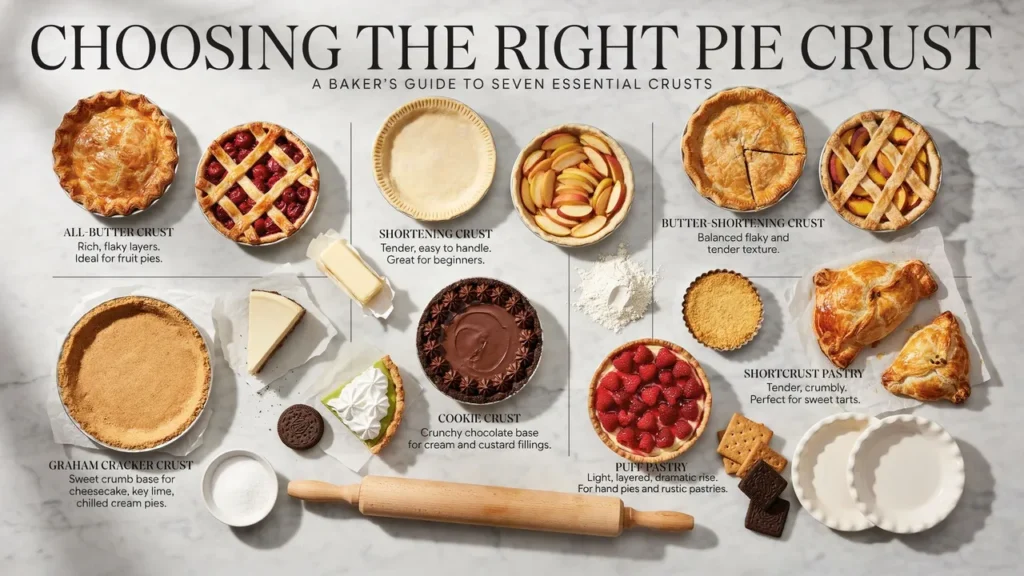
The best crust depends on the type of pie you are making.
All-Butter Crust: Great when you want rich flavor and flaky layers.
Shortening Crust: Useful when tenderness and easy handling are priorities.
Butter-Shortening Crust: A versatile option that combines butter flavor with the tenderness of shortening.
Graham Cracker Crust: Excellent for cheesecake, key lime pie, and chilled cream pies.
Cookie Crust: Works well with chocolate, cheesecake, and creamy fillings.
Shortcrust Pastry: Ideal for sweet tarts and pies where a tender, crumbly texture is preferred.
Puff Pastry: Best when you want a light, layered crust for individual or rustic pies.
Pie Crust Size Chart
The size of the pie plate determines how much dough you need.
| Pie Plate Size | Approx. Diameter | Typical Use | Dough Needed |
|---|---|---|---|
| Mini | 4–5 in | Individual pies | 60–100 g |
| Small | 6–7 in | Small pies | 120–180 g |
| Standard | 8 in | Small family pie | 180–250 g |
| Standard | 9 in | Most pies | 220–300 g |
| Deep Dish | 9 in | Deep-filled pies | 300–400 g |
| Large | 10 in | Large family pies | 280–350 g |
| Extra Large | 11 in | Large pies | 350–450 g |
Dough requirements vary depending on crust thickness, plate depth, and whether you are making a single or double crust.
Pie Crust Thickness Chart
The thickness of the dough affects both texture and durability.
| Crust Style | Approx. Thickness | Result |
|---|---|---|
| Very Thin | 2–3 mm | Delicate & crisp |
| Thin | 3–4 mm | Light & flaky |
| Standard | 4–5 mm | Balanced |
| Thick | 5–6 mm | Hearty & sturdy |
| Very Thick | 6+ mm | Dense & substantial |
For many standard pies, rolling the dough to around 3–5 mm provides a good balance between flakiness and strength.
Single Crust Vs Double Crust Chart
Not every pie requires a top crust.
| Crust Style | Bottom Crust | Top Crust | Best For |
|---|---|---|---|
| Single Crust | Yes | No | Custard, cream pies |
| Double Crust | Yes | Yes | Apple, cherry, berry pies |
| Lattice | Yes | Partial | Fruit pies |
| Crumb Topping | Yes | Crumb topping | Fruit pies |
| Crustless | No | No | Some custard pies |
A double crust can help contain juicy fruit fillings, while single-crust pies allow the filling to remain fully visible.
Pie Crust Ingredients Chart
Each ingredient has a specific purpose in pastry.
| Ingredient | Main Function |
|---|---|
| Flour | Provides structure |
| Butter | Adds flavor & flakiness |
| Shortening | Adds tenderness |
| Water | Brings dough together |
| Sugar | Adds sweetness & browning |
| Salt | Enhances flavor |
| Egg | Adds richness & structure |
| Milk | Adds tenderness & color |
| Vinegar | Can help limit gluten development |
| Ice Water | Keeps butter and dough cool |
The amount and type of fat have a major effect on the final texture.
Butter Vs Shortening Pie Crust
Butter and shortening create somewhat different results.
| Feature | Butter | Shortening |
|---|---|---|
| Flavor | Rich, buttery | Mild |
| Flakiness | Excellent | Very good |
| Tenderness | Good | Excellent |
| Browning | Better | Lighter |
| Handling | Can be more sensitive | Generally easy |
| Aroma | Strong | Mild |
Many bakers combine both fats to balance flavor, flakiness, and tenderness.
Pie Crust For Different Fillings
Different fillings work better with different crusts.
| Pie Filling | Recommended Crust | Why |
|---|---|---|
| Apple | All-butter, double crust | Flaky & sturdy |
| Cherry | Butter-shortening | Handles juicy filling |
| Blueberry | All-butter | Crisp & flavorful |
| Pumpkin | Single crust | Supports custard filling |
| Pecan | All-butter | Rich flavor |
| Chocolate Cream | Graham cracker | Crisp contrast |
| Key Lime | Graham cracker | Sweet & crunchy |
| Cheesecake | Graham cracker | Classic pairing |
| Lemon Meringue | Shortcrust | Tender base |
| Coconut Cream | Cookie/Graham | Crisp texture |
The moisture and weight of the filling should be considered when choosing a crust.
Sweet Pie Crust Chart
Sweet pies often use crusts with a little sugar for flavor and browning.
| Crust | Sweetness | Texture | Best Use |
|---|---|---|---|
| Sweet Shortcrust | Medium | Tender | Fruit & cream pies |
| Graham Cracker | Medium-high | Crunchy | Cream pies |
| Cookie Crust | Medium-high | Crisp | Cheesecake |
| Butter Pastry | Low-medium | Flaky | Fruit pies |
| Nut Crust | Low-medium | Crunchy | Cream pies |
Sugar should be balanced with the sweetness of the filling.
Savory Pie Crust Chart
Pie crust can also be used for savory dishes.
| Savory Pie | Suitable Crust | Main Character |
|---|---|---|
| Chicken Pot Pie | Butter pastry | Flaky |
| Beef Pie | Shortcrust | Sturdy |
| Vegetable Pie | Shortcrust | Tender |
| Quiche | Shortcrust | Crisp |
| Meat Pie | Butter-shortening | Rich |
| Mushroom Pie | Shortcrust | Savory |
Savory crusts generally contain little or no sugar.
Pie Crust Baking Temperature Chart
Baking temperatures vary by recipe and filling.
| Baking Stage | Approx. Temperature | Purpose |
|---|---|---|
| High Heat | 400–425°F | Initial browning |
| Moderate Heat | 350–375°F | Main baking |
| Lower Heat | 325–350°F | Gentle custard baking |
| Blind Baking | 375–425°F | Set empty crust |
Always follow the specific recipe because crust type and filling can change the ideal temperature.
Blind Baking Chart
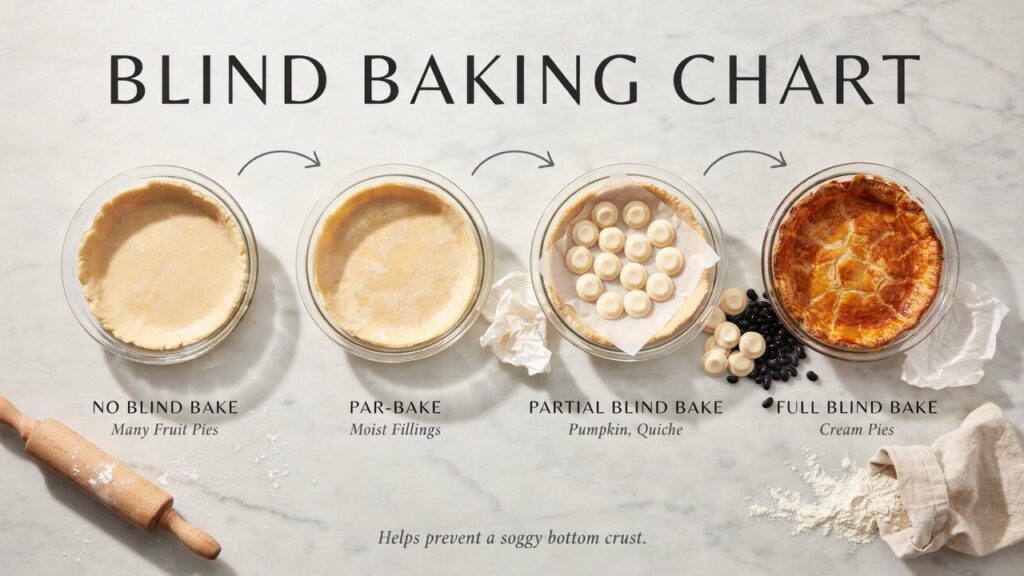
Blind baking means baking the crust partially or completely before adding the filling.
| Blind Baking Type | Typical Use |
|---|---|
| Partial Blind Bake | Pumpkin, quiche |
| Full Blind Bake | Cream pies |
| No Blind Bake | Many fruit pies |
| Par-Bake | Moist fillings |
Blind baking can help prevent the bottom crust from becoming soggy.
Pie Crust Size Comparison
A quick comparison makes it easier to choose the right pie plate.
| Pie Size | Servings | Typical Crust |
|---|---|---|
| 4-inch Mini | 1 | Single |
| 6-inch Small | 1–2 | Single |
| 8-inch | 6–8 | Single or double |
| 9-inch | 8–10 | Single or double |
| 10-inch | 10–12 | Single or double |
| 9-inch Deep Dish | 8–12 | Double or lattice |
Serving counts are approximate and depend on how large the slices are.
Pie Crust Serving Chart
| Pie Type | Typical Slice Size | Approx. Servings |
|---|---|---|
| 8-inch Pie | 1/8 pie | 6–8 |
| 9-inch Pie | 1/8 pie | 8 |
| 9-inch Deep Dish | 1/8 pie | 8–10 |
| 10-inch Pie | 1/10 pie | 10 |
| Mini Pie | 1 whole pie | 1 |
For parties, smaller slices can increase the number of servings.
How Much Pie Crust Do You Need?
The amount of dough depends on the size and style of the pie.
For a 9-inch single-crust pie, around 220–300 g of dough is a useful general starting range.
For a 9-inch double-crust pie, around 400–550 g total dough may be needed.
For a deep-dish pie, extra dough is usually necessary because the crust needs to cover the deeper sides of the pan.
These are general ranges rather than fixed recipe measurements.
Tips For Making Flaky Pie Crust
Keep the butter cold: Cold pieces of butter create pockets that help form flaky layers.
Do not overmix: Excessive mixing can develop too much gluten and make the crust tough.
Use ice water: Cold liquid helps keep the dough cool.
Chill the dough: Refrigerating the dough before rolling can make it easier to handle.
Avoid adding too much flour: Excess flour can make the crust dry.
Roll evenly: Consistent thickness helps the crust bake evenly.
Do not stretch the dough: Stretching can cause the crust to shrink during baking.
Common Mistakes When Making Pie Crust
Using warm butter: Soft or melted butter can reduce flakiness.
Overworking the dough: Too much handling can make the crust tough.
Adding too much water: Excess water can encourage gluten development.
Rolling unevenly: Thin spots may burn while thick areas remain underbaked.
Skipping chilling: Warm dough is harder to handle and can lose its structure.
Forgetting to dock the crust: For some single-crust pies, small holes can help prevent excessive bubbling during blind baking.
Overfilling the pie: Excess filling can overflow and make the crust soggy.
Pie Crust Troubleshooting Chart
| Problem | Possible Cause | Solution |
|---|---|---|
| Tough crust | Overmixed dough | Mix gently |
| Crumbly dough | Too little moisture | Add water gradually |
| Soggy bottom | Wet filling | Blind bake when appropriate |
| Shrinking crust | Dough stretched | Place gently in pan |
| Burnt edges | Excessive heat | Protect edges with foil |
| Pale crust | Low browning | Use appropriate baking temperature |
| Crust cracks | Dough too dry | Add moisture gradually |
| Uneven thickness | Poor rolling | Roll from center outward |
Pie Crust Flavor Chart
Different crust ingredients can change the overall flavor.
| Flavor | Ingredients |
|---|---|
| Rich & Buttery | Butter |
| Mild & Tender | Shortening |
| Sweet & Crunchy | Graham crackers |
| Nutty | Almonds, pecans, walnuts |
| Chocolate | Cocoa, chocolate cookies |
| Spiced | Cinnamon, nutmeg |
| Savory | Herbs, cheese |
| Whole-Grain | Whole wheat flour, oats |
Flavorful crusts can complement or contrast with the filling.
Pie Crust Topping Ideas
A top crust does not have to be plain.
Lattice: Creates a classic woven appearance and allows steam to escape.
Cutout Shapes: Leaves, stars, hearts, or other shapes can decorate the surface.
Braided Edge: Adds texture around the rim.
Crumb Topping: A mixture of flour, butter, sugar, and sometimes oats creates a crunchy topping.
Sugar Finish: A light sprinkle of sugar can add sweetness and browning.
Egg Wash: Brushing the crust with egg can create a glossy golden finish.
The History Behind Pie Crust
Pie pastry has a long history across European cooking traditions. Early pastry was often used as a protective container for fillings rather than simply as an edible component.
Over time, pastry techniques developed and pie crust became an important part of both sweet and savory cooking. Different regions developed their own styles, ingredients, and methods.
Today, pie crust can be made with butter, shortening, lard, cookies, crackers, nuts, oats, puff pastry, and many other ingredients.
Frequently Asked Questions
What Is The Best Pie Crust?
There is no single best pie crust. All-butter crusts are popular for their rich flavor and flakiness, while butter-shortening crusts offer a balance of flavor and tenderness.
How Thick Should Pie Crust Be?
A typical pie crust is often rolled to around 3–5 mm thick, although the ideal thickness depends on the recipe and type of pie.
How Much Dough Do I Need For A 9-Inch Pie?
A single-crust 9-inch pie commonly needs around 220–300 g of dough, while a double crust may require roughly 400–550 g total.
What Is The Difference Between Single And Double Pie Crust?
A single crust has only a bottom crust, while a double crust has both a bottom and top crust.
What Is Blind Baking?
Blind baking means baking the crust before adding the filling. It is commonly used for cream pies, quiches, and some custard pies.
Why Does My Pie Crust Get Soggy?
A soggy crust can result from a wet filling, insufficient baking, or not pre-baking the crust when the recipe calls for it.
Why Does My Pie Crust Shrink?
Pie crust can shrink when the dough is stretched while being placed into the pan or when the dough has been overworked.
Is Butter Or Shortening Better For Pie Crust?
Butter provides stronger flavor and good flakiness, while shortening tends to produce a tender and easy-to-handle crust. Many recipes use a combination of both.
Can I Make Pie Crust Ahead Of Time?
Yes. Pie dough can generally be prepared ahead and refrigerated or frozen, depending on the recipe.
What Is The Best Crust For Cream Pie?
Graham cracker, cookie, or fully blind-baked pastry crusts work particularly well with cream-based fillings.
Pie crust may seem simple, but choosing the right type, size, thickness, fat, and baking method can make a major difference in the finished pie. Whether you are making an apple pie, pumpkin pie, cheesecake, quiche, or cream pie, understanding the pie crust chart helps you choose the right crust and achieve the texture and structure you want.
