
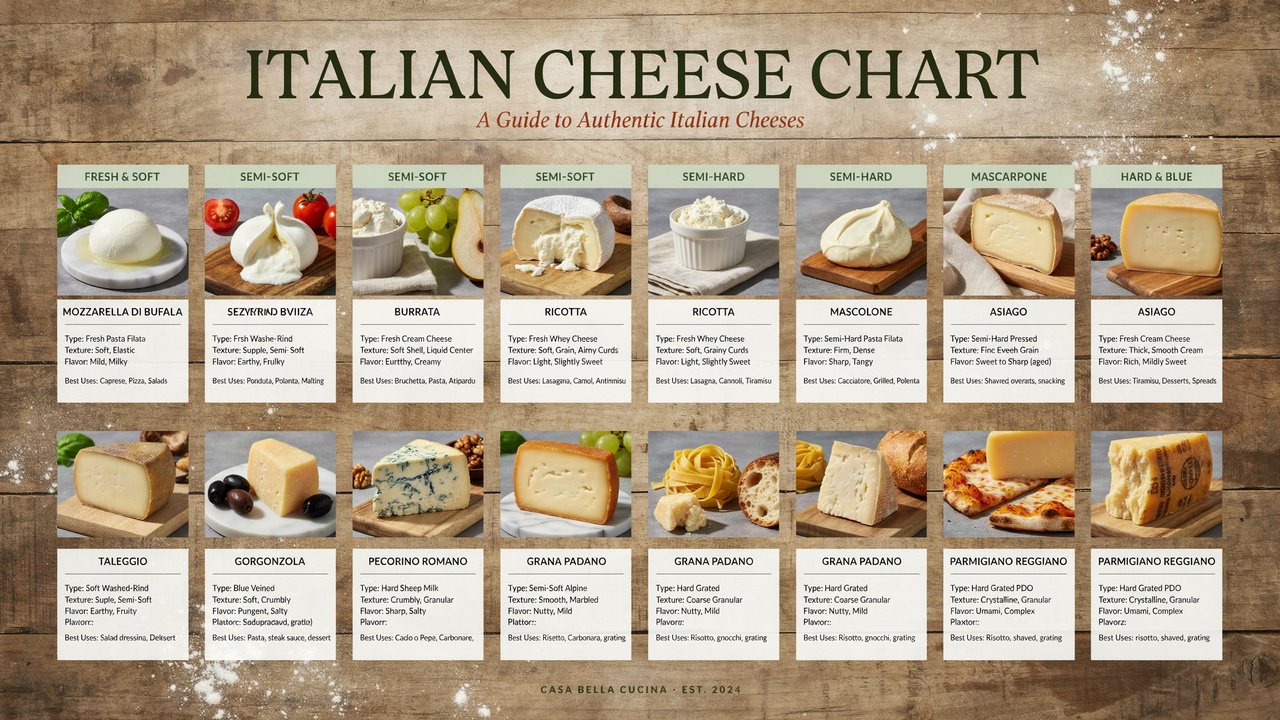
Italian cheese is an essential part of Italian cuisine, with hundreds of varieties ranging from soft and creamy to hard, aged, salty, and intensely flavorful. Each cheese has its own texture, aging process, flavor profile, and best culinary uses. Understanding the Italian cheese chart makes it easier to choose the right cheese for pasta, pizza, salads, desserts, sandwiches, cheese boards, and traditional Italian recipes.
Why Italian Cheese Matters
Cheese plays an important role in many Italian dishes. Some cheeses are designed to melt beautifully, while others are grated over pasta or served as a finishing ingredient.
Fresh cheeses such as mozzarella and ricotta are generally mild and creamy, while aged cheeses such as Parmigiano-Reggiano and Pecorino Romano develop stronger, saltier flavors.
Choosing the right Italian cheese can change the overall flavor and texture of a dish.
Standard Italian Cheese Chart
| Italian Cheese | Type | Texture | Flavor | Best Uses |
|---|---|---|---|---|
| Parmigiano-Reggiano | Hard, aged | Firm & crumbly | Nutty & savory | Pasta, risotto |
| Grana Padano | Hard, aged | Firm & granular | Mild & nutty | Grating, salads |
| Pecorino Romano | Hard, aged | Firm | Salty & sharp | Pasta, sauces |
| Mozzarella | Fresh | Soft & elastic | Mild & milky | Pizza, salads |
| Burrata | Fresh | Soft & creamy | Rich & milky | Salads, bread |
| Ricotta | Fresh | Soft & creamy | Mild & slightly sweet | Lasagna, desserts |
| Mascarpone | Fresh | Very creamy | Mild & buttery | Desserts, sauces |
| Gorgonzola | Blue | Soft to semi-firm | Sharp & tangy | Sauces, cheese boards |
| Taleggio | Soft | Creamy & supple | Mild, earthy | Sandwiches, risotto |
| Provolone | Semi-hard | Firm & smooth | Mild to sharp | Sandwiches, baking |
| Fontina | Semi-soft | Smooth & creamy | Nutty & buttery | Fondue, pasta |
| Asiago | Semi-hard/Hard | Firm | Nutty & savory | Grating, cooking |
Exact flavor and texture can vary with aging.
Italian Cheese By Texture
Italian cheeses can be grouped into several major texture categories.
| Texture | Examples | General Character |
|---|---|---|
| Fresh & Soft | Ricotta, Mascarpone | Creamy & mild |
| Soft | Taleggio, Burrata | Rich & supple |
| Semi-Soft | Fontina, Provolone | Smooth & sliceable |
| Semi-Hard | Asiago | Firm & flavorful |
| Hard | Parmigiano-Reggiano, Pecorino | Dense & grateable |
| Blue | Gorgonzola | Creamy & pungent |
Texture is influenced by milk type, moisture, production method, and aging.
Italian Cheese Flavor Chart
| Flavor | Italian Cheese Examples |
|---|---|
| Mild & Milky | Mozzarella, Ricotta |
| Creamy & Buttery | Mascarpone, Burrata |
| Nutty | Parmigiano-Reggiano, Grana Padano |
| Salty & Sharp | Pecorino Romano |
| Tangy | Gorgonzola |
| Earthy | Taleggio |
| Sweet & Mild | Ricotta |
| Strong & Pungent | Aged Gorgonzola |
Different aging periods can make the same cheese considerably stronger.
Fresh Italian Cheese Chart
Fresh cheeses are generally younger, softer, and higher in moisture.
| Cheese | Milk | Texture | Best Use |
|---|---|---|---|
| Mozzarella | Cow or buffalo | Soft & elastic | Pizza, Caprese salad |
| Burrata | Cow milk | Creamy center | Salads, appetizers |
| Ricotta | Traditionally whey-based | Soft & grainy-creamy | Lasagna, desserts |
| Mascarpone | Cow milk | Thick & creamy | Tiramisu |
| Stracchino | Cow milk | Soft & creamy | Bread, focaccia |
Fresh cheeses are usually best enjoyed relatively soon after production.
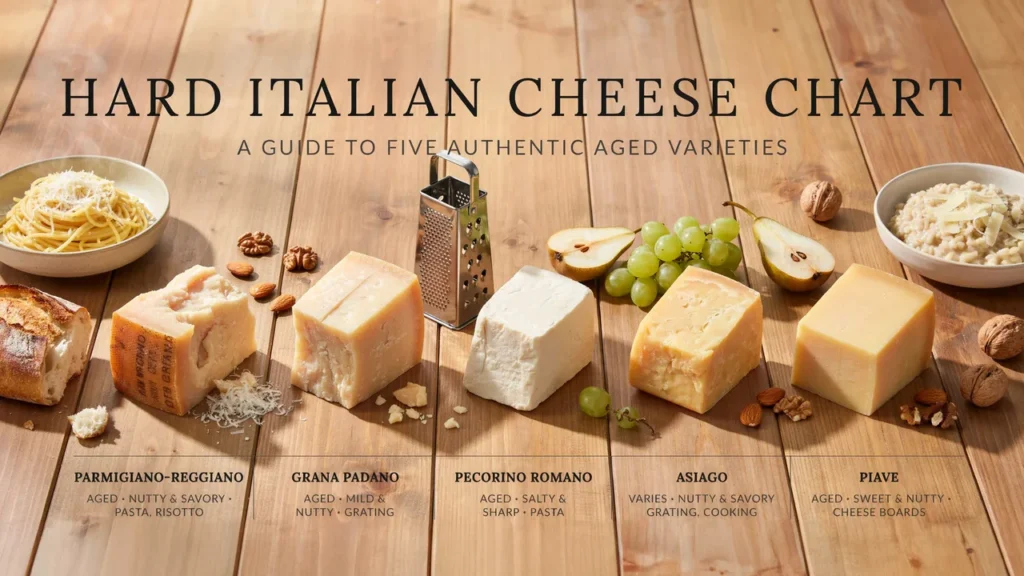
Hard Italian Cheese Chart
| Cheese | Aging | Flavor | Best Use |
|---|---|---|---|
| Parmigiano-Reggiano | Aged | Nutty & savory | Pasta, risotto |
| Grana Padano | Aged | Mild & nutty | Grating |
| Pecorino Romano | Aged | Salty & sharp | Pasta |
| Asiago | Varies | Nutty & savory | Grating, cooking |
| Piave | Aged | Sweet & nutty | Cheese boards |
Hard cheeses are excellent for grating because their firm structure allows them to be finely shredded.
Italian Cheese Aging Chart
| Aging Level | Texture | Flavor |
|---|---|---|
| Fresh | Soft | Mild & milky |
| Young | Soft to semi-firm | Mild & creamy |
| Medium-Aged | Firm | More savory |
| Aged | Hard | Nutty & intense |
| Extra-Aged | Very firm & crumbly | Strong & concentrated |
As cheese ages, it generally loses moisture and develops more concentrated flavors.
Italian Cheese For Pasta
Different pasta dishes traditionally use different cheeses.
| Cheese | Pasta Pairing |
|---|---|
| Parmigiano-Reggiano | Pasta, risotto |
| Pecorino Romano | Carbonara, cacio e pepe |
| Grana Padano | Creamy pasta, risotto |
| Gorgonzola | Gnocchi, creamy pasta |
| Ricotta | Lasagna, stuffed pasta |
| Mascarpone | Creamy pasta sauces |
| Asiago | Baked pasta |
The strongest cheeses should be used carefully so they do not overpower delicate sauces.
Italian Cheese For Pizza
| Cheese | Pizza Style |
|---|---|
| Mozzarella | Classic pizza |
| Buffalo Mozzarella | Neapolitan-style pizza |
| Provolone | Rich cheese pizza |
| Gorgonzola | Gourmet pizza |
| Fontina | Creamy specialty pizza |
| Parmigiano-Reggiano | Finishing cheese |
Mozzarella is especially popular because it melts well while maintaining a pleasant creamy texture.
Italian Cheese For Lasagna
Lasagna can use several different cheeses.
| Cheese | Role In Lasagna |
|---|---|
| Ricotta | Creamy filling |
| Mozzarella | Melting & stretch |
| Parmigiano-Reggiano | Savory finishing flavor |
| Pecorino | Stronger salty flavor |
| Mascarpone | Extra creamy filling |
A combination of ricotta, mozzarella, and Parmesan creates a rich and balanced lasagna.
Italian Cheese For Salads
| Cheese | Salad Pairing |
|---|---|
| Mozzarella | Tomato & basil |
| Burrata | Tomatoes, greens |
| Ricotta Salata | Mediterranean salads |
| Gorgonzola | Pear & walnut salads |
| Parmigiano-Reggiano | Arugula salads |
Fresh cheeses are especially good when paired with ripe vegetables and fresh herbs.
Italian Cheese For Desserts
Italian cheese is not limited to savory foods.
| Cheese | Dessert Use |
|---|---|
| Mascarpone | Tiramisu |
| Ricotta | Cannoli, cheesecake |
| Gorgonzola | Pear & honey pairings |
| Ricotta | Sweet pastries |
| Mascarpone | Fruit desserts |
Mascarpone is particularly useful in desserts because of its rich, smooth texture.
Italian Cheese Milk Chart
| Cheese | Common Milk |
|---|---|
| Parmigiano-Reggiano | Cow |
| Grana Padano | Cow |
| Mozzarella | Cow or buffalo |
| Buffalo Mozzarella | Buffalo |
| Pecorino Romano | Sheep |
| Ricotta | Traditionally whey from various milks |
| Gorgonzola | Cow |
| Taleggio | Cow |
| Fontina | Cow |
| Asiago | Cow |
Milk type has a major influence on flavor and texture.
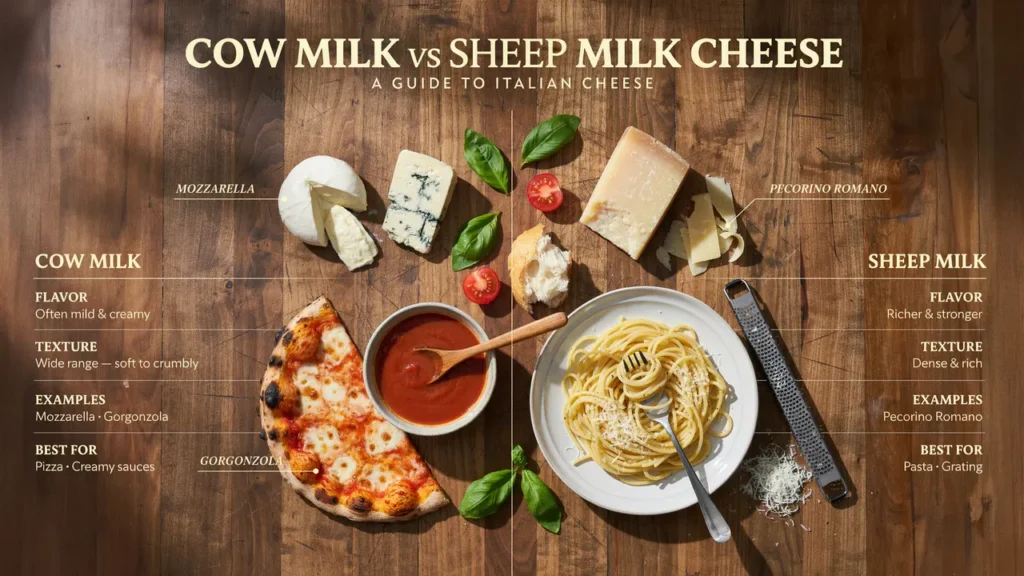
Cow Milk Vs Sheep Milk Cheese
| Feature | Cow Milk | Sheep Milk |
|---|---|---|
| Flavor | Often mild & creamy | Often richer & stronger |
| Texture | Wide range | Often dense & rich |
| Examples | Mozzarella, Gorgonzola | Pecorino Romano |
| Best For | Pizza, sauces | Pasta, grating |
Sheep’s-milk cheeses are commonly known as Pecorino cheeses.
Italian Cheese Vs Parmesan
“Parmesan” is commonly used as a general term for hard, grated cheeses, but Parmigiano-Reggiano is a specific Italian cheese with protected production requirements.
| Feature | Parmigiano-Reggiano | Generic Parmesan |
|---|---|---|
| Origin | Italy | Can be produced elsewhere |
| Aging | Controlled | Varies |
| Flavor | Complex & nutty | Varies |
| Texture | Granular & crumbly | Varies |
| Best Use | Pasta, risotto | General cooking |
For traditional Italian recipes, Parmigiano-Reggiano provides a distinctive flavor.
Parmigiano-Reggiano Vs Grana Padano
| Feature | Parmigiano-Reggiano | Grana Padano |
|---|---|---|
| Texture | Firm & granular | Firm & granular |
| Flavor | Rich & nutty | Mild & nutty |
| Saltiness | Moderate | Generally milder |
| Aging | Longer range | Often shorter |
| Best Use | Pasta, risotto | Pasta, soups, salads |
Both are excellent grating cheeses, but their flavor intensity can differ.
Pecorino Cheese Chart
Pecorino refers to Italian cheeses made from sheep’s milk.
| Cheese | Flavor | Best Use |
|---|---|---|
| Pecorino Romano | Salty & sharp | Pasta |
| Pecorino Toscano | Mild & buttery | Cheese boards |
| Pecorino Sardo | Savory & earthy | Tables, cooking |
| Pecorino Siciliano | Rich & firm | Grating, snacks |
Pecorino Romano is particularly famous for dishes such as cacio e pepe and carbonara.
Italian Blue Cheese Chart
| Cheese | Texture | Flavor |
|---|---|---|
| Gorgonzola Dolce | Soft & creamy | Mild & sweet |
| Gorgonzola Piccante | Firmer | Strong & sharp |
| Other Italian Blues | Varies | Tangy & pungent |
Gorgonzola pairs well with fruit, nuts, honey, pasta, and creamy sauces.
Italian Cheese Pairing Chart
| Cheese | Fruit | Nuts | Wine/Food Pairing |
|---|---|---|---|
| Parmigiano-Reggiano | Pear, apple | Walnuts | Pasta, honey |
| Gorgonzola | Pear, figs | Walnuts | Honey, salads |
| Pecorino | Pear, grapes | Almonds | Bread, cured meats |
| Mozzarella | Tomato | Pine nuts | Basil, olive oil |
| Taleggio | Pear, grapes | Walnuts | Bread |
| Fontina | Apple | Hazelnuts | Bread, vegetables |
Pairing depends on the age and strength of the cheese.
Italian Cheese Board Chart
For an Italian-style cheese board, combining different textures makes the experience more interesting.
| Cheese Style | Example |
|---|---|
| Fresh | Mozzarella |
| Creamy | Burrata |
| Semi-Soft | Taleggio |
| Hard | Parmigiano-Reggiano |
| Sheep’s Milk | Pecorino Romano |
| Blue | Gorgonzola |
Serve with bread, crackers, fruit, nuts, olives, and suitable accompaniments.
Italian Cheese Substitution Chart
Sometimes a specific Italian cheese is unavailable.
| Original Cheese | Possible Substitute |
|---|---|
| Parmigiano-Reggiano | Grana Padano |
| Pecorino Romano | Parmigiano-Reggiano |
| Mozzarella | Provolone |
| Mascarpone | Cream cheese in some recipes |
| Ricotta | Cottage cheese |
| Fontina | Gruyère |
| Gorgonzola | Other blue cheese |
Substitutions can change the flavor and texture, so the closest match depends on the recipe.
Italian Cheese Storage Chart
| Cheese Type | Storage Approach |
|---|---|
| Fresh Cheese | Refrigerate & use relatively quickly |
| Soft Cheese | Refrigerate, well wrapped |
| Semi-Hard | Refrigerate, protect from drying |
| Hard Cheese | Refrigerate, protect from excess moisture |
| Blue Cheese | Refrigerate separately when possible |
Always follow the storage instructions provided with the specific cheese.
Common Mistakes When Choosing Italian Cheese
Using a very strong cheese in a delicate dish: Powerful cheeses can overpower mild ingredients.
Confusing Parmesan with Parmigiano-Reggiano: They are not necessarily the same product.
Using fresh mozzarella for every recipe: Some dishes benefit from firmer, lower-moisture mozzarella.
Ignoring aging: Aged cheeses can have dramatically stronger flavors.
Using too much Pecorino: Its salty flavor can quickly dominate a dish.
Storing cheese incorrectly: Poor storage can affect texture, aroma, and freshness.
Tips For Choosing Italian Cheese
Match texture to the dish: Soft cheeses work well in fillings, while hard cheeses are excellent for grating.
Consider flavor intensity: Mild cheeses suit delicate dishes, while strong cheeses work well with bold ingredients.
Check the milk type: Cow, sheep, and buffalo milk create different flavor profiles.
Consider aging: Younger cheeses tend to be softer and milder, while aged cheeses are generally firmer and more concentrated.
Use fresh cheeses fresh: Mozzarella, burrata, and ricotta are best when their freshness and texture are preserved.
Italian Cheese Nutrition Chart
Cheese nutrition varies considerably by type and serving size.
| Cheese Type | General Nutrition Character |
|---|---|
| Fresh Cheese | Protein & fat, often higher moisture |
| Hard Cheese | Concentrated protein & fat |
| Blue Cheese | Protein & fat |
| Ricotta | Protein with moderate fat |
| Mascarpone | High in fat |
| Mozzarella | Protein & fat, high moisture |
For exact calories, protein, fat, sodium, and other nutrients, check the nutrition label for the specific cheese.
Italian Cheese Serving Size Chart
A typical cheese serving depends on how it is being served.
| Serving | Approx. Amount | Best Use |
|---|---|---|
| Small | 15–20 g | Tasting |
| Standard | 25–30 g | Cheese board |
| Large | 40–50 g | Snack |
| Cooking Portion | Varies | Pasta, pizza, sauces |
Recipe quantities can be much higher than a typical standalone cheese-board serving.
Italian Cheese For Cooking
| Dish | Recommended Cheese |
|---|---|
| Carbonara | Pecorino Romano |
| Cacio e Pepe | Pecorino Romano |
| Risotto | Parmigiano-Reggiano |
| Pizza | Mozzarella |
| Lasagna | Ricotta & Mozzarella |
| Tiramisu | Mascarpone |
| Gnocchi | Gorgonzola |
| Caprese Salad | Mozzarella |
| Pasta | Parmigiano-Reggiano |
Matching the cheese to the traditional dish can help create a more balanced result.
The History Behind Italian Cheese
Italy has a long and diverse cheese-making tradition, with regional varieties shaped by local milk, climate, agriculture, and culinary customs. Different regions became known for different cheeses.
Northern Italy is famous for cheeses such as Gorgonzola, Taleggio, Fontina, and Grana Padano, while central and southern regions are associated with varieties such as Pecorino Romano, Mozzarella, and Ricotta.
This regional diversity is one of the reasons Italian cheese has become such an important part of global cuisine.
Frequently Asked Questions
What Is The Most Popular Italian Cheese?
Mozzarella and Parmigiano-Reggiano are among the most internationally recognized Italian cheeses.
What Is The Best Italian Cheese For Pasta?
Parmigiano-Reggiano and Pecorino Romano are excellent choices for many pasta dishes.
What Is The Difference Between Parmesan And Parmigiano-Reggiano?
Parmigiano-Reggiano is a specific Italian cheese produced under protected requirements, while “Parmesan” can refer more generally to similar hard cheeses.
What Is The Best Italian Cheese For Pizza?
Mozzarella is the classic choice because it melts well and has a mild, creamy flavor.
What Is The Best Italian Cheese For Lasagna?
A combination of ricotta, mozzarella, and Parmigiano-Reggiano works well in many lasagna recipes.
What Is Pecorino Cheese?
Pecorino is a family of Italian sheep’s-milk cheeses. Pecorino Romano is one of the most famous varieties.
Is Gorgonzola A Blue Cheese?
Yes. Gorgonzola is an Italian blue cheese with a range of flavors from mild and creamy to sharp and intense.
What Is The Difference Between Mozzarella And Burrata?
Mozzarella has a more uniform, elastic interior, while burrata has a creamy interior made with stracciatella and cream.
What Italian Cheese Is Used In Tiramisu?
Mascarpone is the traditional creamy cheese used in classic tiramisu.
Which Italian Cheese Is Best For A Cheese Board?
A combination of Parmigiano-Reggiano, Pecorino, Taleggio, Gorgonzola, and a fresh cheese such as mozzarella or burrata provides a wide range of textures and flavors.
Italian cheese offers an enormous range of flavors, textures, milk types, and aging styles. From creamy mascarpone and fresh mozzarella to sharp Pecorino Romano and nutty Parmigiano-Reggiano, each cheese has its own place in the kitchen. Understanding the Italian cheese chart helps you choose the right variety for pasta, pizza, salads, desserts, cooking, or a beautifully balanced cheese board.
