
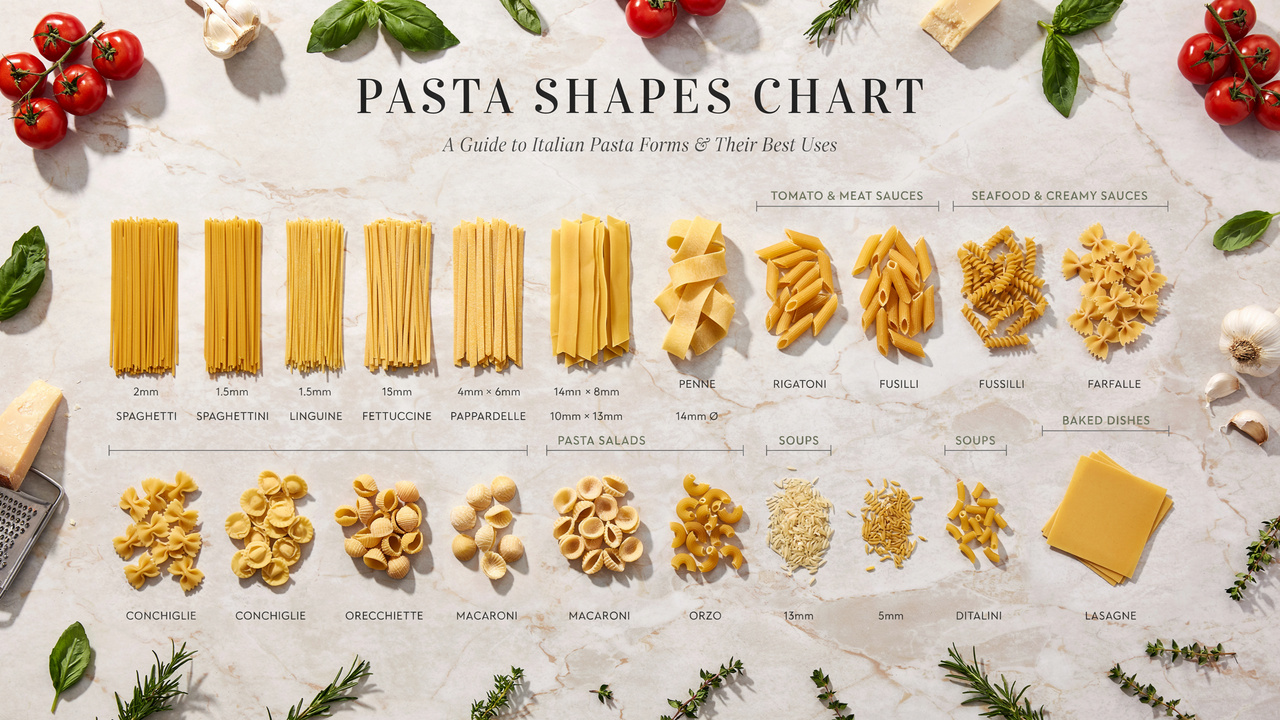
Pasta is much more than just noodles. From long spaghetti and delicate angel hair to ridged penne, spiral fusilli, and tiny soup pasta, each shape is designed to work with food in a slightly different way. But have you ever wondered why there are so many pasta shapes? Understanding the pasta shapes chart makes it easier to choose the right pasta for sauces, soups, salads, baked dishes, and everyday meals. Let’s explore the most popular pasta shapes, their sizes, textures, and the dishes they work best with.
Why Pasta Shape Matters
Pasta shape is not just about appearance. The size, thickness, curves, ridges, and openings of pasta affect how sauce clings to it and how the pasta feels when you eat it.
Long, thin pasta such as spaghetti works especially well with smooth sauces, oil-based sauces, and tomato sauces. Tubular shapes such as penne and rigatoni can hold sauce inside their tubes, while ridges provide additional surface area for sauce.
Small shapes such as orzo and ditalini are particularly useful in soups, while shapes such as farfalle and fusilli work well in pasta salads because their shapes hold ingredients and dressing effectively.
Choosing the right pasta shape can therefore make a simple dish taste and feel completely different.
Standard Pasta Shapes And Sizes
There are hundreds of pasta shapes, but only a selection are commonly found in supermarkets and restaurants.
Pasta Shapes Chart
| Pasta Shape | Approximate Size | Best Use |
|---|---|---|
| Spaghetti | About 10–12 in long | Tomato, meat & oil sauces |
| Spaghettini | About 10–12 in long | Light sauces & seafood |
| Linguine | About 10–12 in long | Seafood & creamy sauces |
| Fettuccine | About 10–12 in long | Creamy & rich sauces |
| Pappardelle | About 10–12 in long, wide | Hearty meat sauces |
| Penne | About 1.5–2 in long | Tomato, meat & baked dishes |
| Rigatoni | About 2 in long | Thick & chunky sauces |
| Fusilli | About 1.5–2 in long | Sauces & pasta salads |
| Farfalle | About 1–2 in across | Salads & light sauces |
| Conchiglie | Small to large shells | Sauces, salads & baking |
| Orecchiette | About 1 in across | Vegetables & thick sauces |
| Macaroni | About 1 in long | Cheese sauces & casseroles |
| Orzo | About 0.5 in long | Soups & salads |
| Ditalini | About 0.5 in long | Soups & pasta salads |
| Lasagne | Large flat sheets | Layered baked dishes |
The exact dimensions vary between brands and varieties. For example, pasta manufacturers may produce slightly different widths and lengths for the same named shape.
Choosing The Right Pasta Shape
The best pasta shape depends mainly on the type of dish and sauce you’re preparing.
Spaghetti: A versatile long pasta that works well with tomato sauces, seafood, vegetables, meat sauces, and oil-based sauces.
Penne: Its tube shape and angled ends make it excellent for sauces that need to get inside the pasta.
Rigatoni: Larger and wider than penne, making it especially useful for chunky meat and vegetable sauces.
Fusilli: Its spiral shape catches sauce and small ingredients, making it useful for pasta salads and thick sauces.
Farfalle: The bow-tie shape works particularly well with lighter sauces, vegetables, and cold pasta salads.
Orecchiette: Its small cup-like shape can hold bits of sauce and vegetables, making it especially useful with chunky ingredients.
Orzo: This tiny rice-shaped pasta is commonly used in soups, salads, and side dishes.
Lasagne: Flat sheets are designed to be layered with sauce, cheese, meat, and vegetables before baking.
Long Pasta Vs Short Pasta
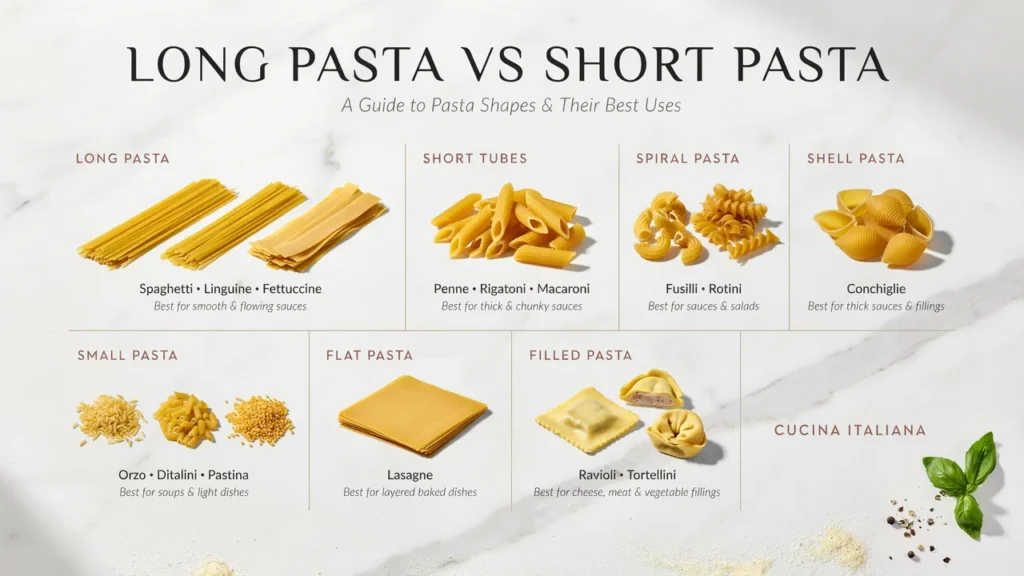
Pasta shapes are often divided into broad categories based on their structure.
| Pasta Category | Examples | Best For |
|---|---|---|
| Long Pasta | Spaghetti, linguine, fettuccine | Smooth & flowing sauces |
| Short Tubes | Penne, rigatoni, macaroni | Thick & chunky sauces |
| Spiral Pasta | Fusilli, rotini | Sauces & salads |
| Shell Pasta | Conchiglie | Thick sauces & fillings |
| Small Pasta | Orzo, ditalini, pastina | Soups & light dishes |
| Flat Pasta | Lasagne | Layered baked dishes |
| Filled Pasta | Ravioli, tortellini | Cheese, meat & vegetable fillings |
The shape of the pasta changes the way sauce and other ingredients interact with each bite.
Pasta Shape And Sauce Pairing
Some pasta shapes are particularly well suited to certain types of sauce.
| Pasta Shape | Best Sauce Types |
|---|---|
| Spaghetti | Tomato, marinara, oil-based |
| Linguine | Seafood, pesto, light cream |
| Fettuccine | Alfredo, cream, mushroom |
| Pappardelle | Ragù, meat, mushroom |
| Penne | Tomato, pesto, cream |
| Rigatoni | Meat, tomato, baked sauces |
| Fusilli | Pesto, cheese, vegetable |
| Farfalle | Light cream, tomato, salads |
| Orecchiette | Vegetable, sausage, thick sauces |
| Conchiglie | Cheese, meat, tomato |
| Macaroni | Cheese, cream, baked dishes |
| Orzo | Broth, vegetables, salads |
Tube-shaped and ridged pasta can be especially effective with thicker sauces because their surfaces and openings help hold onto the sauce.
Pasta Shapes And Serving Size
Pasta shape can also affect how much dry pasta looks like a serving. The same weight of pasta can occupy different amounts of space depending on the shape.
A common general serving guideline is 2 ounces (56 g) of dry pasta per person, although the volume of that amount varies considerably by shape.
For example, a 56 g serving of spaghetti can look very different from 56 g of penne, fusilli, or small soup pasta.
Pasta Serving Size Chart
| Pasta Type | Dry Serving | Approximate Cooked Amount |
|---|---|---|
| Spaghetti | 2 oz (56 g) | About 1 cup |
| Fettuccine | 2 oz (56 g) | About 1 cup |
| Linguine | 2 oz (56 g) | About 1 cup |
| Farfalle | 2 oz (56 g) | About 1.25 cups |
| Penne | 2 oz (56 g) | About 1–1.25 cups |
| Rigatoni | 2 oz (56 g) | About 1.25 cups |
| Rotini | 2 oz (56 g) | About 1 cup |
| Orzo | 2 oz (56 g) | About 0.8 cup |
| Ditalini | 2 oz (56 g) | About 1.25 cups |
These cooked volumes can vary by brand and cooking method, but they demonstrate why measuring pasta by weight is generally more consistent than measuring by cups.
Pasta Shape Vs Cooking Time
Different shapes can require different cooking times, even when they are made from the same basic ingredients.
Thin pasta generally cooks faster than thick or large pasta. Small pasta can also cook quickly, while thick tubular shapes may require more time for the center to become tender.
Pasta Cooking Time Chart
| Pasta Shape | Typical Cooking Time |
|---|---|
| Spaghettini | About 5–8 minutes |
| Spaghetti | About 8–11 minutes |
| Linguine | About 9–12 minutes |
| Fettuccine | About 10–12 minutes |
| Penne | About 10–12 minutes |
| Fusilli | About 10–12 minutes |
| Farfalle | About 10–12 minutes |
| Rigatoni | About 11–13 minutes |
| Macaroni | About 7–10 minutes |
| Orzo | About 8–10 minutes |
Cooking times vary by brand, thickness, ingredients, and whether the pasta is intended to be cooked al dente. Always check the package instructions for the specific product.
Pasta Shapes For Soups
Small pasta shapes are particularly useful in soups because they are easy to eat with a spoon and can add texture without overwhelming the broth.
Orzo: Its rice-like appearance makes it a popular choice for soups and brothy dishes.
Ditalini: This tiny tube-shaped pasta is especially useful in vegetable soups and bean-based dishes.
Pastina: Very small pasta shapes are traditionally used in simple soups and light meals.
Fideo: Short pieces of thin pasta are commonly used in soups and broths.
Small soup pasta is generally designed to complement the broth rather than dominate the dish.
Pasta Shapes For Pasta Salad
Not every pasta shape works equally well in a cold pasta salad.
Shapes with curves, folds, and openings can hold dressing and small ingredients such as vegetables, herbs, and cheese.
Best Pasta Shapes For Salad
| Pasta Shape | Why It Works |
|---|---|
| Fusilli | Spirals catch dressing |
| Rotini | Twists hold small ingredients |
| Farfalle | Compact shape works well cold |
| Penne | Tubes hold dressing |
| Orecchiette | Cup shape catches ingredients |
| Small Shells | Open shape holds dressing |
For pasta salads, short shapes are generally easier to mix and eat than very long pasta.
Pasta Shapes For Baked Dishes
Large and sturdy pasta shapes are excellent for baked dishes because they can handle thicker sauces and longer cooking.
Penne: Great for baked pasta casseroles and tomato-based dishes.
Rigatoni: Its large tubes work particularly well with meat and cheese sauces.
Manicotti: Large tubes are designed to be filled before baking.
Conchiglie: Large shells can hold cheese, meat, and vegetable fillings.
Lasagne: Flat sheets create the classic layered structure of lasagna.
These shapes allow sauce and cheese to spread throughout the dish while maintaining a satisfying pasta texture.
Pasta Shape Vs Texture
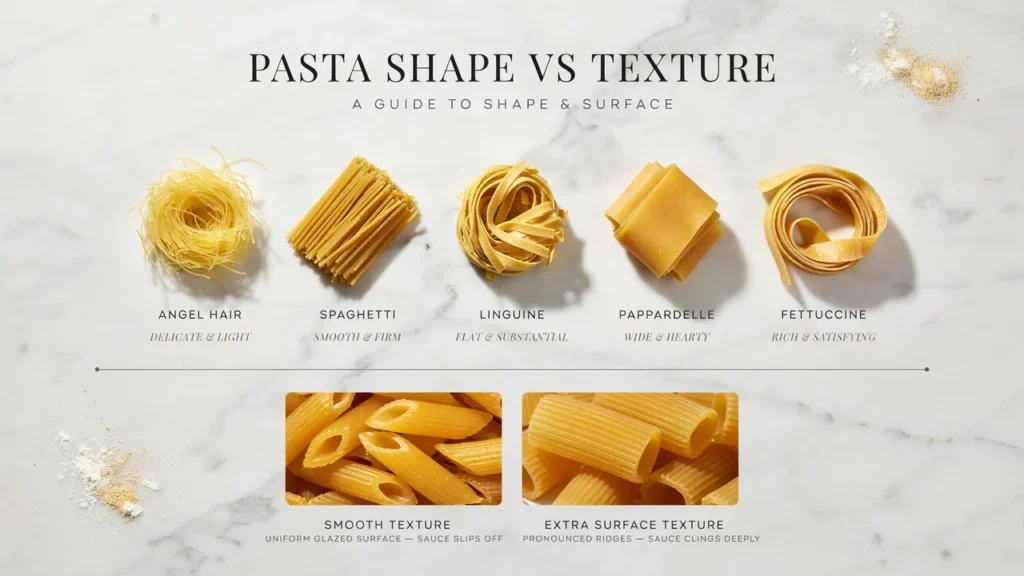
The shape of pasta affects more than sauce—it also changes the eating experience.
Thin pasta tends to feel delicate and light, while wide shapes such as pappardelle create a more substantial bite.
Ridged pasta has extra surface texture, while smooth pasta provides a more uniform mouthfeel.
Pasta Texture Chart
| Shape | Texture Experience |
|---|---|
| Angel Hair | Very delicate |
| Spaghetti | Smooth and firm |
| Linguine | Flat and slightly substantial |
| Fettuccine | Wide and rich |
| Pappardelle | Very wide and hearty |
| Penne | Firm with a tubular bite |
| Rigatoni | Thick and substantial |
| Fusilli | Springy and twisted |
| Farfalle | Firm center with thinner edges |
| Shells | Firm with sauce-filled bites |
Cooking pasta al dente, meaning firm but cooked through, helps preserve the intended texture of many pasta shapes.
Popular Italian Pasta Shapes
Italy has an enormous variety of pasta shapes, with different regions developing their own traditional forms.
| Pasta Shape | General Origin/Association | Common Use |
|---|---|---|
| Spaghetti | Southern Italy | Tomato & seafood |
| Orecchiette | Puglia | Vegetables & sausage |
| Fettuccine | Central Italy | Creamy sauces |
| Pappardelle | Tuscany | Hearty ragù |
| Rigatoni | Rome | Rich sauces |
| Trofie | Liguria | Pesto |
| Bucatini | Lazio/Rome | Tomato-based sauces |
| Lasagne | Northern & Central Italy | Layered baked dishes |
Pasta names and regional traditions can vary, and many shapes are now enjoyed throughout Italy and around the world.
How Pasta Shapes Affect Sauce
A pasta shape essentially acts as a vehicle for sauce.
Long strands allow sauce to coat the surface as you twirl them around a fork. Tubes allow sauce to enter the center. Ridges create additional areas for sauce to cling to. Twists and folds can trap herbs, vegetables, cheese, and other small ingredients.
This is why choosing a pasta shape isn’t simply a matter of appearance. The right combination can make the sauce and pasta work together much better.
Tips For Choosing Pasta Shapes
Match shape to sauce: Thick sauces generally work well with larger or ridged shapes.
Use long pasta for smooth sauces: Spaghetti and linguine are versatile choices.
Choose small shapes for soup: Orzo and ditalini are easier to eat with broth.
Use sturdy pasta for baking: Penne, rigatoni, and large shells hold up well.
Choose twists for salads: Fusilli and rotini catch dressing effectively.
Consider texture: Different shapes create noticeably different bites.
Common Mistakes When Choosing Pasta Shapes
Using delicate pasta with heavy sauce: Very thin pasta can become overwhelmed by thick sauces.
Using long pasta for soup: Long strands can be difficult to eat in broth.
Ignoring ridges: Ridged shapes can hold more sauce than smooth versions.
Overcooking small pasta: Tiny shapes can become soft quickly.
Measuring by volume only: Different shapes occupy different amounts of space, so weight is more consistent.
Assuming all pasta cooks the same way: Thickness and shape affect cooking time.
Pasta Shapes Vs Pasta Types
It’s also useful to understand the difference between a pasta shape and a pasta type.
Pasta shapes describe the physical form, such as spaghetti, penne, fusilli, or shells. Pasta types can also describe the ingredients or preparation method, such as whole-wheat pasta, gluten-free pasta, fresh pasta, or dried pasta.
The same shape can sometimes be made from different ingredients.
For example, penne can be produced from traditional durum wheat semolina, while gluten-free versions may be made from ingredients such as corn, rice, legumes, or other grains.
The History Behind Pasta Shapes
Pasta has developed into an enormous family of shapes over centuries. Different regions of Italy developed forms suited to local ingredients, cooking traditions, and sauces.
Some shapes were created to hold thick sauces, while others were designed for soups, baked dishes, or filled preparations.
Even the names often describe the shape. For example, penne refers to the shape of an old-style writing pen, while orecchiette translates roughly to “little ears.” Farfalle means “butterflies,” reflecting its distinctive bow-tie appearance.
This combination of regional tradition and practical design is one reason the world of pasta is so diverse.
Frequently Asked Questions
What Is The Most Popular Pasta Shape?
Spaghetti is one of the most widely recognized and commonly used pasta shapes. It pairs well with many sauces, including tomato, meat, seafood, and oil-based sauces.
What Pasta Shape Holds The Most Sauce?
Large ridged and tubular shapes such as rigatoni and penne rigate are excellent at holding thick sauces because sauce can cling to the ridges and enter the tubes.
Which Pasta Is Best For Creamy Sauce?
Fettuccine is a classic choice for creamy sauces because its wide, flat shape provides plenty of surface area for rich sauces.
Which Pasta Is Best For Pasta Salad?
Fusilli, rotini, farfalle, penne, and small shells are all good choices because their shapes can hold dressing and small ingredients.
Which Pasta Is Best For Soup?
Small shapes such as orzo, ditalini, and pastina are excellent for soups because they are easy to eat with a spoon and blend naturally with broth.
Which Pasta Shape Is Best For Meat Sauce?
Large shapes such as rigatoni and pappardelle work particularly well with hearty meat sauces. Their size and structure help balance substantial sauces.
How Much Dry Pasta Is One Serving?
A common guideline is approximately 2 ounces (56 g) of dry pasta per person, although serving needs vary depending on the meal and pasta shape.
Why Are There So Many Pasta Shapes?
Different pasta shapes developed to work with different sauces, ingredients, cooking methods, and regional food traditions. Their unique structures affect how sauce is held and how the pasta feels when eaten.
Pasta shapes may look like simple variations, but each one has a purpose. From long spaghetti designed for twirling to ridged rigatoni that captures thick sauces, tiny orzo for soups, and flat lasagne sheets for layered dishes, the shape can make a major difference in the final meal. Understanding the pasta shapes chart helps you choose the right pasta for every recipe, sauce, and cooking style.
