
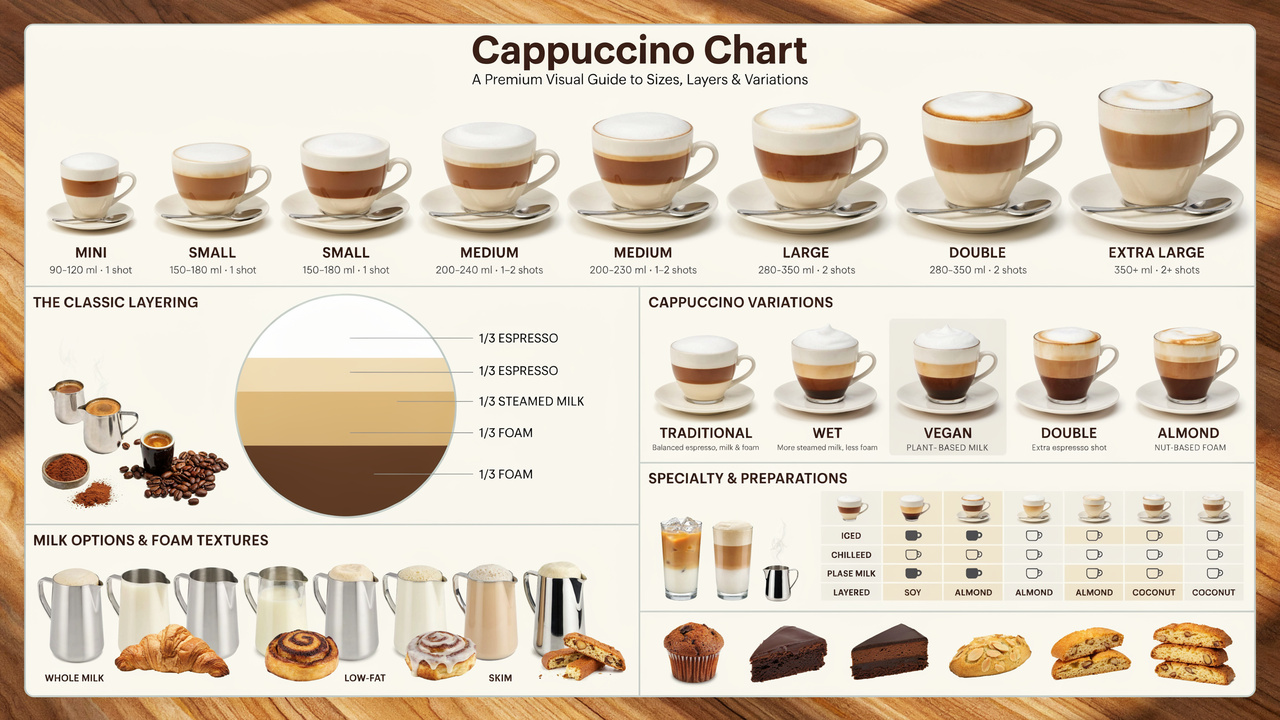
Cappuccino is one of the most popular espresso-based coffee drinks, known for its rich espresso flavor, steamed milk, and thick layer of foam. While a traditional cappuccino is relatively simple, different cafes and coffee cultures serve it in different sizes and styles. Understanding the cappuccino chart makes it easier to compare cappuccino types, cup sizes, ingredients, milk ratios, foam levels, and serving styles.
Why Cappuccino Size Matters
The size of a cappuccino affects the balance between espresso, milk, and foam. A smaller traditional cappuccino tends to have a stronger coffee flavor, while larger versions contain more milk and can taste smoother and milder.
For coffee shops, consistent sizing is important because it affects flavor, presentation, pricing, and customer expectations.
For home baristas, understanding the basic proportions helps create a cappuccino with a balanced espresso taste rather than a drink that tastes mostly like steamed milk.
Standard Cappuccino Sizes
Cappuccino sizes vary by cafe and country, but these are common serving ranges.
Cappuccino Size Chart
| Cappuccino Size | Approx. Volume | Espresso | Milk & Foam | Best For |
|---|---|---|---|---|
| Mini | 90–120 ml | 1 shot | Small amount | Strong coffee flavor |
| Small | 150–180 ml | 1 shot | Moderate | Traditional-style serving |
| Medium | 200–240 ml | 1–2 shots | More milk & foam | Everyday coffee |
| Large | 280–350 ml | 2 shots | Larger milk portion | Milder coffee flavor |
| Extra Large | 350 ml+ | 2+ shots | High milk volume | Large servings |
Exact sizes vary between cafes and coffee machines.
Traditional Cappuccino Ratio
A classic cappuccino is often described as having roughly equal parts of espresso, steamed milk, and milk foam.
This simple balance creates the characteristic combination of strong coffee, creamy milk, and airy foam.
Modern specialty coffee shops may use slightly different ratios depending on the espresso dose, cup size, and milk texture.
Cappuccino Ingredients Chart
| Ingredient | Typical Amount | Purpose |
|---|---|---|
| Espresso | 1–2 shots | Strong coffee base |
| Steamed Milk | Moderate | Creaminess |
| Milk Foam | Thick layer | Light texture |
| Cocoa Powder | Optional | Decoration & flavor |
| Cinnamon | Optional | Warm spice |
| Sugar | Optional | Sweetness |
A traditional cappuccino does not require flavored syrups or whipped cream.
Cappuccino Layer Chart
A cappuccino can be thought of as three main components.
| Layer | Component | Main Character |
|---|---|---|
| Bottom | Espresso | Strong & aromatic |
| Middle | Steamed Milk | Creamy & smooth |
| Top | Milk Foam | Light & airy |
The components blend together when drinking, but the foam creates the recognizable cappuccino appearance.
Cappuccino Vs Latte Vs Flat White
| Drink | Espresso | Milk | Foam | General Taste |
|---|---|---|---|---|
| Cappuccino | Strong | Moderate | High | Balanced & rich |
| Latte | Strong | High | Low | Creamy & mild |
| Flat White | Strong | Moderate | Thin | Smooth & coffee-forward |
| Macchiato | Strong | Very Low | Small | Very strong |
| Mocha | Strong | High | Moderate | Chocolatey & sweet |
The main difference is the balance of espresso, steamed milk, and foam.
Cappuccino Type Chart
Cappuccino can be prepared in several styles.
| Cappuccino Type | Main Feature | Flavor |
|---|---|---|
| Traditional Cappuccino | Espresso + milk + foam | Rich & balanced |
| Dry Cappuccino | More foam, less milk | Stronger & lighter |
| Wet Cappuccino | More steamed milk | Creamier & milder |
| Double Cappuccino | Extra espresso | Stronger coffee |
| Iced Cappuccino | Cold preparation | Chilled & refreshing |
| Flavored Cappuccino | Added syrup | Sweet & flavored |
| Vegan Cappuccino | Plant-based milk | Creamy & coffee-forward |
Not every cafe uses these names in exactly the same way.
Dry Vs Wet Cappuccino
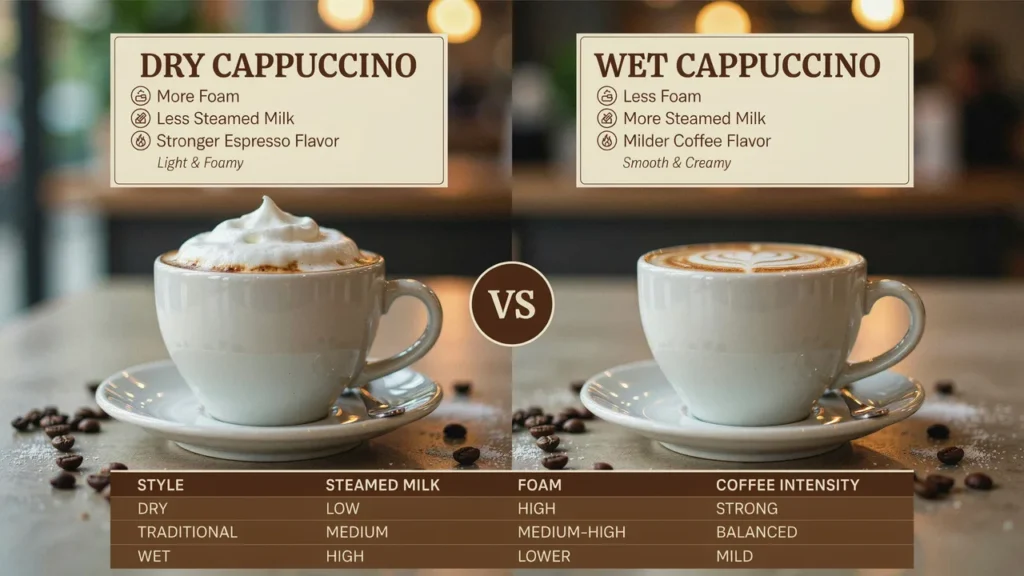
One of the easiest ways to customize a cappuccino is by changing the milk-to-foam balance.
Dry Cappuccino
A dry cappuccino contains more foam and less steamed milk. The result is a lighter texture and a stronger perceived espresso flavor.
Wet Cappuccino
A wet cappuccino contains more steamed milk and less foam. It is smoother and creamier and may resemble a small latte.
| Style | Steamed Milk | Foam | Coffee Intensity |
|---|---|---|---|
| Dry | Low | High | Strong |
| Traditional | Medium | Medium-High | Balanced |
| Wet | High | Lower | Mild |
Cappuccino Milk Types Chart
Different types of milk can change the texture and flavor.
| Milk Type | Foam | Flavor | Best For |
|---|---|---|---|
| Whole Milk | Excellent | Rich & creamy | Classic cappuccino |
| Low-Fat Milk | Good | Light & creamy | Lower-fat option |
| Skim Milk | High | Light | Large foam volume |
| Oat Milk | Good | Slightly sweet | Plant-based cappuccino |
| Soy Milk | Good | Creamy & nutty | Plant-based option |
| Almond Milk | Moderate | Nutty | Light flavored drinks |
| Coconut Milk | Moderate | Tropical | Distinctive flavor |
Whole milk is often preferred for a rich microfoam texture, although modern plant-based milks can also steam well.
Cappuccino Milk Temperature
Milk should be heated enough to create smooth texture without scorching it.
| Temperature | Result |
|---|---|
| Below 55°C / 130°F | Warm but less developed |
| 55–65°C / 130–150°F | Smooth & sweet |
| 65–70°C / 150–158°F | Very hot |
| Above 70°C / 158°F | Greater risk of scalded flavor |
For specialty coffee, many baristas aim around 55–65°C (130–150°F) depending on the milk and desired result.
Cappuccino Foam Chart
| Foam Style | Texture | Result |
|---|---|---|
| Light Foam | Thin & silky | Creamy drink |
| Microfoam | Smooth & fine | Specialty coffee style |
| Traditional Foam | Thick & airy | Classic appearance |
| Very Dry Foam | Large foam volume | Stronger espresso impression |
Fine microfoam creates a smoother mouthfeel than large, dry bubbles.
Cappuccino Cup Size Chart
Traditional cappuccinos are generally served in relatively small cups compared with large cafe-style milk drinks.
| Cup Size | Approx. Volume | Style |
|---|---|---|
| Small Cup | 120–150 ml | Strong & traditional |
| Medium Cup | 150–180 ml | Classic |
| Large Cup | 200–240 ml | Modern cafe style |
| Oversized Cup | 280 ml+ | Milk-heavy |
The exact serving size depends on the coffee shop and region.
Cappuccino Espresso Shot Chart
| Espresso Amount | Coffee Strength | Best For |
|---|---|---|
| 1 Shot | Moderate | Small cappuccino |
| 2 Shots | Strong | Medium or large cappuccino |
| 3 Shots | Very Strong | Extra-large serving |
Adding more espresso increases caffeine and intensifies the coffee flavor.
Cappuccino Caffeine Chart
Caffeine depends mainly on the amount and type of espresso used.
| Espresso | Approx. Caffeine* |
|---|---|
| 1 Shot | 60–80 mg |
| 2 Shots | 120–160 mg |
| 3 Shots | 180–240 mg |
*Actual caffeine varies considerably by coffee bean, roast, extraction method, and serving size.
Milk itself contains little to no caffeine, so most of the caffeine in a cappuccino comes from the espresso.
Cappuccino Calories Chart
Calories depend heavily on the milk and any added sugar or syrup.
| Cappuccino Style | General Calorie Level |
|---|---|
| Skim Milk | Lower |
| Low-Fat Milk | Moderate |
| Whole Milk | Moderate |
| Oat Milk | Moderate |
| Sweetened Flavored | Higher |
| Whipped Cream Topping | Higher |
For exact calories, check the nutrition information provided by the cafe or the milk product used.
Cappuccino Flavor Chart
| Flavor | Main Character |
|---|---|
| Classic | Espresso & creamy milk |
| Chocolate | Rich & sweet |
| Vanilla | Smooth & sweet |
| Caramel | Sweet & buttery |
| Hazelnut | Nutty & aromatic |
| Cinnamon | Warm & spicy |
| Mocha | Coffee & chocolate |
| Peppermint | Cool & sweet |
Traditional cappuccino is generally enjoyed without flavored syrups.
Cappuccino Topping Chart
| Topping | Flavor | Appearance |
|---|---|---|
| Cocoa Powder | Chocolatey | Dark dusting |
| Cinnamon | Warm & spicy | Brown dusting |
| Chocolate Shavings | Rich | Decorative |
| Nutmeg | Aromatic | Light spice |
| Latte Art | No added flavor | Decorative foam |
Toppings are optional and vary by coffee tradition.
Cappuccino Serving Temperature Chart
A cappuccino is generally served hot enough to enjoy immediately but not so hot that the milk becomes scorched.
| Serving Style | General Temperature |
|---|---|
| Warm | 50–55°C |
| Hot | 55–65°C |
| Very Hot | 65–70°C |
| Extra Hot | 70°C+ |
Higher temperatures can reduce milk sweetness and damage the texture.
Cappuccino Food Pairing Chart
Cappuccino pairs especially well with pastries and lightly sweet foods.
| Food | Why It Works |
|---|---|
| Croissant | Buttery & flaky |
| Biscotti | Crisp & lightly sweet |
| Cinnamon Roll | Sweet & spiced |
| Chocolate Cake | Rich & complementary |
| Cookies | Simple & sweet |
| Muffin | Soft & mildly sweet |
| Banana Bread | Fruity & comforting |
| Toast | Simple breakfast pairing |
| Almond Pastry | Nutty & buttery |
The bitterness of espresso balances sweet foods particularly well.
Cappuccino For Breakfast
A cappuccino can work well as part of a breakfast or morning snack.
Popular pairings include:
- Croissants
- Toast
- Eggs
- Muffins
- Fruit
- Yogurt
- Pastries
- Biscotti
A smaller cappuccino is often easier to pair with a full breakfast than a very large milk-based drink.
How To Make A Cappuccino
A basic cappuccino follows a simple process.
- Prepare fresh espresso.
- Steam the milk until smooth and creamy.
- Create a layer of fine foam.
- Pour the steamed milk over the espresso.
- Finish with the foam.
- Add cocoa or cinnamon if desired.
The goal is to create smooth microfoam rather than large, dry bubbles.
Common Mistakes When Making Cappuccino
Using too much milk: This can turn the drink into something closer to a latte.
Creating large bubbles: Large bubbles produce rough foam instead of smooth microfoam.
Overheating the milk: Excessive heat can create a cooked or burnt flavor.
Using weak espresso: The coffee flavor may disappear beneath the milk.
Making the cup too large: Very large cups can upset the traditional espresso-to-milk balance.
Adding too much sugar or syrup: This can hide the natural flavor of the espresso and milk.
Tips For A Better Cappuccino
Use freshly ground coffee: Fresh espresso generally has better aroma and flavor.
Use fresh milk: Fresh milk creates better texture when steamed.
Create fine microfoam: Smooth foam produces a creamy mouthfeel.
Keep the proportions balanced: Espresso, steamed milk, and foam should complement one another.
Preheat the cup: A warm cup helps maintain the drink’s temperature.
Serve immediately: Cappuccino is best enjoyed soon after preparation.
Cappuccino Vs Coffee
| Feature | Cappuccino | Regular Brewed Coffee |
|---|---|---|
| Base | Espresso | Brewed coffee |
| Milk | Yes | Optional |
| Foam | Yes | Usually no |
| Texture | Creamy & airy | Liquid & light |
| Flavor | Concentrated coffee + milk | Brewed coffee-forward |
| Preparation | Espresso machine | Coffee maker or manual brew |
Cappuccino offers a much more concentrated coffee experience combined with steamed milk.
Cappuccino Vs Macchiato
| Feature | Cappuccino | Macchiato |
|---|---|---|
| Espresso | 1–2 shots | Usually 1–2 shots |
| Milk | Moderate | Very small amount |
| Foam | Significant | Small amount |
| Size | Larger | Smaller |
| Taste | Balanced | Much stronger |
The traditional espresso macchiato uses only a small amount of milk or foam to “mark” the espresso.
The History Behind Cappuccino
Cappuccino developed from European coffee traditions and became strongly associated with Italian coffee culture. Its name is commonly linked to the Capuchin friars, with the drink’s color being compared to the color of their robes.
Over time, espresso machines and improved milk-steaming techniques helped establish the modern cappuccino. Today, cappuccino is served worldwide in cafes, restaurants, and homes.
Frequently Asked Questions
What Is A Cappuccino?
A cappuccino is an espresso-based coffee drink made with espresso, steamed milk, and milk foam.
What Is The Traditional Cappuccino Ratio?
A traditional cappuccino is often described as approximately one-third espresso, one-third steamed milk, and one-third foam, although modern coffee shops may use different proportions.
How Many Shots Of Espresso Are In A Cappuccino?
A small cappuccino commonly uses one shot, while larger versions may use two or more.
Is Cappuccino Stronger Than A Latte?
A cappuccino generally has a stronger coffee flavor because it contains less milk than a typical latte.
What Is A Dry Cappuccino?
A dry cappuccino contains more foam and less steamed milk, creating a lighter texture and stronger espresso impression.
What Is A Wet Cappuccino?
A wet cappuccino contains more steamed milk and less foam, making it creamier and closer to a latte.
What Milk Is Best For Cappuccino?
Whole milk is traditionally popular because it creates rich, smooth foam. Oat, soy, and other plant-based milks can also work well.
How Much Caffeine Is In A Cappuccino?
Caffeine depends on the espresso used. A cappuccino with one espresso shot may contain roughly 60–80 mg, while two shots can contain approximately 120–160 mg.
Can Cappuccino Be Made With Plant-Based Milk?
Yes. Oat, soy, almond, and other plant-based milks can be used, although their foam and flavor characteristics differ.
Is Cappuccino Served Hot Or Cold?
Traditional cappuccino is served hot. Iced or cold versions also exist, but they are modern variations rather than the classic preparation.
Cappuccino is a simple drink with a surprisingly detailed balance of espresso, steamed milk, and foam. From traditional small cups to modern larger versions, the right proportions can dramatically change the flavor and texture. Understanding the cappuccino chart makes it easier to compare sizes, milk types, foam levels, caffeine, calories, toppings, and food pairings so you can choose or prepare the perfect cappuccino.
