
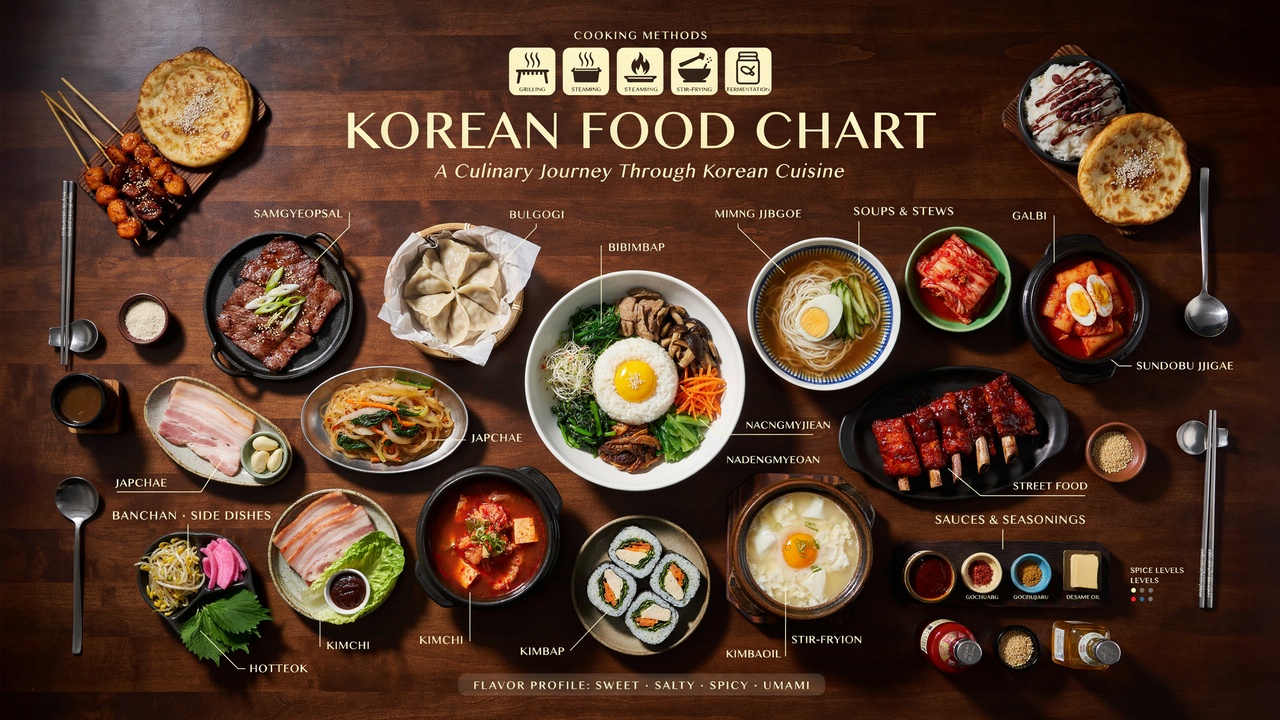
Korean food is known for its bold flavors, colorful ingredients, fermented foods, grilled meats, rice dishes, noodles, soups, and a wide variety of side dishes. From spicy kimchi and sizzling Korean barbecue to bibimbap, japchae, tteokbokki, and refreshing naengmyeon, Korean cuisine offers an exciting combination of sweet, salty, spicy, sour, and savory flavors. Understanding the Korean food chart makes it easier to compare popular dishes, ingredients, cooking methods, spice levels, and serving styles.
Why Korean Food Matters
Korean cuisine is built around balance and variety. A typical Korean meal may include rice, a main dish, soup, vegetables, fermented foods, and several small side dishes called banchan.
Fermentation is also an important part of Korean cooking. Foods such as kimchi, doenjang, and gochujang add deep flavors that can make even simple dishes taste complex.
Korean food also includes many different cooking methods, including grilling, steaming, boiling, stir-frying, braising, and fermentation.
Standard Korean Food Chart
Here are some of the most popular Korean foods and their basic characteristics.
Korean Food Chart
| Korean Food | Main Ingredients | Flavor | Meal Type |
|---|---|---|---|
| Bibimbap | Rice, vegetables, egg, meat | Savory & spicy | Main |
| Bulgogi | Marinated beef | Sweet & savory | Main |
| Kimchi | Cabbage, chili, seasonings | Spicy & sour | Side |
| Japchae | Glass noodles, vegetables, meat | Savory & slightly sweet | Main/Side |
| Tteokbokki | Rice cakes, chili sauce | Spicy & sweet | Snack |
| Samgyeopsal | Pork belly | Rich & savory | Main |
| Galbi | Beef short ribs | Sweet & savory | Main |
| Kimchi Jjigae | Kimchi, tofu, pork | Spicy & sour | Soup/Stew |
| Sundubu Jjigae | Soft tofu, seafood/meat | Spicy & savory | Stew |
| Naengmyeon | Buckwheat noodles, broth | Cold & refreshing | Main |
| Kimbap | Rice, vegetables, fillings | Savory | Snack/Main |
| Mandu | Dumpling wrapper, meat/vegetables | Savory | Snack/Main |
Recipes and ingredients can vary by region and household.
Choosing The Right Korean Food
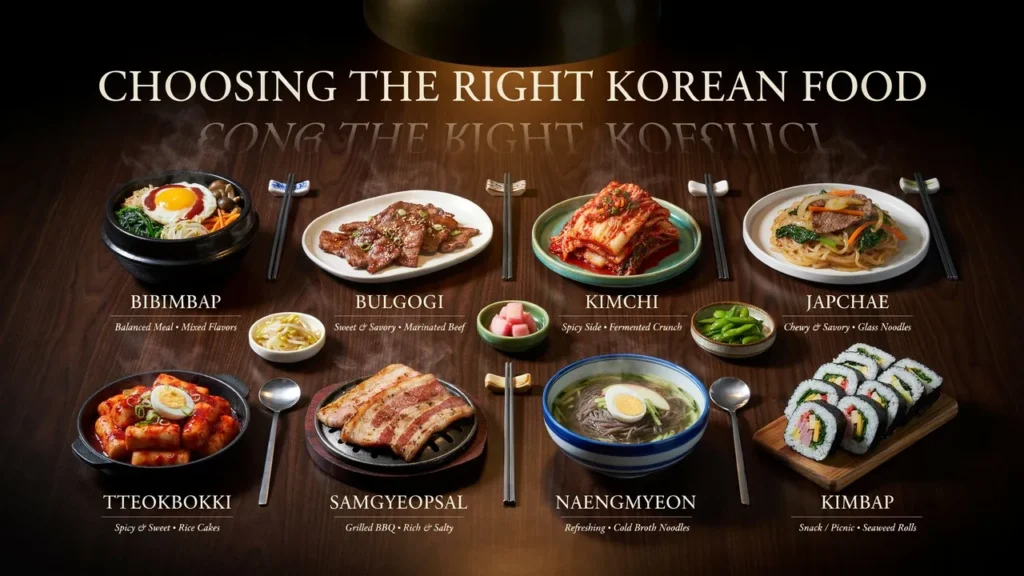
The best Korean dish depends on your preferred flavor and meal style.
Bibimbap: Great for a colorful meal combining rice, vegetables, protein, and sauce.
Bulgogi: A good choice if you enjoy sweet and savory marinated beef.
Kimchi: Perfect as a spicy, fermented side dish that adds acidity and depth.
Japchae: Ideal when you want chewy noodles with vegetables and a mildly sweet savory flavor.
Tteokbokki: Popular for people who enjoy chewy rice cakes and spicy sauce.
Samgyeopsal: Excellent for a Korean barbecue experience centered around grilled pork belly.
Naengmyeon: A refreshing choice, especially when you want a cold noodle dish.
Kimbap: Convenient for snacks, lunch boxes, picnics, or quick meals.
Korean Rice Dish Chart
Rice is an important part of Korean cuisine and appears in many different dishes.
| Rice Dish | Main Ingredients | Flavor |
|---|---|---|
| Bibimbap | Rice, vegetables, egg, meat | Savory & spicy |
| Kimchi Fried Rice | Rice, kimchi, egg | Spicy & savory |
| Gimbap/Kimbap | Rice, vegetables, fillings | Savory |
| Bokkeumbap | Fried rice, vegetables, meat | Savory |
| Samgyetang Rice | Rice, chicken, herbs | Mild & savory |
| Multigrain Rice | Rice, grains, beans | Nutty & hearty |
| Rice Porridge | Rice, broth, meat/seafood | Mild & comforting |
Rice can be served as a simple side or become the foundation of a complete Korean meal.
Korean Noodle Chart
Korean cuisine has many noodle dishes with different textures and temperatures.
| Noodle | Popular Dish | Characteristics |
|---|---|---|
| Dangmyeon | Japchae | Chewy & translucent |
| Naengmyeon Noodles | Naengmyeon | Thin & chewy |
| Wheat Noodles | Jajangmyeon | Soft & chewy |
| Somyeon | Bibim Guksu | Thin & delicate |
| Kalguksu Noodles | Kalguksu | Thick & soft |
| Ramyeon Noodles | Korean Ramyeon | Springy & chewy |
The type of noodle can greatly affect the texture and eating experience.
Korean Soup And Stew Chart
Soups and stews are an important part of Korean meals.
| Soup/Stew | Main Ingredients | Flavor |
|---|---|---|
| Kimchi Jjigae | Kimchi, tofu, pork | Spicy & sour |
| Sundubu Jjigae | Soft tofu, seafood/meat | Spicy & savory |
| Doenjang Jjigae | Soybean paste, vegetables, tofu | Earthy & salty |
| Samgyetang | Chicken, ginseng, rice | Mild & savory |
| Seolleongtang | Beef bones | Mild & rich |
| Galbitang | Beef short ribs | Rich & savory |
| Miyeok Guk | Seaweed, beef/seafood | Mild & savory |
| Kalguksu | Knife-cut noodles, broth | Warm & comforting |
Some Korean soups are mild and comforting, while others can be intensely spicy.
Korean Side Dish Chart
Korean side dishes are known as banchan and are often served alongside rice and the main meal.
| Banchan | Main Ingredient | Flavor |
|---|---|---|
| Kimchi | Cabbage or vegetables | Spicy & sour |
| Kongnamul Muchim | Soybean sprouts | Fresh & savory |
| Sigeumchi Namul | Spinach | Mild & savory |
| Gamja Jorim | Potatoes | Sweet & savory |
| Eomuk Bokkeum | Fish cake | Savory & slightly sweet |
| Musaengchae | Radish | Spicy & refreshing |
| Dubu Jorim | Tofu | Savory & spicy |
| Oi Muchim | Cucumber | Spicy & refreshing |
Banchan can range from fresh vegetables to fermented foods and braised side dishes.
Korean Food Spice Level Chart
Korean cuisine includes both mild and very spicy foods.
| Food | General Spice Level |
|---|---|
| Bulgogi | Mild |
| Galbi | Mild |
| Kimbap | Mild |
| Japchae | Mild |
| Samgyetang | Mild |
| Bibimbap | Mild-medium |
| Kimchi | Medium |
| Kimchi Jjigae | Medium-high |
| Tteokbokki | Medium-high |
| Buldak | Very high |
| Spicy Cold Noodles | High |
Spice levels vary significantly depending on the amount and type of chili used.
Korean Sauce And Seasoning Chart
Korean cuisine uses several distinctive sauces and seasonings.
| Sauce/Seasoning | Main Ingredients | Flavor |
|---|---|---|
| Gochujang | Fermented chili, rice, soybeans | Spicy & savory |
| Gochugaru | Korean chili flakes | Spicy & slightly sweet |
| Doenjang | Fermented soybeans | Salty & earthy |
| Soy Sauce | Fermented soybeans | Salty & savory |
| Sesame Oil | Sesame seeds | Nutty |
| Sesame Seeds | Sesame | Nutty & crunchy |
| Ssamjang | Soybean/chili pastes | Savory & spicy |
| Rice Vinegar | Fermented rice | Tangy |
These ingredients form the foundation of many Korean sauces, marinades, soups, and side dishes.
Korean Meat Food Chart
Korean cuisine is particularly well known for grilled and marinated meats.
| Meat Dish | Main Meat | Flavor |
|---|---|---|
| Bulgogi | Beef | Sweet & savory |
| Galbi | Beef ribs | Sweet & smoky |
| Samgyeopsal | Pork belly | Rich & savory |
| Dak Bulgogi | Chicken | Sweet & savory |
| Dakgalbi | Chicken | Spicy & savory |
| Bossam | Pork | Savory & tender |
| Jeyuk Bokkeum | Pork | Spicy & savory |
| Galbi Jjim | Beef ribs | Rich & sweet-savory |
Marinades often include soy sauce, garlic, sesame oil, sugar or fruit, and other seasonings.
Korean Seafood Food Chart
Korea’s coastal geography has also made seafood an important part of its cuisine.
| Seafood Food | Main Ingredient | Flavor |
|---|---|---|
| Haemul Pajeon | Seafood, green onion | Savory |
| Ojingeo Bokkeum | Squid | Spicy & savory |
| Saengseon Gui | Grilled fish | Savory |
| Jjamppong | Seafood, noodles | Spicy & rich |
| Haemultang | Mixed seafood | Spicy & savory |
| Ganjang Gejang | Raw crab, soy sauce | Salty & rich |
| Eomuk | Fish cake | Savory |
Seafood dishes can range from light grilled fish to rich and spicy noodle soups.
Korean Street Food Chart
Korean street food is popular for its convenient portions and bold flavors.
| Street Food | Main Ingredients | Flavor |
|---|---|---|
| Tteokbokki | Rice cakes, chili sauce | Spicy & sweet |
| Hotteok | Sweet filled pancake | Sweet |
| Eomuk | Fish cake | Savory |
| Kimbap | Rice, vegetables, fillings | Savory |
| Twigim | Fried vegetables/seafood | Crispy |
| Korean Corn Dog | Sausage/cheese, batter | Savory |
| Bungeoppang | Fish-shaped pastry | Sweet |
| Mandu | Dumplings | Savory |
Street foods are often served in small portions, making them popular snacks or quick meals.
Korean Breakfast Food Chart
Korean breakfast can include many of the same foods eaten later in the day.
| Food | Typical Ingredients | General Profile |
|---|---|---|
| Rice & Soup | Rice, soup, side dishes | Traditional |
| Gyeran Mari | Rolled eggs | Mild & savory |
| Kimchi & Rice | Rice, kimchi | Spicy & simple |
| Porridge | Rice, meat/seafood | Mild & comforting |
| Kimbap | Rice, vegetables, fillings | Convenient |
| Grilled Fish & Rice | Fish, rice, banchan | Savory |
Unlike some Western breakfast traditions, Korean meals do not always separate breakfast foods from lunch or dinner foods.
Korean Dessert Chart
Korean desserts include traditional rice cakes, sweet drinks, shaved ice, and modern bakery items.
| Dessert | Main Ingredients | Flavor |
|---|---|---|
| Bingsu | Shaved ice, toppings | Sweet & refreshing |
| Hotteok | Dough, brown sugar, nuts | Sweet & warm |
| Tteok | Rice flour | Chewy & mild |
| Yakgwa | Wheat, honey | Sweet & rich |
| Sikhye | Rice, malt, sugar | Sweet & refreshing |
| Patbingsu | Shaved ice, red beans | Sweet & creamy |
| Hodu Gwaja | Walnut, sweet filling | Nutty & sweet |
Korean Food Ingredient Chart
| Ingredient | Common Uses |
|---|---|
| Rice | Rice bowls, kimbap |
| Kimchi | Side dishes, stews, fried rice |
| Gochujang | Sauces, marinades |
| Gochugaru | Kimchi, soups, sauces |
| Soy Sauce | Marinades, soups |
| Sesame Oil | Seasoning, marinades |
| Garlic | Meat, soups, sauces |
| Green Onion | Soups, pancakes, toppings |
| Tofu | Stews, side dishes |
| Seaweed | Soups, rolls |
| Daikon Radish | Kimchi, soups, side dishes |
| Napa Cabbage | Kimchi, soups |
These ingredients create many of the characteristic flavors associated with Korean cooking.
Korean Food Flavor Chart
Korean dishes often combine several flavor characteristics.
| Flavor | Common Ingredients |
|---|---|
| Spicy | Gochugaru, gochujang |
| Sweet | Sugar, fruit, honey |
| Salty | Soy sauce, doenjang |
| Sour | Kimchi, vinegar |
| Nutty | Sesame oil, sesame seeds |
| Savory | Garlic, fermented pastes |
| Smoky | Grilled meats |
| Fresh | Green onion, cucumber, herbs |
The combination of sweet, salty, spicy, sour, and savory flavors gives Korean cuisine its distinctive character.
Korean Food Cooking Method Chart
| Cooking Method | Popular Foods |
|---|---|
| Grilling | Bulgogi, galbi, samgyeopsal |
| Stir-Frying | Japchae, spicy pork |
| Boiling | Soups, noodles |
| Steaming | Mandu, eggs |
| Braising | Galbi jjim |
| Fermenting | Kimchi, doenjang |
| Pan-Frying | Pajeon |
| Deep-Frying | Twigim, Korean fried chicken |
| Simmering | Jjigae, stews |
Korean cooking uses both quick high-heat methods and slow cooking techniques.
Korean Food Serving Size Chart
Serving sizes depend on whether a food is served as a main dish, side dish, snack, or part of a shared meal.
| Korean Food | Typical Serving |
|---|---|
| Cooked Rice | 1 cup |
| Bibimbap | 1 bowl |
| Bulgogi | 100–200 g |
| Japchae | 1–1½ cups |
| Kimchi | ¼–½ cup |
| Tteokbokki | 1 serving |
| Kimbap | 6–10 pieces |
| Soup/Stew | 1–2 cups |
| Mandu | 5–8 pieces |
| Bingsu | 1 shared bowl |
These are general serving ranges and can vary by recipe and restaurant.
Korean Food Pairing Chart
Some Korean foods are traditionally enjoyed together.
| Main Food | Common Pairings |
|---|---|
| Bulgogi | Rice, lettuce wraps, kimchi |
| Samgyeopsal | Ssamjang, lettuce, garlic |
| Bibimbap | Gochujang, sesame oil, vegetables |
| Tteokbokki | Eomuk, boiled eggs |
| Japchae | Bulgogi, banchan |
| Kimchi Jjigae | Rice, kimchi |
| Galbi | Rice, grilled vegetables |
| Kimbap | Pickled radish, soup |
| Korean Fried Chicken | Pickled radish, sauces |
| Naengmyeon | Beef, cucumber, egg |
Pairing different textures and flavors helps create a balanced Korean meal.
Vegetarian Korean Food Chart
Korean cuisine includes many vegetable-based dishes, although some traditional recipes use fish sauce, shrimp, or other seafood ingredients.
| Dish | Main Ingredients |
|---|---|
| Vegetable Bibimbap | Rice, vegetables |
| Vegetable Japchae | Glass noodles, vegetables |
| Vegetable Kimbap | Rice, vegetables |
| Pajeon | Green onions, flour |
| Vegetable Banchan | Mixed vegetables |
| Tofu Dishes | Tofu, seasonings |
| Vegetable Mandu | Vegetables, tofu |
| Mushroom Bulgogi-Style Dish | Mushrooms, vegetables |
When choosing vegetarian Korean food, it is important to check sauces and seasonings because some may contain seafood ingredients.
Korean Food Protein Chart
| Food | Main Protein Source | General Protein Level |
|---|---|---|
| Tofu | Soybeans | Moderate |
| Eggs | Eggs | Moderate |
| Bulgogi | Beef | High |
| Galbi | Beef | High |
| Samgyeopsal | Pork | High |
| Chicken | Poultry | High |
| Fish | Seafood | High |
| Shrimp | Seafood | High |
| Mandu | Meat/tofu | Moderate-high |
| Beans | Legumes | Moderate |
Protein levels vary depending on portion size and recipe.
Common Mistakes When Choosing Korean Food
Assuming all Korean food is spicy: Many Korean dishes are mild, especially grilled meats, soups, rice dishes, and some side dishes.
Ignoring banchan: Korean meals often include several small side dishes that contribute different flavors and textures.
Confusing gochujang and gochugaru: Gochujang is a fermented chili paste, while gochugaru is Korean chili powder or flakes.
Overlooking fermentation: Kimchi and fermented soybean products are important parts of Korean cuisine.
Expecting every dish to be served individually: Korean meals often involve several dishes shared at the table.
Adding too much sauce: Gochujang, soy sauce, and other seasonings can be quite strong, so a little can go a long way.
Tips For Enjoying Korean Food
Try different spice levels: Start with mild dishes if you are unfamiliar with Korean chili flavors.
Explore banchan: Small side dishes are an important part of the Korean dining experience.
Try grilled foods: Bulgogi, galbi, and samgyeopsal offer a good introduction to Korean flavors.
Balance spicy foods: Rice, vegetables, and mild side dishes can complement spicy dishes.
Experiment with fermentation: Kimchi, doenjang, and other fermented foods provide distinctive flavors.
Try both traditional and street foods: They offer very different experiences of Korean cuisine.
The History Behind Korean Food
Korean cuisine developed through centuries of agricultural traditions, regional ingredients, preservation techniques, and cultural practices. Rice became an important staple, while vegetables, grains, seafood, and meats contributed to a diverse food culture.
Fermentation became especially important as a way of preserving foods through different seasons. This helped produce traditional foods such as kimchi, doenjang, and other fermented ingredients.
Over time, Korean cuisine developed a strong tradition of shared meals, side dishes, grilling, soups, stews, and carefully seasoned vegetables. Today, Korean food has become popular worldwide, with dishes such as Korean barbecue, kimchi, bibimbap, fried chicken, and tteokbokki appearing on menus around the globe.
Frequently Asked Questions
What Is The Most Popular Korean Food?
Kimchi, bibimbap, bulgogi, Korean barbecue, tteokbokki, japchae, and Korean fried chicken are among the most internationally popular Korean foods.
What Is A Traditional Korean Meal?
A traditional Korean meal can include rice, soup or stew, a main dish, and several banchan, or side dishes.
What Is The Most Common Korean Side Dish?
Kimchi is one of the most recognizable Korean side dishes, although many different types of banchan are served with Korean meals.
Is All Korean Food Spicy?
No. Korean cuisine includes many mild dishes such as bulgogi, japchae, kimbap, samgyetang, and some grilled fish and vegetable dishes.
What Is Gochujang?
Gochujang is a fermented Korean chili paste made with ingredients such as chili, fermented soybean products, and grains. It provides spicy, savory, and slightly sweet flavors.
What Is Gochugaru?
Gochugaru is Korean chili powder or flakes. It is commonly used in kimchi, soups, sauces, and other Korean dishes.
What Is The Difference Between Bulgogi And Galbi?
Bulgogi is typically made with thinly sliced marinated beef, while galbi generally refers to marinated grilled beef short ribs.
What Is Korean Barbecue?
Korean barbecue is a dining style where meat is grilled, often at the table. Popular choices include bulgogi, galbi, and samgyeopsal.
What Is Tteokbokki Made Of?
Tteokbokki is primarily made with chewy rice cakes, commonly cooked in a spicy and slightly sweet sauce.
What Is Kimbap?
Kimbap is a Korean roll made with rice and various fillings wrapped in dried seaweed. Fillings can include vegetables, egg, meat, fish cake, or other ingredients.
What Is The Difference Between Kimchi And Gochujang?
Kimchi is generally a fermented vegetable dish, while gochujang is a fermented chili paste used as a seasoning, sauce, or ingredient.
What Are Some Popular Korean Desserts?
Popular Korean sweet foods include bingsu, hotteok, tteok, yakgwa, and sweet rice-based desserts.
Korean cuisine offers an incredible variety of rice dishes, noodles, grilled meats, seafood, soups, stews, fermented foods, side dishes, street foods, and desserts. Understanding the Korean food chart makes it easier to compare flavors, spice levels, ingredients, cooking methods, and serving sizes. Whether you want spicy tteokbokki, savory bulgogi, colorful bibimbap, chewy japchae, or refreshing naengmyeon, Korean food provides a wide range of dishes for different tastes and occasions.
