
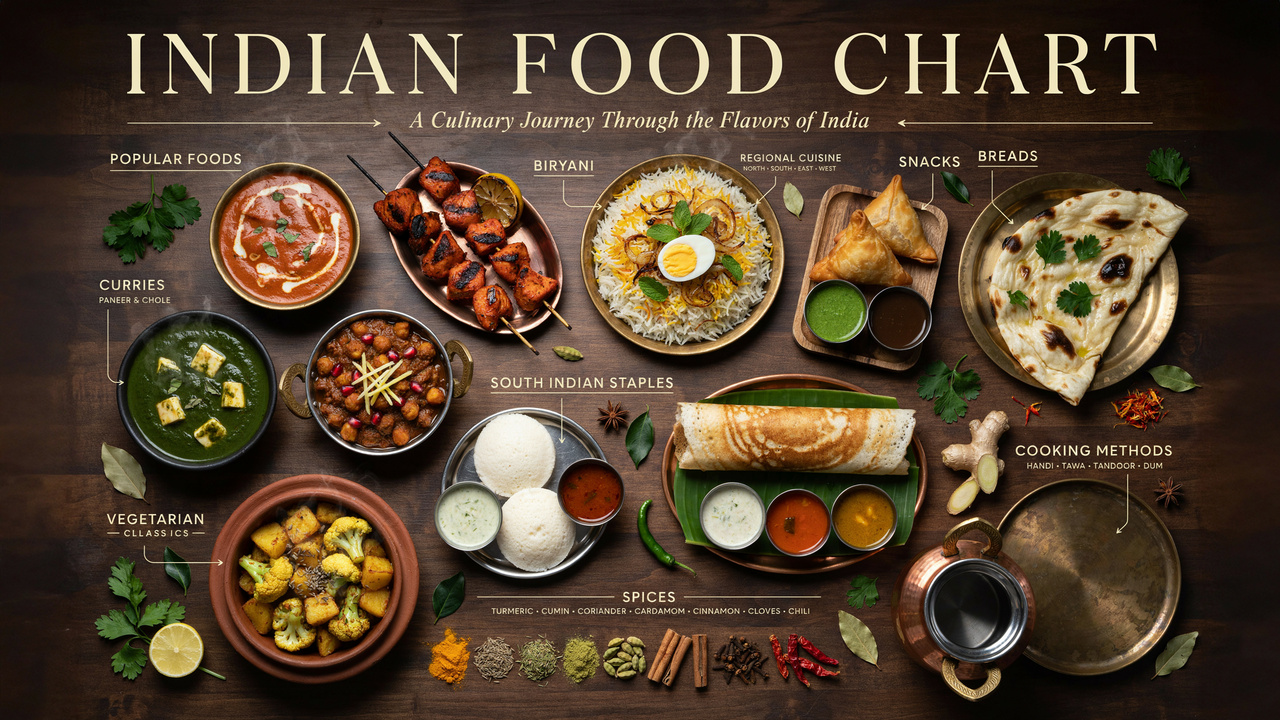
Indian food is known for its incredible variety of flavors, spices, textures, and cooking traditions. From creamy curries and fragrant biryani to crispy dosas, soft naan, flavorful rice dishes, samosas, and rich desserts, Indian cuisine offers something for almost every taste. Understanding the Indian food chart makes it easier to compare popular dishes, regional specialties, ingredients, cooking methods, and flavor profiles.
Why Indian Food Variety Matters
Indian cuisine is not one single style of cooking. Food traditions differ greatly between regions, communities, and states. Northern Indian cuisine is often associated with breads, dairy, rich gravies, and tandoori cooking, while many southern dishes feature rice, lentils, coconut, curry leaves, and tangy flavors.
Spices also play an important role, but Indian food is not simply about making dishes spicy. Spices such as cumin, coriander, turmeric, cardamom, cinnamon, cloves, and mustard seeds are used to create aroma, color, depth, and balance.
Standard Indian Food Chart
Here are some popular Indian dishes and their basic characteristics.
Indian Food Chart
| Indian Food | Main Ingredients | Flavor | Cooking Style |
|---|---|---|---|
| Butter Chicken | Chicken, tomato, butter, cream | Rich & creamy | Simmered |
| Chicken Tikka | Chicken, yogurt, spices | Smoky & savory | Grilled |
| Biryani | Rice, meat/vegetables, spices | Aromatic & rich | Layered/cooked |
| Samosa | Potato, peas, pastry | Savory & spicy | Fried |
| Naan | Flour, yogurt | Soft & slightly chewy | Tandoor-baked |
| Palak Paneer | Spinach, paneer, spices | Creamy & earthy | Simmered |
| Chole | Chickpeas, spices | Spicy & savory | Simmered |
| Dosa | Rice, lentils | Crisp & savory | Griddled |
| Idli | Rice, lentils | Soft & mild | Steamed |
| Rajma | Kidney beans, spices | Rich & savory | Simmered |
| Rogan Josh | Meat, spices | Rich & aromatic | Slow-cooked |
| Aloo Gobi | Potato, cauliflower, spices | Savory & earthy | Stir-fried/simmered |
Recipes and ingredients can vary significantly by region and household.
Choosing The Right Indian Food
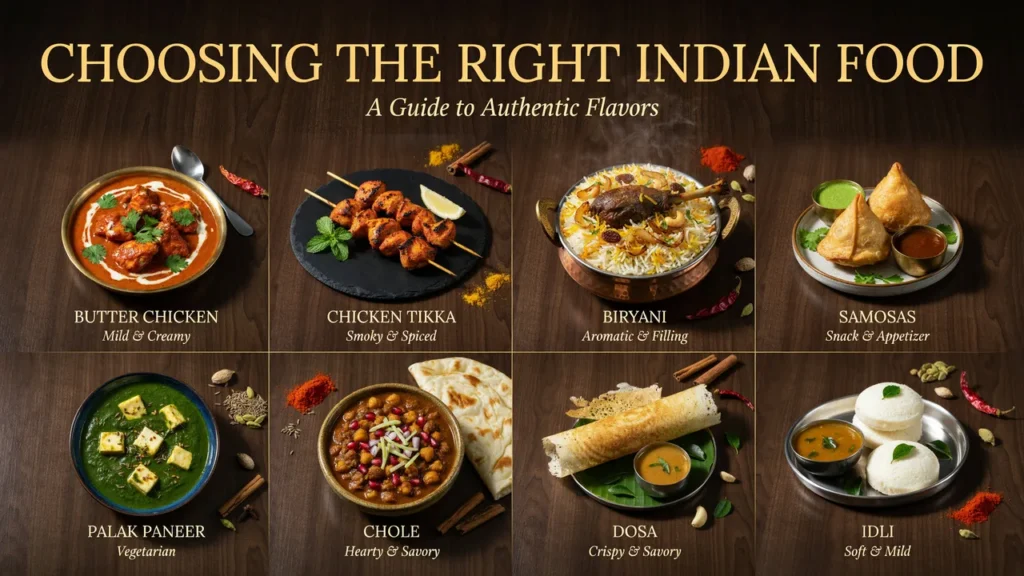
The best Indian dish depends on the flavors and textures you enjoy.
Butter Chicken: A good choice if you prefer a mild, creamy, tomato-based curry.
Chicken Tikka: Great for people who enjoy grilled, smoky, spiced chicken.
Biryani: Ideal when you want an aromatic and filling rice-based meal.
Samosa: Perfect as a snack or appetizer with chutney.
Palak Paneer: A popular vegetarian option combining spinach and paneer.
Chole: A hearty chickpea dish that pairs well with rice or Indian breads.
Dosa: Excellent when you prefer a crispy, savory South Indian dish.
Idli: A soft and mild option often served with sambar and chutney.
Indian Regional Food Chart
India’s different regions have distinctive food traditions.
| Region | Common Characteristics | Popular Foods |
|---|---|---|
| North India | Breads, dairy, rich gravies | Naan, butter chicken |
| South India | Rice, lentils, coconut | Dosa, idli, sambar |
| West India | Sweet, spicy, diverse | Dhokla, pav bhaji |
| East India | Rice, fish, sweets | Fish curry, rasgulla |
| Punjab | Dairy, wheat, hearty dishes | Sarson ka saag, paneer |
| Gujarat | Vegetarian, mildly sweet | Dhokla, thepla |
| Rajasthan | Spiced, hearty, dry-region foods | Dal baati churma |
| Bengal | Fish, rice, mustard | Fish curry, mishti doi |
| Kerala | Coconut, seafood, spices | Appam, fish curry |
| Maharashtra | Spicy, savory, varied | Vada pav, misal pav |
Regional cuisines can overlap, and dishes are often prepared differently from one household or restaurant to another.
Indian Curry Chart
Curries are among the best-known parts of Indian cuisine.
| Curry | Main Ingredient | Flavor |
|---|---|---|
| Butter Chicken | Chicken | Mild, creamy & rich |
| Tikka Masala | Chicken | Tomato-rich & aromatic |
| Palak Paneer | Paneer | Earthy & creamy |
| Chana Masala | Chickpeas | Spicy & tangy |
| Rajma | Kidney beans | Rich & savory |
| Rogan Josh | Meat | Aromatic & rich |
| Korma | Meat/vegetables | Mild & creamy |
| Vindaloo | Meat | Spicy & tangy |
| Dal Makhani | Lentils | Creamy & rich |
| Fish Curry | Fish | Spicy & savory |
The word “curry” covers a very wide range of Indian preparations rather than one specific dish.
Indian Bread Chart
Breads are an important part of many Indian meals, especially in northern and western regions.
| Bread | Main Ingredient | Texture | Cooking Method |
|---|---|---|---|
| Naan | Refined/wheat flour | Soft & chewy | Tandoor |
| Roti | Whole wheat flour | Soft & light | Griddle |
| Chapati | Whole wheat flour | Thin & soft | Griddle |
| Paratha | Wheat flour, fat | Flaky | Pan-cooked |
| Poori | Wheat flour | Puffy & crisp | Deep-fried |
| Bhatura | Refined flour | Puffy & soft | Deep-fried |
| Kulcha | Flour | Soft & slightly crisp | Tandoor |
| Thepla | Wheat flour, spices | Thin & soft | Griddle |
Bread choices often depend on the curry or regional cuisine being served.
Indian Rice Dish Chart
Rice is especially important in southern, eastern, and many northern Indian meals.
| Rice Dish | Main Ingredients | Flavor |
|---|---|---|
| Biryani | Rice, meat/vegetables, spices | Aromatic & rich |
| Pulao | Rice, vegetables/spices | Mild & fragrant |
| Lemon Rice | Rice, lemon, spices | Tangy & fresh |
| Jeera Rice | Rice, cumin | Aromatic & mild |
| Curd Rice | Rice, yogurt | Cool & tangy |
| Tamarind Rice | Rice, tamarind, spices | Tangy & savory |
| Coconut Rice | Rice, coconut, spices | Mild & aromatic |
| Tomato Rice | Rice, tomatoes, spices | Tangy & savory |
Indian Snack Chart
Indian snacks range from fried pastries to steamed and savory dishes.
| Snack | Main Ingredients | Texture |
|---|---|---|
| Samosa | Potato, peas, pastry | Crisp |
| Pakora | Vegetables, chickpea flour | Crispy |
| Vada | Lentils | Crisp outside, soft inside |
| Dhokla | Fermented batter | Soft & spongy |
| Kachori | Flour, filling | Crisp |
| Pani Puri | Crisp shells, fillings | Crisp & juicy |
| Aloo Tikki | Potato | Crisp & soft |
| Vada Pav | Potato fritter, bread | Soft & crispy |
| Bhel Puri | Puffed rice, vegetables | Crunchy |
| Dahi Puri | Crisps, yogurt, chutneys | Creamy & crunchy |
Indian Vegetarian Food Chart
Vegetarian food is an important part of many Indian culinary traditions.
| Dish | Main Ingredients | Flavor |
|---|---|---|
| Palak Paneer | Spinach, paneer | Earthy & creamy |
| Chana Masala | Chickpeas | Spicy & tangy |
| Dal Tadka | Lentils, spices | Savory & aromatic |
| Aloo Gobi | Potato, cauliflower | Earthy & savory |
| Baingan Bharta | Eggplant | Smoky & savory |
| Rajma | Kidney beans | Rich & hearty |
| Malai Kofta | Paneer/vegetable dumplings | Rich & creamy |
| Vegetable Korma | Mixed vegetables | Mild & creamy |
| Dal Makhani | Black lentils, beans | Rich & creamy |
| Bhindi Masala | Okra, spices | Savory & aromatic |
Indian Street Food Chart
Indian street food is famous for bold flavors and contrasting textures.
| Street Food | Region/Association | Main Character |
|---|---|---|
| Vada Pav | Maharashtra | Spicy & savory |
| Pani Puri | Various regions | Tangy & crunchy |
| Pav Bhaji | Maharashtra | Rich & spicy |
| Chole Bhature | North India | Hearty |
| Dosa | South India | Crisp & savory |
| Kathi Roll | Kolkata | Spiced & filling |
| Aloo Tikki | North India | Crispy & savory |
| Bhel Puri | Western India | Crunchy & tangy |
| Samosa | Across India | Crispy & savory |
| Jalebi | Across India | Sweet & syrupy |
Indian Breakfast Food Chart
Indian breakfast varies greatly from one region to another.
| Breakfast | Main Ingredients | Region/Style |
|---|---|---|
| Dosa | Rice, lentils | South Indian |
| Idli | Rice, lentils | South Indian |
| Poha | Flattened rice | Western/Central India |
| Upma | Semolina | South Indian |
| Paratha | Wheat flour | North Indian |
| Aloo Paratha | Potato, wheat flour | North Indian |
| Uttapam | Fermented rice-lentil batter | South Indian |
| Puri Bhaji | Puri, vegetables | North/West India |
| Chole Bhature | Chickpeas, bhatura | North Indian |
| Pongal | Rice, lentils | South Indian |
Indian Dessert Chart
Indian desserts are known for milk, sugar, nuts, fruits, grains, and aromatic spices.
| Dessert | Main Ingredients | Flavor |
|---|---|---|
| Gulab Jamun | Milk solids, sugar syrup | Sweet & rich |
| Jalebi | Batter, sugar syrup | Crisp & syrupy |
| Rasgulla | Chhena, sugar syrup | Soft & juicy |
| Kheer | Milk, rice, sugar | Creamy & aromatic |
| Gajar Halwa | Carrots, milk, sugar | Rich & sweet |
| Kulfi | Milk, sugar, nuts | Dense & creamy |
| Rasmalai | Chhena, milk | Creamy & sweet |
| Barfi | Milk solids, sugar | Rich & dense |
| Ladoo | Flour/lentils, sugar | Sweet & rich |
| Mysore Pak | Gram flour, sugar, ghee | Rich & crumbly |
Indian Spice Chart
Spices form the foundation of many Indian dishes.
| Spice | Flavor | Common Uses |
|---|---|---|
| Cumin | Warm & earthy | Curries, rice |
| Coriander | Fresh & citrusy | Curries, spice blends |
| Turmeric | Earthy & slightly bitter | Curries, rice |
| Cardamom | Sweet & aromatic | Desserts, chai |
| Cinnamon | Warm & sweet | Rice, curries |
| Cloves | Strong & aromatic | Biryani, curries |
| Mustard Seeds | Sharp & nutty | South Indian dishes |
| Fenugreek | Earthy & slightly bitter | Curries |
| Black Pepper | Sharp & spicy | Curries, soups |
| Chili | Hot & fruity | Curries, chutneys |
| Fennel | Sweet & aromatic | Curries, spice blends |
| Asafoetida | Strong & savory | Lentil dishes |
Indian Spice Blend Chart
Spice blends combine multiple spices to create distinctive flavors.
| Spice Blend | Common Ingredients | Typical Uses |
|---|---|---|
| Garam Masala | Cumin, coriander, cardamom, cloves | Curries |
| Curry Powder | Mixed spices | Various dishes |
| Chaat Masala | Tangy spices, salt | Snacks, fruit |
| Sambar Powder | Spices, lentils | Sambar |
| Rasam Powder | Spices | Rasam |
| Biryani Masala | Aromatic spices | Biryani |
| Panch Phoron | Five whole spices | Eastern Indian cooking |
| Tandoori Masala | Spices, herbs | Grilled foods |
Spice blends vary by region, brand, and family recipe.
Indian Chutney Chart
Chutneys add flavor and contrast to many Indian meals.
| Chutney | Main Ingredients | Flavor |
|---|---|---|
| Mint Chutney | Mint, herbs | Fresh & spicy |
| Tamarind Chutney | Tamarind, sugar | Sweet & tangy |
| Coconut Chutney | Coconut, spices | Mild & creamy |
| Coriander Chutney | Coriander, herbs | Fresh & bright |
| Tomato Chutney | Tomato, spices | Tangy & savory |
| Peanut Chutney | Peanuts, spices | Nutty & savory |
| Mango Chutney | Mango, spices | Sweet & tangy |
Indian Food Cooking Method Chart
| Cooking Method | Description | Examples |
|---|---|---|
| Tandoori | High-heat clay-oven cooking | Naan, chicken tikka |
| Tadka | Tempering spices in fat | Dal |
| Stir-Frying | Quick cooking | Vegetable dishes |
| Steaming | Cooking with steam | Idli, dhokla |
| Deep-Frying | Cooking in hot oil | Samosa, puri |
| Slow Cooking | Gentle extended cooking | Rogan josh |
| Grilling | Cooking over high heat | Kebabs |
| Simmering | Cooking gently in liquid | Curries |
Indian Food Flavor Chart
| Flavor Profile | Example Foods |
|---|---|
| Mild & Creamy | Korma |
| Spicy & Aromatic | Vindaloo |
| Tangy & Spicy | Chole |
| Rich & Buttery | Butter chicken |
| Smoky | Tandoori chicken |
| Earthy | Dal, saag |
| Sweet & Savory | Some regional curries |
| Fresh & Herbal | Chutneys |
| Sour & Spicy | Rasam |
| Fragrant & Aromatic | Biryani |
Indian dishes often combine several flavor profiles rather than relying on only one.
Indian Food Pairing Chart
| Main Dish | Good Pairings |
|---|---|
| Butter Chicken | Naan, basmati rice |
| Chole | Bhatura, roti |
| Palak Paneer | Naan, rice |
| Biryani | Raita, salad |
| Dal Tadka | Rice, roti |
| Rogan Josh | Naan, rice |
| Dosa | Sambar, coconut chutney |
| Idli | Sambar, chutney |
| Samosa | Mint, tamarind chutney |
| Aloo Paratha | Yogurt, pickle |
| Pav Bhaji | Pav, onions |
| Fish Curry | Rice, vegetables |
Indian Food Serving Chart
Serving sizes vary depending on the dish and whether it is served as a main course or part of a shared meal.
| Food | Typical Serving Style |
|---|---|
| Biryani | 1 bowl or plate |
| Curry | 1 bowl |
| Rice | 1 small/medium bowl |
| Naan | 1–2 pieces |
| Roti | 1–2 pieces |
| Samosa | 1–2 pieces |
| Dosa | 1 large dosa |
| Idli | 2–4 pieces |
| Pakora | Several small pieces |
| Dal | 1 bowl |
| Chutney | 1–3 tablespoons |
| Raita | ½–1 cup |
Restaurant portions can be considerably larger than home servings.
Indian Food Spice Level Chart
Not all Indian food is extremely spicy. Heat depends on the dish, chili variety, and amount used.
| Spice Level | Example |
|---|---|
| Mild | Korma |
| Mild-Medium | Butter chicken |
| Medium | Chole |
| Medium-High | Tikka masala |
| High | Vindaloo |
| Very High | Chili-heavy regional dishes |
You can often adjust the heat level when cooking Indian food at home.
Indian Vegetarian Vs Non-Vegetarian Food
| Category | Examples |
|---|---|
| Vegetarian | Paneer, dal, chole, aloo gobi |
| Egg-Based | Egg curry, egg dosa |
| Chicken | Butter chicken, tikka |
| Lamb/Mutton | Rogan josh, kebabs |
| Fish | Fish curry, fish fry |
| Seafood | Prawn curry, coastal seafood |
| Vegan-Friendly Options | Many dal, vegetable and rice dishes |
Always check ingredients because dairy, ghee, eggs, or other animal products may be included in dishes that otherwise appear vegetarian.
Common Mistakes When Choosing Indian Food
Assuming all Indian food is spicy: Many dishes are mild, aromatic, creamy, or subtly seasoned.
Ignoring regional differences: A South Indian breakfast can be completely different from a North Indian meal.
Ordering too much food: Indian restaurant dishes can be filling, especially when combined with rice and bread.
Forgetting side dishes: Raita, chutney, pickles, and vegetables can balance rich main dishes.
Using too many spices at once: More spices do not always mean better flavor. Balance is important.
Confusing curry with one specific dish: Indian cuisine contains many different gravies, dry preparations, lentil dishes, and regional sauces.
Tips For Enjoying Indian Food
Try different regions: Exploring North, South, East, and West Indian dishes reveals very different flavors.
Balance rich and light foods: Pair creamy curries with fresh salads, vegetables, or raita.
Try both rice and bread: Some dishes work particularly well with naan or roti, while others are ideal with rice.
Explore vegetarian dishes: Indian cuisine offers an enormous variety of vegetarian foods.
Use chutneys: Chutneys can add acidity, freshness, sweetness, or heat.
Try regional breakfasts: Dosa, idli, poha, paratha, and other breakfast foods offer a different side of Indian cuisine.
The History Behind Indian Food
Indian cuisine has developed over thousands of years and has been shaped by geography, agriculture, religion, trade, migration, and cultural exchange.
The availability of rice, wheat, lentils, spices, vegetables, dairy, seafood, and other local ingredients influenced regional cooking traditions. Trade also introduced ingredients and techniques that became part of Indian food culture over time.
Today, Indian cuisine is enjoyed around the world, but dishes can differ significantly from their traditional regional forms.
Frequently Asked Questions
What Are The Most Popular Indian Foods?
Popular Indian foods include biryani, butter chicken, chicken tikka, naan, samosas, dosa, idli, palak paneer, chole, dal, and various regional curries.
What Is A Popular Indian Vegetarian Food?
Palak paneer, chole, dal, aloo gobi, rajma, dosa, idli, and vegetable biryani are popular vegetarian choices.
What Is The Most Popular Indian Rice Dish?
Biryani is one of the best-known Indian rice dishes. It is prepared in many regional styles using different meats, vegetables, spices, and cooking methods.
What Indian Food Is Mild?
Korma, butter chicken, some paneer dishes, naan, rice dishes, and certain lentil preparations can be relatively mild.
What Indian Food Is Spicy?
Vindaloo, some Chettinad dishes, spicy curries, and chili-heavy regional preparations can be quite hot.
What Is The Difference Between Naan And Roti?
Naan is generally made from a softer dough and traditionally cooked in a tandoor, while roti is usually a thinner whole-wheat flatbread cooked on a griddle or flat cooking surface.
What Is The Difference Between Biryani And Pulao?
Both are seasoned rice dishes, but biryani generally involves more elaborate layering and stronger aromatic seasoning, while pulao is often simpler and more lightly seasoned.
What Is Indian Chutney?
Chutney is a flavorful condiment that can be fresh, cooked, sweet, sour, spicy, or savory. Common examples include mint, coconut, coriander, and tamarind chutneys.
Is Indian Food Always Vegetarian?
No. Indian cuisine includes a large variety of vegetarian, egg-based, chicken, lamb, fish, and seafood dishes.
What Is A Good Indian Meal Combination?
A balanced meal might include rice or roti, a curry or dal, vegetables, and a side such as raita or chutney.
Indian cuisine offers an enormous variety of foods, flavors, spices, and cooking techniques. From biryani, naan, curries, and tandoori dishes to dosa, idli, samosas, dal, paneer, chutneys, and traditional sweets, every region brings something different to the table. Understanding the Indian food chart makes it easier to compare popular dishes, regional cuisines, ingredients, spice levels, cooking methods, and traditional food pairings.
