
Reusable water bottles come in many different sizes, from compact bottles that fit easily into a backpack to large insulated bottles designed to hold enough water for an entire day. Choosing the right size depends on your daily routine, activity level, storage space, and how often you can refill the bottle.
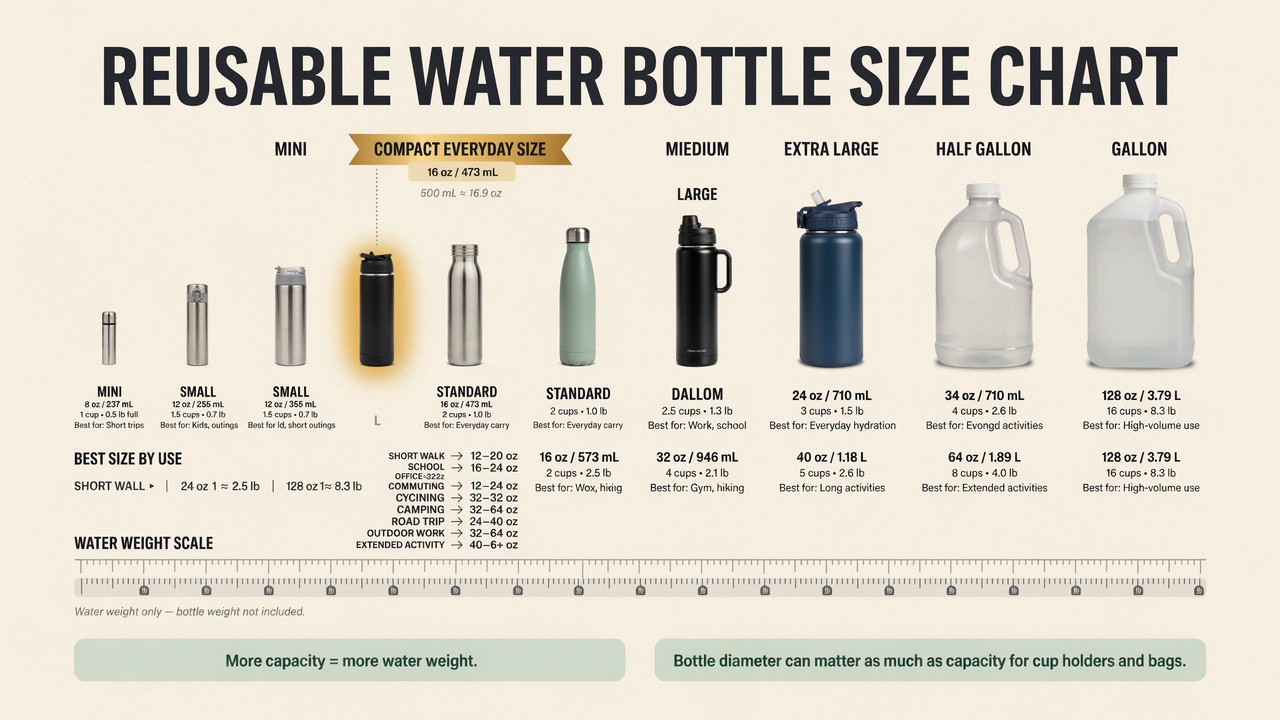
This reusable water bottle size chart explains common bottle capacities in ounces, milliliters, and liters, along with approximate cup equivalents, weight when filled, dimensions, and the best uses for each size.
Why Reusable Water Bottle Size Matters
The size of a reusable water bottle affects portability, hydration, weight, and convenience. A small bottle is easy to carry but may need frequent refilling, while a large bottle provides more water but becomes heavier when full.
Choosing the right size can help you:
- Carry enough water throughout the day
- Reduce frequent refills
- Find a bottle that fits your bag
- Choose a bottle that fits your cup holder
- Track water intake more easily
- Match the bottle to your activity
- Avoid carrying unnecessary weight
Standard Reusable Water Bottle Size Chart
| Bottle Size | Capacity | Approx. Cups | Approx. Full Water Weight | Best Use |
|---|---|---|---|---|
| Mini | 8 oz / 237 mL | 1 cup | 0.5 lb | Short trips |
| Small | 12 oz / 355 mL | 1.5 cups | 0.7 lb | Kids, short outings |
| Compact | 16 oz / 473 mL | 2 cups | 1.0 lb | Everyday carry |
| Standard | 20 oz / 591 mL | 2.5 cups | 1.3 lb | Work, school |
| Medium | 24 oz / 710 mL | 3 cups | 1.5 lb | Everyday hydration |
| Large | 32 oz / 946 mL | 4 cups | 2.1 lb | Gym, hiking |
| Extra Large | 40 oz / 1.18 L | 5 cups | 2.6 lb | Long activities |
| Half Gallon | 64 oz / 1.89 L | 8 cups | 4.0 lb | Extended activities |
| Gallon | 128 oz / 3.79 L | 16 cups | 8.3 lb | High-volume use |
Weights represent approximate water weight only and do not include the bottle. Actual bottle weight and dimensions vary by material and design.
Reusable Water Bottle Size in Ounces
Fluid ounces are commonly used to describe reusable bottle capacity in the United States.
| Bottle Capacity | Milliliters | Liters | Approx. Cups |
|---|---|---|---|
| 8 oz | 237 mL | 0.24 L | 1 |
| 12 oz | 355 mL | 0.36 L | 1.5 |
| 16 oz | 473 mL | 0.47 L | 2 |
| 20 oz | 591 mL | 0.59 L | 2.5 |
| 24 oz | 710 mL | 0.71 L | 3 |
| 32 oz | 946 mL | 0.95 L | 4 |
| 40 oz | 1,183 mL | 1.18 L | 5 |
| 64 oz | 1,893 mL | 1.89 L | 8 |
| 128 oz | 3,785 mL | 3.79 L | 16 |
Reusable Water Bottle Size in Milliliters
Milliliters and liters are commonly used for reusable bottles around the world.
| Capacity | Fluid Ounces | Liters | Common Description |
|---|---|---|---|
| 250 mL | 8.5 oz | 0.25 L | Mini |
| 350 mL | 11.8 oz | 0.35 L | Small |
| 500 mL | 16.9 oz | 0.5 L | Compact |
| 600 mL | 20.3 oz | 0.6 L | Standard |
| 750 mL | 25.4 oz | 0.75 L | Medium |
| 1,000 mL | 33.8 oz | 1 L | Large |
| 1,500 mL | 50.7 oz | 1.5 L | Extra large |
| 2,000 mL | 67.6 oz | 2 L | Very large |
| 3,000 mL | 101.4 oz | 3 L | Jumbo |
Reusable Water Bottle Size Conversion Chart
| Liters | Milliliters | Fluid Ounces | Approx. Cups |
|---|---|---|---|
| 0.25 L | 250 mL | 8.5 oz | 1.1 |
| 0.5 L | 500 mL | 16.9 oz | 2.1 |
| 0.6 L | 600 mL | 20.3 oz | 2.5 |
| 0.75 L | 750 mL | 25.4 oz | 3.2 |
| 1 L | 1,000 mL | 33.8 oz | 4.2 |
| 1.5 L | 1,500 mL | 50.7 oz | 6.3 |
| 2 L | 2,000 mL | 67.6 oz | 8.5 |
| 3 L | 3,000 mL | 101.4 oz | 12.7 |
8 oz Reusable Water Bottle
An 8-ounce reusable bottle is compact and lightweight. It is useful when portability is more important than capacity.
It can work well for:
- Young children
- Short walks
- Short appointments
- Small bags
- Situations where water is readily available
Because of its small capacity, it may require frequent refilling.
12 oz Reusable Water Bottle
A 12-ounce bottle offers a little more capacity while remaining very portable.
It can be suitable for:
- Children
- Short school periods
- Short outings
- Small handbags or backpacks
- Light everyday use
16 oz / 500 mL Reusable Water Bottle
A 16-ounce bottle is one of the most convenient compact sizes. A 500 mL bottle is very close to 16.9 fluid ounces.
This size works well for:
- Commuting
- School
- Office use
- Short workouts
- Everyday carrying
- Travel
Its relatively small footprint makes it easy to store in many bags.
20 oz Reusable Water Bottle
A 20-ounce bottle provides more capacity than a typical 500 mL bottle without becoming particularly large.
It is a useful middle-ground size for:
- Work
- School
- Walking
- Commuting
- Light exercise
- Everyday hydration
24 oz Reusable Water Bottle
A 24-ounce bottle holds approximately 3 cups of water.
It provides a good balance between portability and capacity and can be useful for:
- Office workers
- Students
- Gym sessions
- Commuting
- Daily errands
32 oz Reusable Water Bottle
A 32-ounce bottle holds approximately 1 liter of water.
It is one of the most popular larger reusable bottle sizes and is commonly used for:
- Gym workouts
- Hiking
- Outdoor activities
- Long workdays
- Sports
- Extended travel
The main drawback is weight: a full 32-ounce bottle contains roughly 2 pounds of water before the bottle itself is added.
40 oz Reusable Water Bottle
A 40-ounce bottle provides approximately 1.18 liters of capacity.
It is useful for people who want a larger water supply while avoiding the size of a half-gallon bottle.
Common uses include:
- Long workdays
- Gym sessions
- Road trips
- Outdoor activities
- Extended periods between refills
64 oz Reusable Water Bottle
A 64-ounce bottle holds approximately 1.89 liters, or half a gallon.
This is a large bottle intended for situations where frequent refilling is inconvenient.
It can be useful for:
- Long hikes
- Camping
- Outdoor work
- Extended sporting activities
- Long days away from water sources
Because it holds around 4 pounds of water, it can be cumbersome to carry.
128 oz / Gallon Reusable Water Bottle
A gallon bottle holds approximately 3.79 liters.
It is primarily designed for high-volume water storage rather than maximum portability.
A full gallon of water weighs roughly 8.3 pounds, before adding the weight of the bottle.
Reusable Water Bottle Size by Use
| Activity | Recommended Size |
|---|---|
| Short walk | 12–20 oz |
| School | 16–24 oz |
| Office | 20–32 oz |
| Commuting | 16–24 oz |
| Running | 12–24 oz |
| Gym | 24–40 oz |
| Cycling | 20–32 oz |
| Hiking | 32–64 oz |
| Camping | 32–64+ oz |
| Road trip | 24–40 oz |
| Outdoor work | 32–64 oz |
| Extended activity | 40–64+ oz |
These are general recommendations. Actual hydration requirements vary according to activity, climate, duration, and individual needs.
Best Reusable Water Bottle Size for School
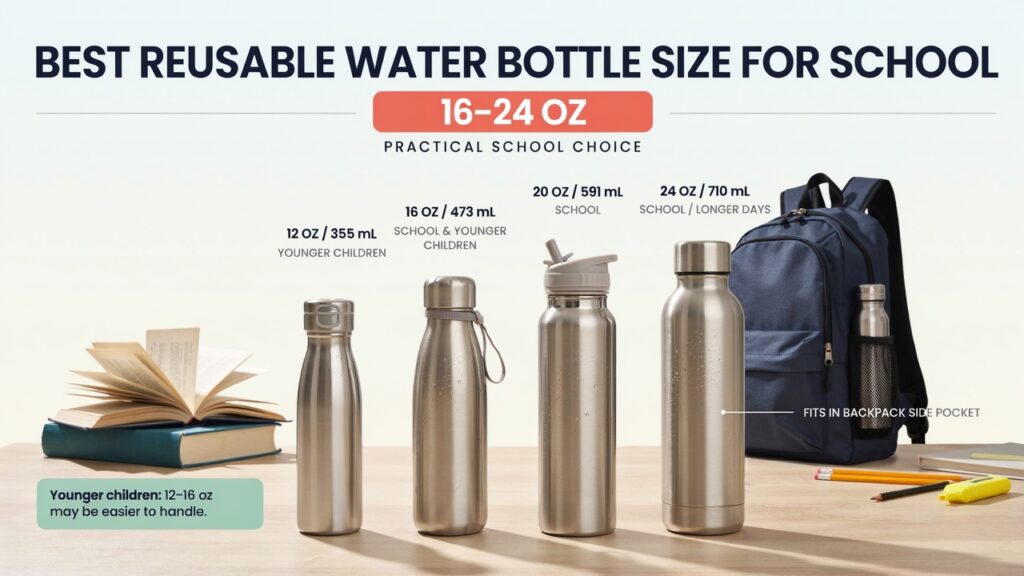
For school, a 16- to 24-ounce bottle is often a practical choice.
It provides enough water for several hours while remaining easy to carry in a backpack.
For younger children, a 12- to 16-ounce bottle may be easier to handle.
Best Reusable Water Bottle Size for Work
A 20- to 32-ounce bottle is a convenient range for office use.
A 24-ounce bottle is relatively easy to carry, while a 32-ounce bottle reduces the need for refilling during the workday.
Best Reusable Water Bottle Size for the Gym
For the gym, a 24- to 40-ounce bottle can be useful.
A 32-ounce bottle is particularly convenient for longer workouts because it provides a substantial amount of water without being as large as a half-gallon container.
Best Reusable Water Bottle Size for Hiking
For hiking, bottle capacity depends on the trail, weather, duration, and availability of water.
| Hike | Common Capacity |
|---|---|
| Short hike | 20–32 oz |
| Half-day hike | 32–64 oz |
| Long hike | 64 oz or more |
| Extended trip | Multiple containers/reservoir |
For long hikes, carrying water in multiple bottles or a hydration reservoir can distribute weight more comfortably.
Best Reusable Water Bottle Size for Travel
A 20- to 32-ounce bottle is a versatile travel size.
It is large enough to provide useful capacity while still being relatively easy to carry.
For air travel, remember that a reusable bottle should generally be empty when passing through security checkpoints where liquid restrictions apply.
Reusable Water Bottle Size and Weight
Water weighs approximately 1 kilogram per liter.
| Bottle Capacity | Approx. Water Weight |
|---|---|
| 8 oz / 237 mL | 0.52 lb |
| 12 oz / 355 mL | 0.78 lb |
| 16 oz / 473 mL | 1.04 lb |
| 20 oz / 591 mL | 1.30 lb |
| 24 oz / 710 mL | 1.57 lb |
| 32 oz / 946 mL | 2.09 lb |
| 40 oz / 1.18 L | 2.61 lb |
| 64 oz / 1.89 L | 4.17 lb |
| 128 oz / 3.79 L | 8.35 lb |
These figures represent water only.
A stainless steel insulated bottle can add noticeable additional weight compared with a lightweight plastic bottle.
Reusable Water Bottle Dimensions
Bottle dimensions vary by manufacturer and design. A wide insulated bottle may have the same capacity as a tall narrow bottle.
| Capacity | Approx. Height | Typical Diameter |
|---|---|---|
| 12 oz | 6–8 in | 2–2.5 in |
| 16–17 oz | 8–9 in | 2.5–2.75 in |
| 20 oz | 8–10 in | 2.5–3 in |
| 24 oz | 9–11 in | 2.75–3.25 in |
| 32 oz | 9–12 in | 3–3.5 in |
| 40 oz | 10–12 in | 3.5–4 in |
| 64 oz | 10–13 in | 4–5 in |
These measurements are approximate and can vary substantially according to bottle shape, insulation, lid, handle, and construction.
Reusable Water Bottle Size for Cup Holders
If you plan to keep your bottle in a vehicle cup holder, diameter can be more important than capacity.
| Bottle Size | Cup Holder Compatibility |
|---|---|
| 12–16 oz | Usually easy |
| 20 oz | Often compatible |
| 24 oz | Usually compatible depending on base |
| 32 oz | Varies significantly |
| 40 oz | Often too wide for standard holders |
| 64 oz | Generally not designed for standard cup holders |
Always check the base diameter when cup-holder compatibility matters.
Stainless Steel vs Plastic Bottle Sizes
Reusable bottles are commonly made from stainless steel, plastic, glass, or combinations of materials.
Stainless Steel
Stainless steel bottles are durable and are widely available in insulated designs. They can be heavier than plastic bottles.
Plastic
Plastic bottles are often lightweight and convenient for sports, school, and everyday carrying.
Glass
Glass bottles can provide a clean drinking experience but are generally heavier and more fragile.
The same capacity can have different dimensions and weights depending on the material.
Insulated Reusable Water Bottle Size
Insulated bottles often have thicker walls, which can increase their outside diameter.
Popular capacities include:
- 20 oz
- 24 oz
- 32 oz
- 40 oz
- 64 oz
A 32-ounce insulated bottle can be a useful compromise between capacity and portability.
Reusable Water Bottle Size for Kids
Children generally benefit from bottles that are small enough to carry comfortably.
| Child | Suggested Size |
|---|---|
| Young child | 8–12 oz |
| Elementary school | 12–20 oz |
| Older child | 16–24 oz |
| Teenager | 20–32 oz |
The bottle should be easy for the child to hold, open, close, and clean.
Reusable Water Bottle Size for Sports
| Sport | Common Bottle Size |
|---|---|
| Running | 12–24 oz |
| Tennis | 20–32 oz |
| Soccer | 24–40 oz |
| Basketball | 24–40 oz |
| Cycling | 20–32 oz |
| Gym training | 24–40 oz |
| Outdoor sports | 32–64 oz |
For longer or more intense activity, additional water capacity may be useful.
How to Choose the Right Reusable Water Bottle Size
1. Think About Your Routine
If you can refill your bottle frequently, a smaller bottle may be sufficient.
2. Consider How Much Weight You Want to Carry
More capacity means more water weight.
3. Check Your Bag
Make sure the bottle fits comfortably into your backpack, purse, or travel bag.
4. Check the Diameter
A bottle may have a convenient capacity but still be too wide for your cup holder or backpack pocket.
5. Consider Cleaning
Very large bottles can be harder to wash, especially if they have narrow openings.
6. Match the Bottle to Your Activity
Choose a compact bottle for short trips and a larger bottle for extended activities.
Common Reusable Water Bottle Size Mistakes
Choosing the Largest Bottle Available
A huge bottle is not always practical. It can become heavy and difficult to carry.
Choosing a Bottle That Is Too Small
Small bottles can require frequent refilling.
Ignoring Empty Bottle Weight
Two bottles with the same capacity can have very different weights.
Forgetting the Bottle Diameter
Capacity does not tell you whether the bottle will fit into a cup holder.
Carrying More Water Than Necessary
For short trips where refill stations are readily available, a smaller bottle may be more convenient.
Reusable Water Bottle Size for All-Day Use
For many people, 32–40 ounces offers a useful balance for extended daily use.
A 32-ounce bottle provides approximately 1 liter of water, while a 40-ounce bottle provides around 1.18 liters.
If carrying a large bottle all day is inconvenient, using a smaller bottle and refilling it may be a better option.
Reusable Water Bottle Size and Hydration Tracking
Bottle capacity can make it easier to monitor how much water you have consumed.
For example
