
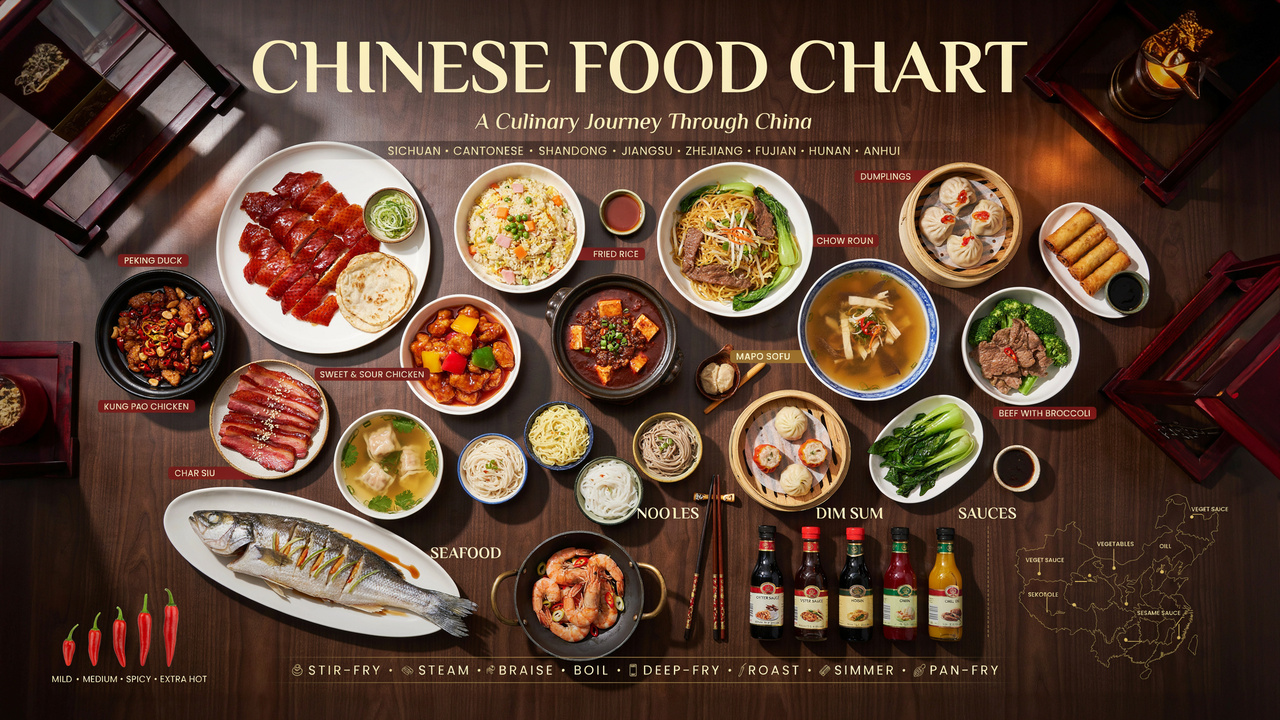
Chinese food is known for its incredible variety, from stir-fried noodles and fried rice to dumplings, soups, steamed dishes, and flavorful vegetable recipes. Different regions of China have developed their own ingredients, cooking techniques, and flavor profiles. Understanding the Chinese food chart makes it easier to compare popular dishes, discover new meals, and choose foods based on flavor, ingredients, and cooking style.
Why Chinese Food Variety Matters
Chinese cuisine is not one single style of cooking. It includes many regional traditions, each with its own characteristics. Sichuan dishes are often known for bold and spicy flavors, while Cantonese cuisine commonly emphasizes fresh ingredients and lighter seasoning.
The same ingredient can also be prepared in several ways, including stir-frying, steaming, braising, roasting, boiling, and deep-frying. This variety makes Chinese cuisine suitable for many different tastes and meal preferences.
Standard Chinese Food Chart
Here are some popular Chinese dishes and their basic characteristics.
Chinese Food Chart
| Chinese Food | Main Ingredients | Flavor | Cooking Style |
|---|---|---|---|
| Fried Rice | Rice, egg, vegetables | Savory | Stir-fried |
| Chow Mein | Noodles, vegetables, protein | Savory | Stir-fried |
| Dumplings | Dough, meat/vegetables | Savory | Steamed/boiled/fried |
| Spring Rolls | Wrapper, vegetables/meat | Crispy & savory | Fried |
| Kung Pao Chicken | Chicken, peanuts, chili | Spicy & savory | Stir-fried |
| Sweet and Sour Chicken | Chicken, sauce, vegetables | Sweet & tangy | Fried/stir-fried |
| Mapo Tofu | Tofu, meat, chili | Spicy & savory | Simmered |
| Hot and Sour Soup | Broth, tofu, vegetables | Sour & spicy | Simmered |
| Peking Duck | Duck, pancakes, sauce | Savory & rich | Roasted |
| Beef with Broccoli | Beef, broccoli, sauce | Savory | Stir-fried |
| Char Siu | Pork, marinade | Sweet & savory | Roasted |
| Wonton Soup | Wontons, broth | Mild & savory | Boiled |
Recipes and ingredients can vary greatly between regions and restaurants.
Choosing The Right Chinese Food
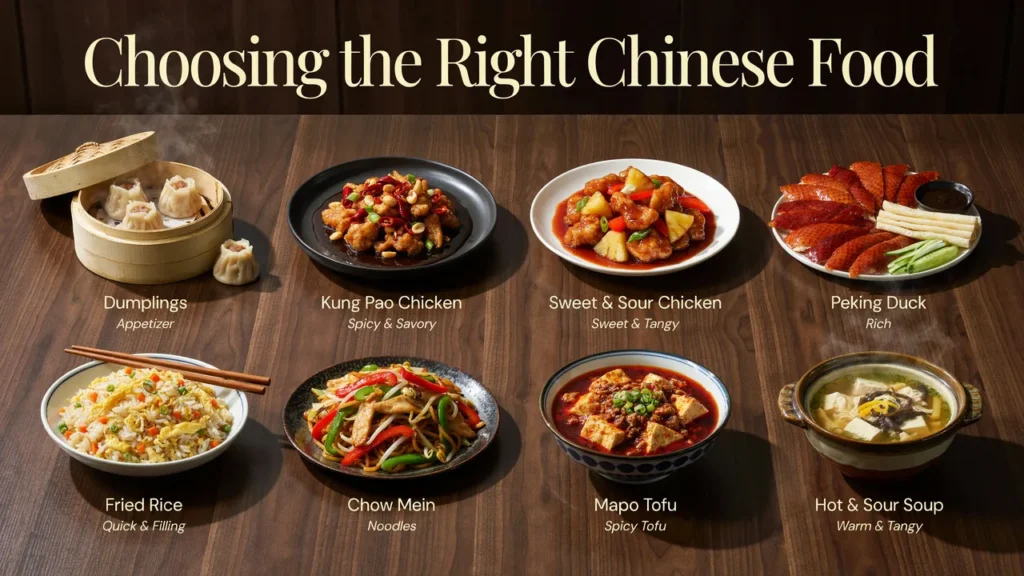
The best Chinese dish depends on the flavor and texture you prefer.
Fried Rice: A versatile choice for a quick and filling meal.
Chow Mein: Great when you prefer noodles with vegetables and protein.
Dumplings: Ideal as an appetizer, snack, or part of a larger meal.
Kung Pao Chicken: A good choice for people who enjoy spicy, savory flavors with a little sweetness.
Sweet and Sour Chicken: Suitable for those who prefer a sweeter and tangier flavor.
Mapo Tofu: A flavorful option for lovers of spicy tofu dishes.
Hot and Sour Soup: Excellent when you want something warm, tangy, and spicy.
Peking Duck: A richer dish traditionally served with thin pancakes and accompanying sauces.
Chinese Regional Food Chart
China has many regional cuisines with distinctive characteristics.
| Regional Cuisine | Flavor Profile | Popular Foods |
|---|---|---|
| Sichuan | Spicy, bold, aromatic | Mapo tofu, Kung Pao dishes |
| Cantonese | Mild, fresh, balanced | Dim sum, steamed fish |
| Shandong | Savory, seafood-focused | Seafood dishes, soups |
| Jiangsu | Delicate, slightly sweet | Braised dishes |
| Zhejiang | Fresh, light, delicate | Seafood, bamboo shoots |
| Fujian | Light, savory, seafood-rich | Soups, seafood dishes |
| Hunan | Spicy, aromatic | Chili-based dishes |
| Anhui | Earthy, hearty | Braised meats, vegetables |
Regional cooking styles can overlap, and modern restaurants often combine techniques from different traditions.
Chinese Noodle Chart
Noodles are an important part of many Chinese meals.
| Noodle Type | Texture | Common Uses |
|---|---|---|
| Wheat Noodles | Chewy | Stir-fries, soups |
| Egg Noodles | Springy | Chow mein |
| Rice Noodles | Soft & delicate | Stir-fries, soups |
| Hand-Pulled Noodles | Chewy & elastic | Noodle soups |
| Knife-Cut Noodles | Thick & chewy | Soups, stir-fries |
| Glass Noodles | Slippery | Soups, stir-fries |
| Dan Dan Noodles | Thin & firm | Spicy noodle dishes |
| Lo Mein Noodles | Soft & chewy | Saucy noodle dishes |
Different noodle shapes and textures work better with different sauces and cooking methods.
Chinese Rice Dish Chart
Rice is a staple in many Chinese meals.
| Rice Dish | Main Ingredients | Flavor |
|---|---|---|
| Egg Fried Rice | Rice, egg, vegetables | Savory |
| Yangzhou Fried Rice | Rice, egg, vegetables, protein | Mild & savory |
| Chicken Fried Rice | Rice, chicken, vegetables | Savory |
| Vegetable Fried Rice | Rice, vegetables | Light & savory |
| Sticky Rice | Glutinous rice | Soft & chewy |
| Clay Pot Rice | Rice, meat, vegetables | Rich & savory |
| Steamed Rice | Rice, water | Mild |
Fried rice is especially useful for combining rice with vegetables, eggs, meat, and seasonings.
Chinese Dumpling Chart
Chinese dumplings come in many shapes, fillings, and cooking methods.
| Dumpling Type | Typical Filling | Cooking Method |
|---|---|---|
| Jiaozi | Pork, vegetables | Boiled/steamed/fried |
| Guotie | Pork, vegetables | Pan-fried |
| Har Gow | Shrimp | Steamed |
| Wontons | Pork, shrimp | Boiled/steamed |
| Xiaolongbao | Pork, soup filling | Steamed |
| Vegetable Dumplings | Mixed vegetables | Steamed/fried |
| Chicken Dumplings | Chicken, vegetables | Steamed/boiled |
Dumplings can be served with dipping sauces, soups, or as part of a larger meal.
Chinese Soup Chart
Chinese soups range from light broths to hearty and spicy options.
| Soup | Main Ingredients | Flavor |
|---|---|---|
| Hot and Sour Soup | Tofu, mushrooms, broth | Spicy & sour |
| Wonton Soup | Wontons, broth | Mild & savory |
| Egg Drop Soup | Egg, broth | Light & savory |
| Corn Soup | Corn, egg, broth | Mild & slightly sweet |
| Winter Melon Soup | Winter melon, broth | Light & delicate |
| Hot Pot Broth | Various ingredients | Rich & savory |
| Seafood Soup | Seafood, vegetables | Savory |
Soup can be served as an appetizer or as part of a complete meal.
Chinese Vegetable Food Chart
Vegetables play an important role in Chinese cooking.
| Vegetable | Common Preparation |
|---|---|
| Bok Choy | Stir-fried or steamed |
| Chinese Broccoli | Stir-fried or steamed |
| Napa Cabbage | Stir-fried or braised |
| Snow Peas | Stir-fried |
| Bean Sprouts | Stir-fried |
| Chinese Eggplant | Braised or stir-fried |
| Mushrooms | Stir-fried or steamed |
| Water Chestnuts | Stir-fried |
| Bamboo Shoots | Stir-fried or simmered |
| Chinese Mustard Greens | Pickled or cooked |
Vegetables are often cooked quickly over high heat to preserve texture.
Chinese Meat Dish Chart
| Dish | Main Protein | Flavor |
|---|---|---|
| Kung Pao Chicken | Chicken | Spicy & savory |
| Sweet and Sour Pork | Pork | Sweet & tangy |
| Char Siu | Pork | Sweet & savory |
| Mongolian Beef | Beef | Savory & slightly sweet |
| Beef with Broccoli | Beef | Savory |
| Orange Chicken | Chicken | Sweet & citrusy |
| Peking Duck | Duck | Rich & savory |
| Twice-Cooked Pork | Pork | Spicy & savory |
| General Tso’s Chicken | Chicken | Sweet, savory & spicy |
Preparation and seasoning can differ substantially between traditional Chinese versions and Western Chinese-American restaurant versions.
Chinese Seafood Chart
China’s long coastline contributes to a wide variety of seafood dishes.
| Seafood | Common Preparation | Flavor |
|---|---|---|
| Shrimp | Stir-fried or steamed | Mild & savory |
| Fish | Steamed or braised | Delicate |
| Crab | Steamed or stir-fried | Sweet & savory |
| Squid | Stir-fried | Savory |
| Clams | Stir-fried | Briny & savory |
| Scallops | Steamed or stir-fried | Delicate |
| Prawns | Stir-fried | Sweet & savory |
Steaming is particularly valued for preserving the natural flavor of fresh seafood.
Chinese Breakfast Food Chart
Breakfast in China can be very different from a typical Western breakfast.
| Food | Main Ingredients | Type |
|---|---|---|
| Congee | Rice, water | Porridge |
| Youtiao | Wheat dough | Fried bread |
| Baozi | Filled dough | Steamed |
| Jianbing | Batter, egg, fillings | Savory crepe |
| Tea Eggs | Eggs, tea, spices | Egg dish |
| Rice Noodles | Rice noodles, broth | Noodle dish |
| Steamed Buns | Flour, yeast | Steamed |
Breakfast choices vary considerably by region.
Chinese Dim Sum Chart
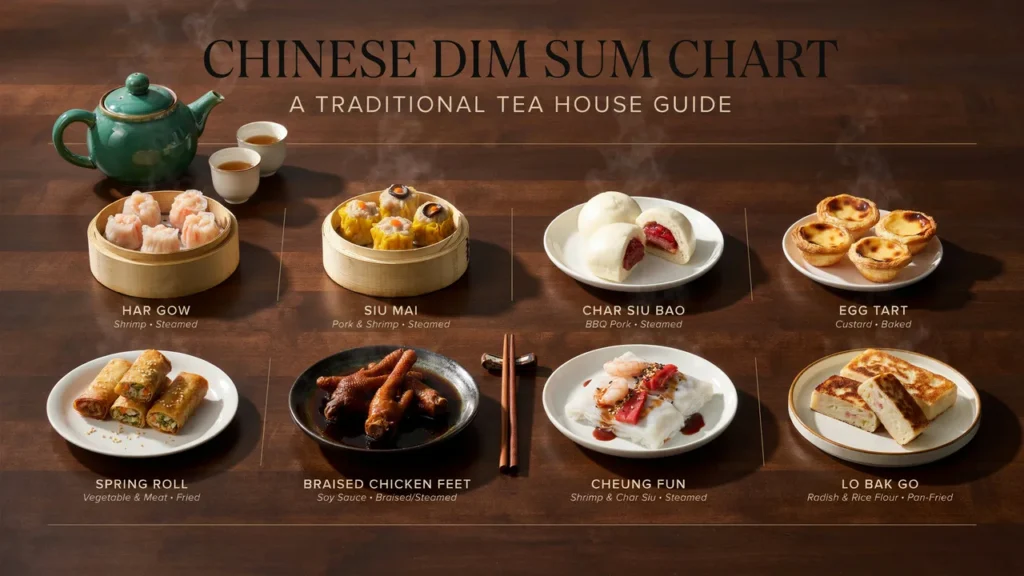
Dim sum includes many small dishes traditionally enjoyed with tea.
| Dim Sum | Main Filling | Cooking Style |
|---|---|---|
| Har Gow | Shrimp | Steamed |
| Siu Mai | Pork/shrimp | Steamed |
| Char Siu Bao | BBQ pork | Steamed |
| Egg Tart | Egg custard | Baked |
| Spring Rolls | Vegetables/meat | Fried |
| Chicken Feet | Chicken feet, sauce | Braised/steamed |
| Rice Noodle Rolls | Rice flour, fillings | Steamed |
| Turnip Cake | Radish, rice flour | Pan-fried |
Dim sum is often served as several small dishes rather than one large entrée.
Chinese Sauce Chart
Sauces provide much of the characteristic flavor in Chinese cooking.
| Sauce | Main Flavor | Common Uses |
|---|---|---|
| Soy Sauce | Salty & savory | Stir-fries, marinades |
| Oyster Sauce | Rich & savory | Vegetables, meat |
| Hoisin Sauce | Sweet & savory | Meat, dipping |
| Black Bean Sauce | Salty & fermented | Beef, vegetables |
| Sweet Chili Sauce | Sweet & spicy | Dipping, appetizers |
| Plum Sauce | Sweet & fruity | Duck, spring rolls |
| Chili Oil | Spicy & aromatic | Noodles, dumplings |
| Sesame Sauce | Nutty & rich | Noodles, dipping |
Sauce intensity can vary depending on the recipe and amount used.
Chinese Flavor Profile Chart
| Flavor Profile | Example Foods |
|---|---|
| Spicy | Mapo tofu, Hunan dishes |
| Sweet & Sour | Sweet and sour chicken |
| Savory | Fried rice, beef dishes |
| Salty & Umami | Soy-based dishes |
| Fresh & Light | Steamed fish |
| Rich & Aromatic | Braised pork |
| Sour & Spicy | Hot and sour soup |
| Sweet & Savory | Char siu |
Chinese cooking often combines several flavor elements in the same dish.
Chinese Cooking Method Chart
| Cooking Method | Description | Examples |
|---|---|---|
| Stir-Frying | Quick cooking over high heat | Fried rice |
| Steaming | Cooking with steam | Dumplings |
| Braising | Slow cooking in liquid | Braised pork |
| Boiling | Cooking in water or broth | Wontons |
| Deep-Frying | Cooking in hot oil | Spring rolls |
| Roasting | Dry-heat cooking | Peking duck |
| Simmering | Gentle cooking in liquid | Soups |
| Pan-Frying | Cooking with a smaller amount of oil | Dumplings |
Each method creates a different texture and flavor.
Chinese Food Pairing Chart
| Main Dish | Good Pairings |
|---|---|
| Fried Rice | Dumplings, vegetables |
| Chow Mein | Spring rolls, soup |
| Kung Pao Chicken | Steamed rice, vegetables |
| Peking Duck | Pancakes, cucumber, sauce |
| Mapo Tofu | Steamed rice, vegetables |
| Sweet and Sour Chicken | Fried rice, vegetables |
| Dumplings | Soup, vegetables |
| Char Siu | Rice, greens |
| Stir-Fried Beef | Rice, broccoli |
| Fish | Steamed rice, vegetables |
Pairing dishes allows different flavors and textures to balance one another.
Chinese Vegetarian Food Chart
Chinese cuisine offers many vegetarian dishes.
| Vegetarian Food | Main Ingredients |
|---|---|
| Vegetable Fried Rice | Rice, vegetables |
| Tofu Stir-Fry | Tofu, vegetables |
| Vegetable Dumplings | Cabbage, mushrooms |
| Mapo Tofu | Tofu, chili, seasonings |
| Stir-Fried Bok Choy | Bok choy, garlic |
| Buddha’s Delight | Mixed vegetables, tofu |
| Vegetable Chow Mein | Noodles, vegetables |
| Eggplant with Garlic | Eggplant, garlic, sauce |
When ordering vegetarian food, check the sauce and broth because some preparations may contain animal-derived ingredients.
Chinese Food Serving Chart
Serving sizes vary by restaurant and dish, but this provides a useful general comparison.
| Food Type | Typical Serving Style |
|---|---|
| Fried Rice | 1 bowl or side portion |
| Noodles | 1 bowl or plate |
| Dumplings | 6–10 pieces |
| Spring Rolls | 1–3 pieces |
| Soup | 1 bowl |
| Stir-Fried Vegetables | 1 shared dish |
| Meat Entrée | 1 shared dish |
| Steamed Rice | 1 small bowl |
| Dim Sum | Several small plates |
Chinese meals are often designed for sharing, so restaurant serving sizes may not equal individual portions.
Chinese Food Spice Chart
Not every Chinese dish is spicy.
| Spice Level | Example |
|---|---|
| Mild | Steamed fish |
| Mild-Medium | Fried rice |
| Medium | Kung Pao chicken |
| Medium-High | Hunan dishes |
| High | Some Sichuan dishes |
| Very High | Chili-heavy regional dishes |
Spice levels can vary significantly between restaurants.
Healthy Chinese Food Choices
Many Chinese cooking methods can produce balanced meals, especially when dishes emphasize vegetables, lean proteins, steamed foods, and moderate amounts of oil.
Good options may include:
- Steamed fish with vegetables
- Stir-fried vegetables
- Steamed dumplings
- Vegetable soup
- Tofu with vegetables
- Steamed rice with lean protein
- Lightly stir-fried chicken
- Vegetable and noodle dishes
Restaurant dishes can differ considerably in sodium, oil, sugar, and portion size, so preparation matters as much as the dish name.
Common Mistakes When Choosing Chinese Food
Assuming every dish is spicy: Many Chinese dishes are mild and delicate.
Ignoring portion size: Restaurant dishes are often intended for sharing.
Choosing only fried foods: Chinese cuisine includes many steamed, boiled, braised, and stir-fried dishes.
Forgetting vegetables: Adding vegetable dishes can create more variety in a meal.
Confusing regional styles: Sichuan, Cantonese, Hunan, and other cuisines have different flavor traditions.
Overusing sauce: Some sauces can be quite salty or sweet, so using a moderate amount can help balance the meal.
Tips For Enjoying Chinese Food
Try different regional cuisines: Exploring different regions can introduce completely different flavors.
Share several dishes: Sharing allows you to experience multiple textures and flavors in one meal.
Balance rich and light dishes: Pair fried or rich foods with steamed vegetables or soup.
Include different textures: Combine crispy, soft, chewy, and tender foods.
Try traditional dishes: Popular Western Chinese restaurant dishes represent only a small part of China’s enormous food culture.
Use dipping sauces thoughtfully: A small amount can add flavor without overpowering the main dish.
The History Behind Chinese Food
Chinese cuisine has developed over thousands of years and has been influenced by geography, agriculture, trade, climate, and regional traditions.
Rice became particularly important in southern China, while wheat-based foods such as noodles, dumplings, and steamed buns became staples in many northern regions. Different climates and local ingredients also shaped distinctive cooking styles.
Today, Chinese cuisine is enjoyed throughout the world, but dishes served internationally may differ from their traditional regional versions.
Frequently Asked Questions
What Are The Most Popular Chinese Foods?
Popular choices include fried rice, chow mein, dumplings, spring rolls, Kung Pao chicken, sweet and sour dishes, hot and sour soup, and Peking duck.
What Is The Most Popular Chinese Rice Dish?
Fried rice is one of the most widely known Chinese rice dishes and can be prepared with eggs, vegetables, chicken, shrimp, pork, or other ingredients.
What Are Common Chinese Noodles?
Common varieties include wheat noodles, egg noodles, rice noodles, hand-pulled noodles, knife-cut noodles, and glass noodles.
What Is Dim Sum?
Dim sum is a collection of small dishes and bite-sized foods, often including dumplings, buns, rolls, pastries, and other savory or sweet items.
What Chinese Food Is Spicy?
Sichuan and Hunan cuisines are particularly known for spicy dishes, although the level of heat varies by recipe.
What Chinese Food Is Mild?
Steamed fish, simple fried rice, many Cantonese dishes, steamed vegetables, and certain noodle dishes can have relatively mild flavors.
What Is A Good Chinese Vegetarian Meal?
Options include vegetable fried rice, tofu stir-fry, vegetable dumplings, Buddha’s delight, stir-fried bok choy, and vegetable chow mein.
What Is The Difference Between Chow Mein And Fried Rice?
Chow mein is primarily a noodle-based dish, while fried rice uses cooked rice as its main ingredient. Both can contain vegetables, eggs, meat, and similar seasonings.
What Is The Difference Between Steaming And Stir-Frying?
Steaming cooks food using steam and usually requires little or no oil. Stir-frying cooks ingredients quickly over high heat with a small amount of oil.
Is Chinese Food Always Spicy?
No. Chinese cuisine includes mild, sweet, sour, savory, aromatic, and spicy dishes. The flavor depends heavily on the region and recipe.
Chinese food offers an enormous range of flavors, ingredients, and cooking techniques. From fried rice, noodles, and dumplings to steamed fish, tofu, stir-fried vegetables, soups, and roasted meats, there is a Chinese dish for almost every preference. Understanding the Chinese food chart makes it easier to compare regional cuisines, identify flavor profiles, choose cooking styles, and create balanced combinations for a complete meal.
