
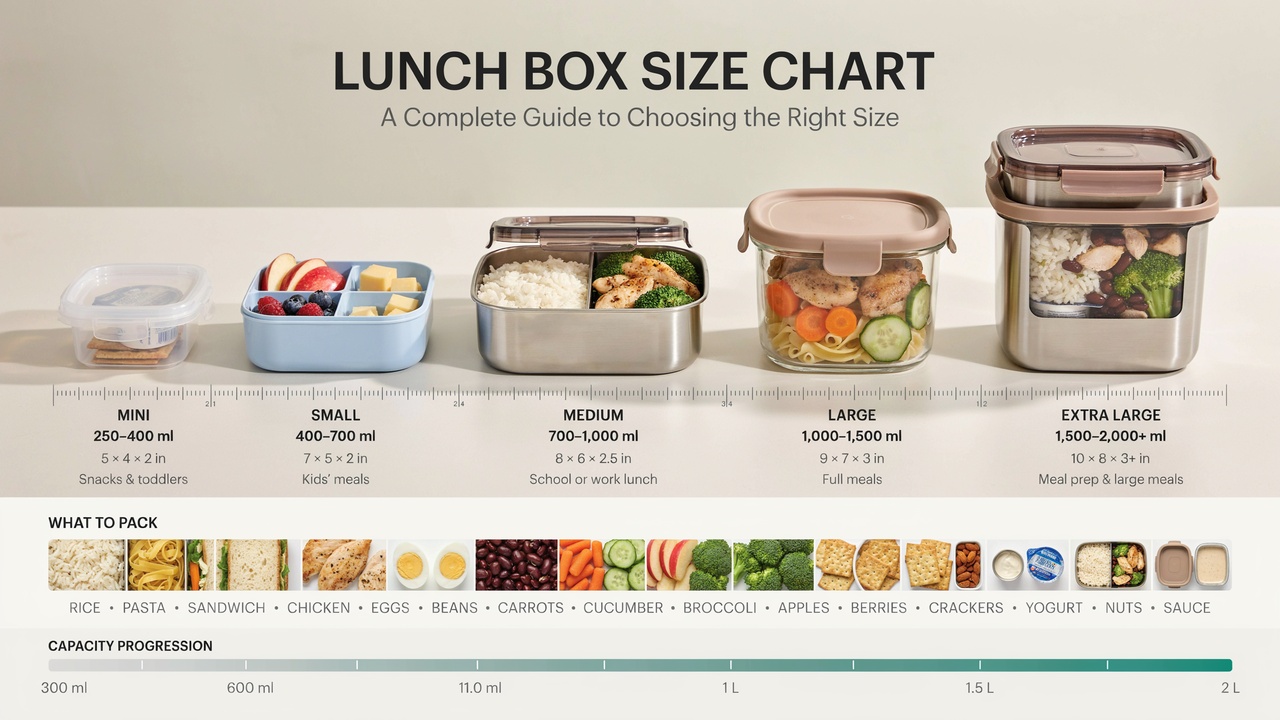
A lunch box is more than just a container for carrying food—it needs to hold the right amount of food while remaining easy to carry and practical for everyday use. From small snack boxes for children to large meal-prep containers for adults, lunch boxes come in many different sizes and designs. Understanding the lunch box size chart helps you choose the right capacity, number of compartments, and shape for school, work, travel, or meal preparation.
Why Lunch Box Size Matters
The size of a lunch box directly affects how much food you can pack. A box that is too small may leave you without enough food, while an oversized container can take up unnecessary space in a backpack or lunch bag.
Compartments also matter. Some lunch boxes are designed for one main meal, while others have separate sections for rice, vegetables, fruit, snacks, and sauces.
Choosing the right size makes packing easier and helps keep different foods organized.
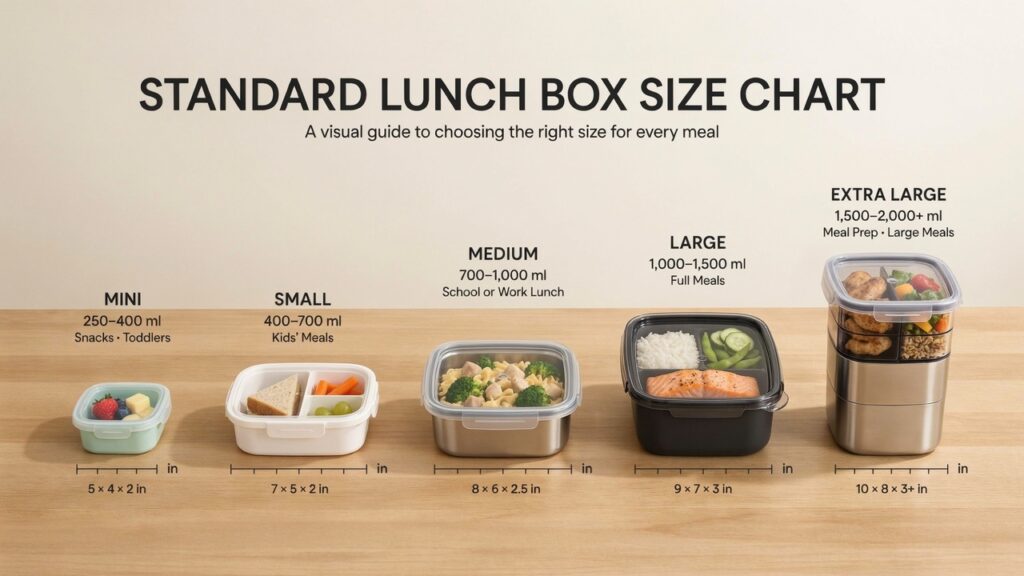
Standard Lunch Box Size Chart
| Lunch Box Size | Capacity | Approx. Dimensions | Best For |
|---|---|---|---|
| Mini | 250–400 ml | 5 × 4 × 2 in | Snacks, toddlers |
| Small | 400–700 ml | 7 × 5 × 2 in | Kids’ meals |
| Medium | 700–1,000 ml | 8 × 6 × 2.5 in | School or work lunch |
| Large | 1,000–1,500 ml | 9 × 7 × 3 in | Full meals |
| Extra Large | 1,500–2,000+ ml | 10 × 8 × 3+ in | Meal prep, large meals |
Dimensions vary considerably by brand and shape.
Lunch Box Capacity Chart
Capacity is usually measured in milliliters or liters.
| Capacity | Approx. Volume | Typical Use |
|---|---|---|
| 300 ml | 0.3 L | Snack |
| 500 ml | 0.5 L | Small meal |
| 750 ml | 0.75 L | Kids’ lunch |
| 1,000 ml | 1 L | Standard lunch |
| 1,250 ml | 1.25 L | Large lunch |
| 1,500 ml | 1.5 L | Full meal + snacks |
| 2,000 ml | 2 L | Meal prep or large serving |
Capacity describes the container’s volume, not necessarily the recommended amount of food for a person.
Lunch Box Size By Age
Different age groups may need different container sizes.
| Age Group | Suggested Capacity | Best For |
|---|---|---|
| Toddlers | 300–500 ml | Small meals & snacks |
| Young Children | 400–700 ml | School lunch |
| Older Children | 600–900 ml | Larger school meals |
| Teenagers | 700–1,200 ml | Larger portions |
| Adults | 800–1,500 ml | Work lunch |
| Meal Prep | 1,000–2,000 ml | Large meals |
Appetite and meal type are more important than age alone.
Lunch Box Portion Chart
A balanced lunch box can contain several different food groups.
| Section | Example Foods |
|---|---|
| Main | Rice, pasta, sandwich |
| Protein | Chicken, eggs, beans |
| Vegetables | Carrots, cucumber, broccoli |
| Fruit | Apple, grapes, berries |
| Snack | Nuts, crackers, yogurt |
| Sauce | Dressing, dip, chutney |
The number of sections depends on the lunch box design.
Lunch Box Compartment Chart
| Compartments | Best For |
|---|---|
| 1 Compartment | Simple meals |
| 2 Compartments | Main + side |
| 3 Compartments | Main + fruit + snack |
| 4 Compartments | Balanced lunch |
| 5+ Compartments | Variety & meal organization |
More compartments can help separate foods, but they can also reduce the usable space of each section.
Bento Lunch Box Size Chart
Bento-style lunch boxes often contain several sections for different foods.
| Bento Size | Capacity | Best Use |
|---|---|---|
| Small Bento | 400–600 ml | Children |
| Medium Bento | 600–900 ml | School lunch |
| Large Bento | 900–1,200 ml | Adults |
| Extra-Large Bento | 1,200–1,500+ ml | Large meals |
Bento boxes are especially useful when you want different foods separated rather than mixed together.
Lunch Box Shape Chart
| Shape | Advantage | Best Use |
|---|---|---|
| Rectangular | Efficient packing | Work & school |
| Square | Balanced compartments | Bento meals |
| Round | Easy to clean | Simple meals |
| Tall | Saves horizontal space | Bags with limited width |
| Flat | Easy stacking | Meal prep |
| Divided | Separates foods | Kids & adults |
Rectangular lunch boxes often make efficient use of backpack and refrigerator space.
Lunch Box Material Chart
| Material | Durability | Main Advantage |
|---|---|---|
| Plastic | Good | Lightweight |
| Stainless Steel | Excellent | Durable & reusable |
| Glass | Good | Easy to clean |
| Silicone | Flexible | Collapsible options |
| Bamboo Fiber | Moderate | Lightweight feel |
| Insulated Fabric | Moderate | Temperature retention |
Material affects weight, durability, cleaning, and portability.
Plastic Vs Stainless Steel Lunch Box
| Feature | Plastic | Stainless Steel |
|---|---|---|
| Weight | Light | Moderate |
| Durability | Good | Very High |
| Odor Retention | Can vary | Generally Low |
| Microwave Use | Depends on product | Usually No |
| Cleaning | Easy | Easy |
| Insulation | Usually Low | Varies |
| Best For | School, everyday use | Long-term reusable use |
Always follow the manufacturer’s instructions for microwave, dishwasher, and freezer use.
Glass Lunch Box Size Chart
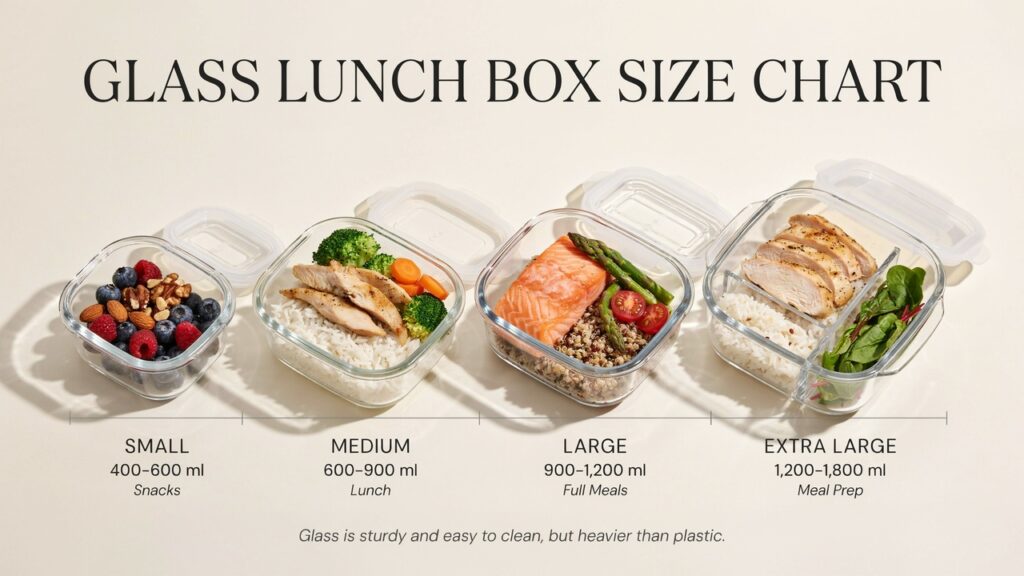
Glass containers are popular for meal preparation because they are sturdy and easy to clean.
| Glass Box Size | Capacity | Best Use |
|---|---|---|
| Small | 400–600 ml | Snacks |
| Medium | 600–900 ml | Lunch |
| Large | 900–1,200 ml | Full meals |
| Extra Large | 1,200–1,800 ml | Meal prep |
Glass is heavier than plastic, so it may not be ideal for young children.
Insulated Lunch Box Size Chart
Insulated lunch boxes are designed to help maintain food temperature when used with appropriate cold packs or heat-retaining containers.
| Size | Capacity | Best For |
|---|---|---|
| Small | 4–6 L | One small meal |
| Medium | 6–10 L | Daily lunch |
| Large | 10–15 L | Full meal + snacks |
| Extra Large | 15 L+ | Family or extended outings |
The capacity of an insulated lunch bag is different from the capacity of an individual food container.
Lunch Box For School
For school lunches, a compact box with separate compartments is often practical.
A typical school lunch box might include:
- Main meal
- Fruit
- Vegetables
- Small snack
- Sauce or dip
A 500–900 ml box can be suitable for many children’s lunches, depending on age and appetite.
Lunch Box For Work
Adults often need a larger container than young children.
| Work Lunch Style | Suggested Capacity |
|---|---|
| Light Lunch | 500–700 ml |
| Standard Lunch | 700–1,000 ml |
| Full Lunch | 1,000–1,300 ml |
| Meal + Snacks | 1,200–1,500 ml |
A stackable design can be useful if you want to carry multiple foods separately.
Lunch Box For Meal Prep
Meal-prep containers are often larger and designed for repeated use.
| Meal Prep Size | Capacity | Best For |
|---|---|---|
| Small | 500–700 ml | Light meals |
| Standard | 700–1,000 ml | Individual lunch |
| Large | 1,000–1,300 ml | Full meal |
| Extra Large | 1,300–1,800 ml | Large meal |
Divided containers can make it easier to portion the main dish and side foods.
Lunch Box Portion Examples
Small Lunch Box
A small box might contain:
Main: Small sandwich
Side: Fruit
Snack: A few crackers
Medium Lunch Box
A medium box could hold:
Main: Rice or pasta
Protein: Chicken or egg
Vegetables: Cucumber or carrots
Fruit: Berries
Large Lunch Box
A large box may accommodate:
Main: Rice, pasta, or noodles
Protein: Chicken, fish, meat, tofu, or beans
Vegetables: Multiple servings
Fruit: One serving
Snack: Nuts or yogurt
The exact amount should match the individual’s appetite rather than the container’s maximum capacity.
Lunch Box Compartment Size Chart
| Compartment Size | Approx. Volume | Good For |
|---|---|---|
| Tiny | 50–100 ml | Sauce |
| Small | 100–200 ml | Nuts, fruit |
| Medium | 200–350 ml | Vegetables |
| Large | 350–600 ml | Main dish |
| Extra Large | 600 ml+ | Main meal |
A container’s total capacity may be divided unevenly between compartments.
Lunch Box For Rice
Rice is a common packed lunch food and benefits from a container with enough depth.
| Rice Meal Size | Suggested Container |
|---|---|
| Small | 500–700 ml |
| Standard | 700–1,000 ml |
| Large | 1,000–1,300 ml |
| Extra Large | 1,300 ml+ |
If rice is packed with curry, vegetables, or protein, additional capacity may be needed.
Lunch Box For Sandwiches
| Sandwich Size | Suggested Box |
|---|---|
| Half Sandwich | Small |
| Standard Sandwich | Small–Medium |
| Large Sandwich | Medium |
| Sandwich + Sides | Medium–Large |
A rectangular lunch box is often convenient for sandwiches because it accommodates the shape efficiently.
Lunch Box For Salads
Salads usually require more volume than their weight might suggest because leafy vegetables are bulky.
| Salad Size | Suggested Capacity |
|---|---|
| Small | 500–700 ml |
| Standard | 700–1,000 ml |
| Large | 1,000–1,500 ml |
| Meal Salad | 1,200–1,800 ml |
Keeping dressing separate can help prevent leafy ingredients from becoming soggy.
Lunch Box For Snacks
| Snack Type | Suggested Capacity |
|---|---|
| Fruit | 300–500 ml |
| Nuts | 200–300 ml |
| Crackers | 300–500 ml |
| Mixed Snacks | 500–700 ml |
| Multiple Snacks | 700–1,000 ml |
Small containers are useful when you only need to carry a snack rather than a complete meal.
Lunch Box Weight Chart
The weight of an empty lunch box varies according to material and design.
| Material | General Weight |
|---|---|
| Lightweight Plastic | Very Light |
| Standard Plastic | Light |
| Silicone | Light |
| Stainless Steel | Moderate |
| Glass | Heavy |
| Insulated Container | Moderate–Heavy |
For children, a lightweight container can make a noticeable difference when carrying a backpack.
Lunch Box Size Vs Portability
| Size | Portability | Best Use |
|---|---|---|
| Mini | Excellent | Snacks |
| Small | Excellent | Kids |
| Medium | Very Good | Daily lunch |
| Large | Good | Full meals |
| Extra Large | Moderate | Meal prep |
The largest container isn’t always the most practical choice.
Lunch Box Leak-Proof Chart
| Design | Leak Protection |
|---|---|
| Simple Lid | Low–Moderate |
| Snap-Lock Lid | Moderate–High |
| Silicone Seal | High |
| Locking Lid + Seal | Very High |
| Separate Sauce Container | High for liquids |
If packing soups, curries, sauces, or dressings, choose a container specifically designed for liquids.
Lunch Box Temperature Guide
A lunch box itself does not necessarily keep food hot or cold. Temperature retention depends on insulation and the use of suitable containers or cold packs.
| Lunch Box Type | Temperature Retention |
|---|---|
| Basic Plastic Box | Low |
| Stainless Steel Box | Low–Moderate |
| Insulated Lunch Bag | Moderate |
| Insulated Food Jar | High |
| Insulated Bento System | Moderate–High |
For food safety, perishable foods should be kept at appropriate temperatures rather than relying solely on the lunch box.
Common Mistakes When Choosing Lunch Box Size
Buying too small: The container may not fit a complete meal.
Buying too large: Extra space can make the box bulky.
Ignoring compartments: A large total capacity may still have sections that are too small for your foods.
Forgetting bag dimensions: The lunch box should fit comfortably inside the lunch bag or backpack.
Choosing heavy materials for children: Glass can be difficult for young children to carry.
Not considering liquids: Soups and sauces require reliable leak protection.
Tips For Choosing The Right Lunch Box
Think about the meal first: Choose the container around the foods you actually pack.
Check the capacity: 700–1,000 ml is a practical range for many standard lunches.
Measure your lunch bag: Make sure the box fits inside comfortably.
Choose compartments when useful: Dividers help separate foods.
Consider weight: Lightweight boxes are convenient for school and travel.
Check the seal: If you pack liquid foods, leak resistance is important.
Look at cleaning requirements: Removable seals and simple designs are usually easier to clean.
Lunch Box Cleaning Chart
| Material | Cleaning |
|---|---|
| Plastic | Hand or dishwasher depending on product |
| Stainless Steel | Usually easy to wash |
| Glass | Easy to clean |
| Silicone | Flexible & easy to clean |
| Insulated Fabric | Often requires spot cleaning |
Always follow the manufacturer’s care instructions.
Lunch Box Storage Chart
When not in use, keep the box clean and completely dry.
Plastic: Store with the lid slightly open if moisture remains.
Stainless steel: Dry thoroughly to reduce water spots.
Glass: Handle carefully and avoid sudden temperature changes.
Silicone: Make sure it is completely dry before storing.
Removable seals: Remove and clean them regularly to prevent trapped food residue.
The History Behind Lunch Boxes
Lunch boxes have evolved from simple food containers into highly specialized products designed for school, work, travel, and meal preparation. Traditional food-carrying containers have existed in many cultures for centuries, while modern lunch boxes introduced lightweight plastics, stainless steel, insulated materials, and compartmentalized designs.
Today, lunch boxes range from simple single-compartment containers to sophisticated bento systems with multiple sections.
Frequently Asked Questions
What Is A Standard Lunch Box Size?
A common everyday lunch box has a capacity of around 700–1,000 ml, although smaller and larger options are widely available.
What Size Lunch Box Is Best For Kids?
A 400–700 ml lunch box is often suitable for younger children, while older children may prefer something closer to 600–900 ml.
What Size Lunch Box Is Best For Adults?
For many adults, 700–1,500 ml provides a useful range depending on meal size and whether snacks are included.
Is A 1-Liter Lunch Box Big Enough?
A 1-liter lunch box can hold a standard individual lunch for many people, especially when the meal includes a main dish and a few sides.
What Size Lunch Box Is Best For Meal Prep?
Containers around 700–1,300 ml are commonly practical for individual meal preparation, while larger containers can be useful for bigger portions.
Are Bento Boxes Better Than Regular Lunch Boxes?
Bento boxes can be useful when you want to separate different foods into compartments. A simple single-compartment box may be better for foods that are meant to stay together.
What Is The Best Lunch Box Material?
There is no single best material. Plastic is lightweight, stainless steel is durable, glass is easy to clean, and insulated designs are useful for temperature retention.
Can I Put Hot Food In A Lunch Box?
It depends on the material and manufacturer’s instructions. Some containers are designed for hot foods, while others may not be suitable for high temperatures.
What Size Lunch Box Fits A Sandwich?
A small or medium rectangular lunch box is often enough for a standard sandwich, with a larger size needed if you want to add fruit, snacks, or other sides.
What Size Lunch Box Is Best For Rice?
For a rice-based meal, 700–1,000 ml is a practical starting range for many standard portions, with more capacity needed for larger meals and multiple side dishes.
How Do I Stop My Lunch Box From Leaking?
Choose a container with a tight-fitting lid, silicone seal, or locking mechanism, especially when packing liquids such as soup, curry, or dressing.
The right lunch box is ultimately about capacity, portion size, compartments, portability, and the type of food you carry. A small box can be perfect for snacks, while a medium or large container is more suitable for complete school, work, or meal-prep lunches. Understanding the lunch box size chart helps you choose a container that fits your meals without taking up unnecessary space.
