
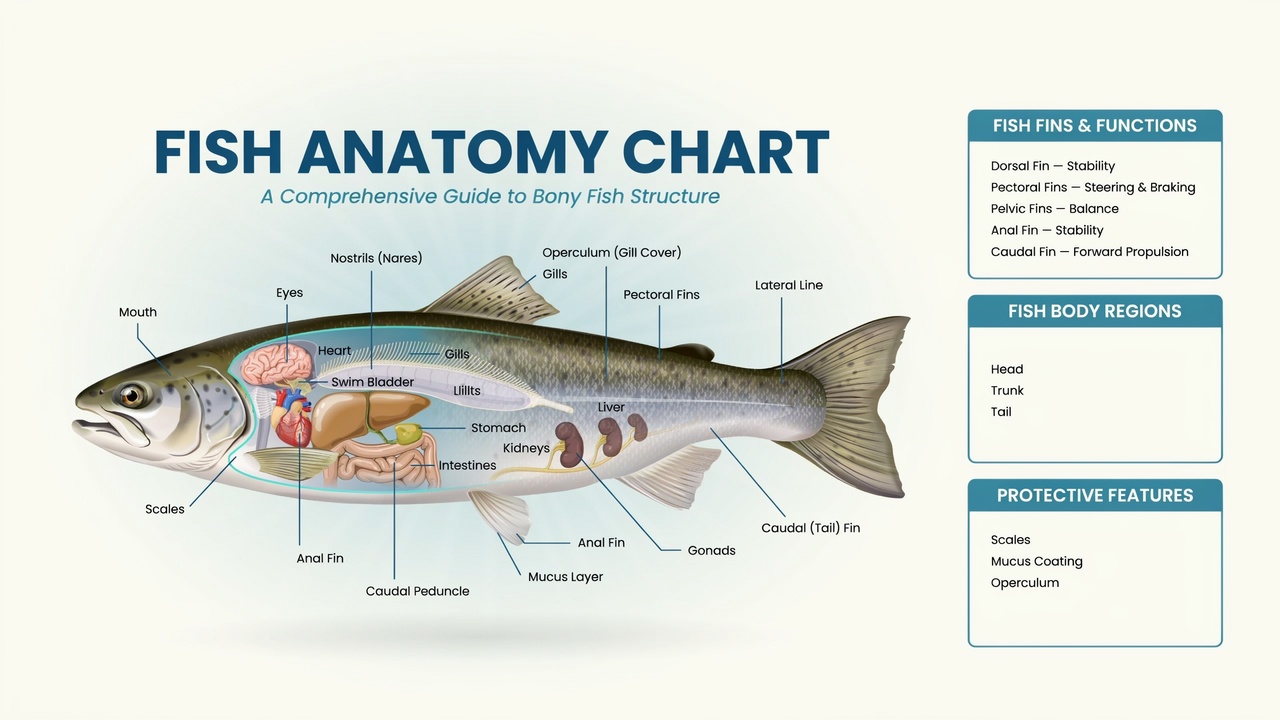
A fish anatomy chart illustrates the major external and internal structures of a fish, helping explain how fish swim, breathe, feed, sense their environment, and survive. Although anatomy varies among species, most bony fish share the same basic body plan, including fins, gills, scales, a lateral line, and internal organs such as the heart and swim bladder.
This guide is useful for students, anglers, aquarists, marine biology enthusiasts, and anyone learning about fish.
Why Learn Fish Anatomy?
Understanding fish anatomy helps you:
- Identify fish species
- Understand swimming and movement
- Learn how fish breathe underwater
- Recognize important internal organs
- Improve fishing and aquarium knowledge
External Fish Anatomy Chart
| Body Part | Location | Primary Function |
|---|---|---|
| Mouth | Front of head | Captures food and takes in water |
| Nostrils (Nares) | Above the mouth | Detects odors (not used for breathing) |
| Eyes | Sides of the head | Vision and detecting movement |
| Operculum (Gill Cover) | Behind the head | Protects the gills and pumps water over them |
| Gills | Under the operculum | Extract oxygen from water |
| Lateral Line | Along both sides | Detects vibrations and water movement |
| Dorsal Fin | Top of the back | Provides stability and prevents rolling |
| Pectoral Fins | Behind the gills | Steering, braking, and maneuvering |
| Pelvic Fins | Underside | Balance and positioning |
| Anal Fin | Bottom near the tail | Stabilizes the body while swimming |
| Caudal Peduncle | Narrow area before the tail | Transfers muscle power to the tail |
| Caudal (Tail) Fin | End of the body | Main source of forward propulsion |
| Scales | Cover the body | Protection and reduced drag |
| Mucus Layer | Covers the scales | Protects against parasites and reduces friction |
Fish Fins and Their Functions
| Fin | Function |
|---|---|
| Dorsal Fin | Prevents rolling and keeps the fish stable |
| Pectoral Fins | Steering, stopping, hovering, and turning |
| Pelvic Fins | Balance and directional control |
| Anal Fin | Adds stability during swimming |
| Caudal (Tail) Fin | Generates forward thrust |
Different species have different tail shapes depending on how they swim.
Internal Fish Anatomy
| Organ | Main Function |
|---|---|
| Brain | Controls body functions and behavior |
| Heart | Pumps blood throughout the body |
| Gills | Exchange oxygen and carbon dioxide |
| Swim Bladder* | Controls buoyancy (*present in most bony fish) |
| Liver | Stores nutrients and supports metabolism |
| Stomach | Begins digestion |
| Intestines | Absorb nutrients |
| Kidneys | Filter waste and regulate body fluids |
| Gonads | Produce eggs or sperm |
Fish Sensory System
| Organ | Purpose |
|---|---|
| Eyes | Detect light, color, and movement |
| Nostrils | Sense chemicals in the water |
| Lateral Line | Detect water pressure and nearby movement |
| Taste Buds | Help locate food |
The lateral line is one of the most unique sensory systems in fish, allowing them to detect predators, prey, and obstacles even in cloudy water.
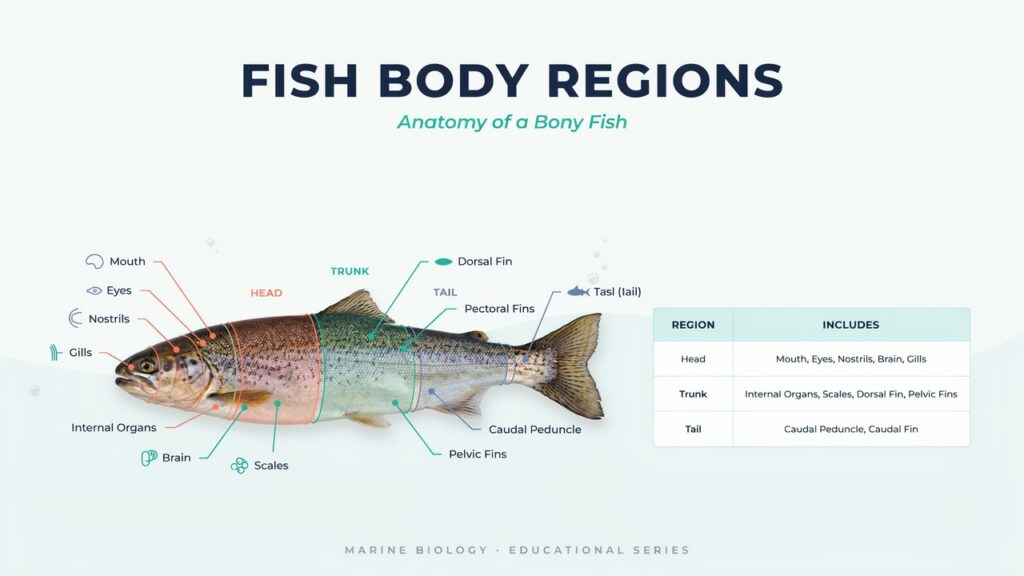
Fish Body Regions
| Region | Includes |
|---|---|
| Head | Mouth, eyes, nostrils, brain, gills |
| Trunk | Internal organs, scales, dorsal and pelvic fins |
| Tail | Caudal peduncle and caudal fin |
Fish Protective Features
| Structure | Function |
|---|---|
| Scales | Protect against injury |
| Mucus Coating | Reduces friction and helps prevent infection |
| Operculum | Shields delicate gill tissue |
Tips for Identifying Fish Anatomy
- The operculum is the hard plate covering the gills.
- The lateral line appears as a faint line running along each side of the fish.
- The caudal fin is the main propulsive fin.
- Most bony fish have paired pectoral and pelvic fins plus unpaired dorsal, anal, and caudal fins.
- Sharks have a similar body plan but do not have an operculum or swim bladder.
Frequently Asked Questions
What is the lateral line?
The lateral line is a sensory organ that detects water movement, pressure changes, and nearby objects.
What does the operculum do?
The operculum protects the gills and helps move water across them for breathing.
Which fin moves a fish forward?
The caudal (tail) fin provides most of the forward thrust during swimming.
Do all fish have a swim bladder?
No. Most bony fish have a swim bladder, while sharks and rays rely on other methods to maintain buoyancy.
What protects a fish from injury?
Fish are protected by scales coated with a slippery mucus layer, which also helps reduce drag and defend against infections.
Conclusion
A fish anatomy chart is an excellent reference for understanding how fish function and survive in aquatic environments. Key structures—including the gills, operculum, fins, scales, lateral line, swim bladder, and tail fin—work together to support breathing, movement, balance, protection, and sensing the surrounding water. Learning these anatomical features makes it easier to identify fish species and understand their adaptations.
