
Chocolate comes in many forms, and the percentage printed on the package can tell you a lot about what is inside. But does 70% chocolate mean it is 70% cocoa? How does 85% compare with 50%? And which percentage is best for baking, desserts, drinks, or eating on its own? Understanding the chocolate percentage chart makes it easier to compare chocolate varieties and choose the right cocoa percentage for every recipe.
Why Chocolate Percentage Matters
The percentage on a chocolate package generally refers to the proportion of cocoa-derived ingredients in the chocolate, including cocoa solids and cocoa butter. The remaining portion can include sugar and other ingredients.
As the cocoa percentage increases, chocolate usually becomes less sweet and more intense. However, percentage alone does not determine quality or flavor. Cocoa origin, roasting, processing, sugar type, and recipe formulation also affect the final taste.
For bakers and dessert makers, knowing the cocoa percentage is especially useful because different chocolates can produce noticeably different flavors and textures.
Standard Chocolate Percentage Chart
Chocolate percentages commonly range from around 30% to more than 90%.
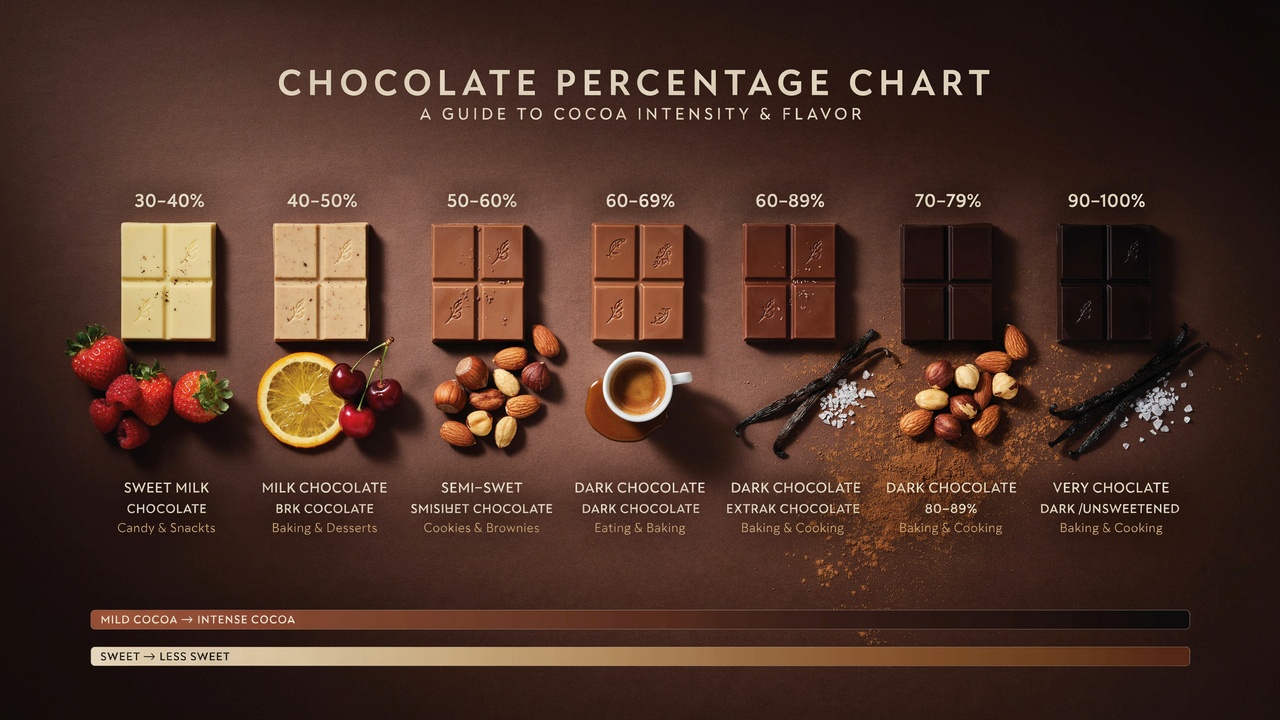
Chocolate Percentage Chart
| Chocolate Percentage | Chocolate Type | Sweetness | Flavor Profile | Best Uses |
|---|---|---|---|---|
| 30–40% | Sweet Milk Chocolate | Very sweet | Creamy, milky | Candy, snacks |
| 40–50% | Milk Chocolate | Sweet | Mild cocoa, creamy | Baking, desserts |
| 50–60% | Semi-Sweet Chocolate | Moderately sweet | Balanced cocoa | Cookies, brownies |
| 60–69% | Dark Chocolate | Mildly sweet | Rich cocoa | Baking, desserts |
| 70–79% | Dark Chocolate | Slightly sweet | Deep cocoa | Eating, baking |
| 80–89% | Extra Dark Chocolate | Low sweetness | Intense, bitter | Eating, sauces |
| 90–100% | Very Dark/Unsweetened | Very low sweetness | Strong, bitter | Baking, cooking |
The exact sweetness and flavor can vary significantly between brands and recipes.
What Does Chocolate Percentage Mean?
If a chocolate bar says 70% cocoa, the percentage generally indicates that 70% of the chocolate consists of cocoa-derived ingredients.
The remaining portion is primarily made up of sugar and other ingredients, depending on the product.
For example, a 70% dark chocolate will generally contain considerably less sugar than a 50% chocolate, although the exact amount depends on the manufacturer.
This is why chocolate percentage is a useful quick reference when comparing different products.
Choosing The Right Chocolate Percentage
The best percentage depends on what you are making.
30–40%: Best for people who prefer very sweet, creamy chocolate.
40–50%: A mild option that works well in milk chocolate desserts and sweet baked goods.
50–60%: A balanced choice for cookies, brownies, cakes, and general baking.
60–69%: Provides a richer cocoa flavor without becoming extremely bitter.
70–79%: Excellent for dark chocolate desserts and eating when you want a stronger cocoa flavor.
80–89%: Suitable for people who prefer intense, less-sweet chocolate.
90–100%: Extremely intense and bitter, generally used in small amounts for baking, sauces, or recipes where sugar is added separately.
Milk Chocolate Vs Dark Chocolate
The biggest difference between milk and dark chocolate is generally the proportion of cocoa ingredients and the presence of milk ingredients.
| Feature | Milk Chocolate | Dark Chocolate |
|---|---|---|
| Cocoa Percentage | Usually lower | Usually higher |
| Milk Ingredients | Common | Usually little or none |
| Sweetness | Higher | Lower |
| Cocoa Flavor | Mild | Stronger |
| Bitterness | Low | Moderate to high |
| Texture | Creamy | Firm & rich |
| Best Uses | Candy, desserts | Baking & eating |
There is no universal percentage that separates milk and dark chocolate in every labeling system, so product definitions can vary by region.
Chocolate Percentage And Sweetness
As a general rule, higher cocoa percentages mean less room for sugar in the formulation.
Sweetness Chart
| Cocoa Percentage | General Sweetness |
|---|---|
| 30–40% | Very Sweet |
| 40–50% | Sweet |
| 50–60% | Moderately Sweet |
| 60–69% | Mildly Sweet |
| 70–79% | Slightly Sweet |
| 80–89% | Low Sweetness |
| 90–100% | Very Low Sweetness |
This is a general guide rather than an exact measurement because different brands can use different amounts and types of sugar.
Chocolate Percentage And Bitterness
Higher cocoa percentages often produce a stronger and more bitter cocoa taste.
| Percentage | Typical Bitterness |
|---|---|
| 30–40% | Very Low |
| 40–50% | Low |
| 50–60% | Mild |
| 60–69% | Moderate |
| 70–79% | Moderate-High |
| 80–89% | High |
| 90–100% | Very High |
Bitterness is also influenced by cocoa bean variety, roasting, fermentation, and processing.
Chocolate Percentage For Baking
Different recipes benefit from different cocoa percentages.
Baking Chocolate Chart
| Recipe | Recommended Chocolate | Why |
|---|---|---|
| Chocolate Chip Cookies | 50–70% | Balanced sweetness |
| Brownies | 60–75% | Rich cocoa flavor |
| Chocolate Cake | 50–70% | Strong but balanced |
| Chocolate Ganache | 55–70% | Smooth & rich |
| Chocolate Mousse | 60–70% | Deep chocolate flavor |
| Hot Chocolate | 50–70% | Rich but drinkable |
| Chocolate Sauce | 50–70% | Balanced sweetness |
| Truffles | 60–75% | Intense cocoa flavor |
| Chocolate Tart | 60–75% | Rich & sophisticated |
| Baking With Added Sugar | 70–100% | Allows sweetness to be controlled |
The best choice depends on the recipe’s sugar, butter, cream, and other ingredients.
Chocolate Percentage For Eating
If you’re eating chocolate on its own, your preferred percentage mostly depends on how sweet and intense you like your chocolate.
Milk Chocolate: Best for a creamy, sweet experience.
50–60%: Good for people transitioning from milk chocolate to darker varieties.
60–69%: Balanced and moderately intense.
70–79%: Rich and cocoa-forward while retaining some sweetness.
80–89%: Strong and less sweet.
90–100%: Extremely intense and bitter, generally preferred by people who enjoy very dark chocolate.
Chocolate Percentage And Texture
Cocoa percentage can influence texture, but the exact texture also depends on cocoa butter, sugar, milk ingredients, and manufacturing.
| Chocolate Type | Typical Texture |
|---|---|
| Milk Chocolate | Creamy & smooth |
| 50–60% Dark | Smooth & firm |
| 60–70% Dark | Firm & rich |
| 70–80% Dark | Dense & crisp |
| 80–90% Dark | Firm & intense |
| 90–100% | Very firm or brittle |
Chocolate stored at the correct temperature should generally have a smooth appearance and clean snap.
Chocolate Percentage And Cocoa Solids
Chocolate labels can mention both cocoa percentage and cocoa solids. These terms are related but should not always be treated as identical.
Cocoa-derived ingredients can include cocoa mass, cocoa liquor, cocoa powder, and cocoa butter. The exact formulation depends on the product.
This is why checking the ingredient list alongside the percentage can provide a clearer picture of the chocolate.
Dark Chocolate Percentage Chart
Dark chocolate is commonly available in a wide range of cocoa percentages.
| Dark Chocolate | Flavor | Sweetness | Best Use |
|---|---|---|---|
| 50–59% | Mild cocoa | Moderate | Cookies & cakes |
| 60–69% | Rich cocoa | Moderate-low | Baking & desserts |
| 70–79% | Deep cocoa | Low | Eating & baking |
| 80–89% | Intense cocoa | Very low | Eating & sauces |
| 90–99% | Very intense | Minimal | Baking & cooking |
| 100% | Pure cocoa intensity | None from added sugar | Baking & cooking |
Higher-percentage chocolate is often easier to balance in recipes that already contain plenty of sugar.
Chocolate Percentage For Desserts
Desserts often combine chocolate with sugar, dairy, fruit, nuts, or other ingredients.
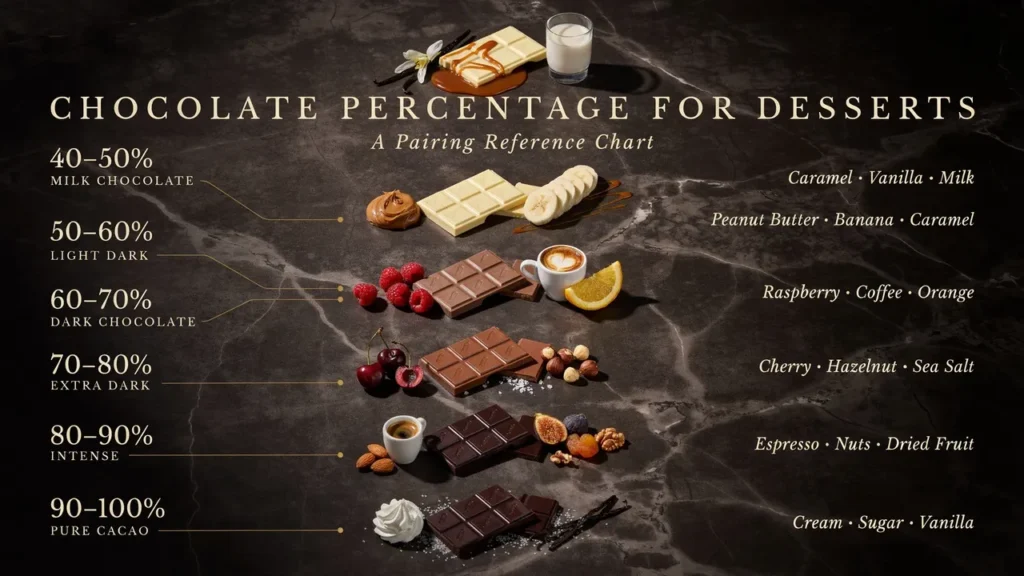
Dessert Pairing Chart
| Chocolate Percentage | Best Dessert Pairings |
|---|---|
| 40–50% | Caramel, vanilla, milk |
| 50–60% | Peanut butter, banana, caramel |
| 60–70% | Raspberry, coffee, orange |
| 70–80% | Cherry, hazelnut, sea salt |
| 80–90% | Espresso, nuts, dried fruit |
| 90–100% | Cream, sugar, vanilla |
Fruit can provide acidity and sweetness that balance stronger dark chocolate.
Chocolate Percentage And Coffee Pairings
Chocolate and coffee are natural partners, but different percentages create different results.
| Chocolate | Coffee Pairing |
|---|---|
| Milk Chocolate | Light & medium roast |
| 50–60% Dark | Medium roast |
| 60–70% Dark | Medium-dark roast |
| 70–80% Dark | Dark roast, espresso |
| 80–90% Dark | Strong espresso |
| 90–100% | Intense espresso-based desserts |
The goal is usually to balance the bitterness and intensity of both ingredients.
Chocolate Percentage And Fruit Pairings
Fruit can provide sweetness and acidity that complement cocoa.
| Chocolate Percentage | Fruit Pairings |
|---|---|
| 40–50% | Banana, strawberry |
| 50–60% | Cherry, raspberry |
| 60–70% | Orange, raspberry, strawberry |
| 70–80% | Cherry, orange, blackberry |
| 80–90% | Dried cherry, orange, fig |
| 90–100% | Dates, dried fruit |
Dark chocolate and orange are especially popular because the bright citrus flavor contrasts with the deep cocoa flavor.
Chocolate Percentage And Nuts
Nuts provide crunch and richness that can balance chocolate.
| Chocolate Percentage | Nut Pairings |
|---|---|
| 40–50% | Peanut, almond |
| 50–60% | Peanut, pecan |
| 60–70% | Hazelnut, almond |
| 70–80% | Hazelnut, pistachio |
| 80–90% | Walnut, hazelnut |
| 90–100% | Almond, pistachio |
Roasted nuts can add additional depth and aroma.
Chocolate Percentage And Sugar
The higher the cocoa percentage, the less room there generally is for sugar and other non-cocoa ingredients.
For this reason, replacing a 50% chocolate with an 85% chocolate in a recipe can noticeably change the final result.
Chocolate And Sugar Comparison
| Chocolate | General Sugar Level | Flavor |
|---|---|---|
| 40% | High | Sweet & creamy |
| 50% | Moderate-high | Balanced |
| 60% | Moderate | Rich |
| 70% | Lower | Cocoa-forward |
| 80% | Low | Intense |
| 90% | Very low | Bitter |
| 100% | No added sugar in pure unsweetened chocolate | Extremely intense |
Actual sugar content varies by brand and recipe, so nutrition labels should be checked when precise information is important.
How To Choose Chocolate For A Recipe
Check the recipe first: Some recipes specify a particular cocoa percentage.
Consider sweetness: If the recipe already contains a lot of sugar, a higher-percentage chocolate may work better.
Think about intensity: Use darker chocolate when you want a stronger cocoa flavor.
Don’t replace percentages blindly: Changing from 55% to 90% can significantly affect sweetness and flavor.
Taste the chocolate: Different brands with the same percentage can taste surprisingly different.
Common Mistakes When Choosing Chocolate Percentage
Assuming higher percentage always means better quality: Cocoa percentage does not automatically determine quality.
Ignoring the recipe’s sugar level: Very dark chocolate can make a dessert less sweet than intended.
Using 100% chocolate like regular eating chocolate: Unsweetened chocolate is extremely intense and is generally better suited to recipes.
Assuming all 70% chocolates taste the same: Cocoa origin and processing can produce major flavor differences.
Confusing cocoa percentage with cocoa powder percentage: These are different product measurements.
Ignoring the ingredient list: Percentage alone doesn’t tell you everything about the chocolate.
Chocolate Percentage For Different Occasions
| Occasion | Recommended Chocolate |
|---|---|
| Kids’ Snacks | 30–50% |
| Everyday Eating | 50–70% |
| Baking Cookies | 50–70% |
| Brownies | 60–75% |
| Chocolate Cake | 50–70% |
| Gourmet Desserts | 65–80% |
| Strong Dark Chocolate | 80–90% |
| Baking With Added Sugar | 70–100% |
These are general recommendations, and personal preference always matters.
The History Behind Chocolate Percentages
Modern chocolate labeling makes it easier for consumers to compare products based on cocoa content. As dark chocolate became more popular, manufacturers increasingly began highlighting percentages such as 60%, 70%, 85%, and 90%.
Today, cocoa percentages are commonly used as a quick way to communicate the approximate proportion of cocoa-derived ingredients in a chocolate product.
However, chocolate quality is influenced by many other factors, including cocoa bean origin, fermentation, roasting, grinding, conching, cocoa butter content, and the balance of sugar and other ingredients.
Frequently Asked Questions
What Does 70% Chocolate Mean?
70% chocolate generally means that approximately 70% of the product consists of cocoa-derived ingredients, with the remaining portion primarily consisting of sugar and other ingredients.
Is 70% Chocolate Bitter?
70% chocolate usually has a noticeably stronger cocoa flavor and less sweetness than milk chocolate, but the bitterness varies by brand and cocoa origin.
What Percentage Is Milk Chocolate?
Milk chocolate generally contains a lower percentage of cocoa ingredients than dark chocolate, although exact requirements and labeling definitions vary by region.
What Percentage Is Dark Chocolate?
Dark chocolate is commonly available from around 50% cocoa and upward, with many products sold in the 60–90% range. Exact classifications can vary.
Is 85% Chocolate Very Bitter?
85% chocolate is generally quite intense and much less sweet than 50–60% chocolate. It is often preferred by people who enjoy strong cocoa flavors.
What Is 100% Chocolate?
100% chocolate is essentially unsweetened chocolate made from cocoa-derived ingredients. It has an extremely intense cocoa flavor and is generally used for cooking or baking rather than eating like a sweet chocolate bar.
What Chocolate Percentage Is Best For Baking?
Around 50–70% works well for many cookies, cakes, brownies, and desserts. Higher percentages can also work when the recipe contains enough sugar to balance the stronger cocoa flavor.
What Chocolate Percentage Is Best For Eating?
For many people, 60–70% offers a useful balance between sweetness and cocoa intensity. Those who prefer stronger chocolate may enjoy 80% or higher.
Does Higher Cocoa Percentage Mean Healthier Chocolate?
A higher cocoa percentage generally means less room for added sugar, but percentage alone does not determine whether a chocolate product is appropriate for a particular diet. The full nutrition and ingredient labels provide more useful information.
Chocolate percentage is a simple number, but it can tell you a lot about the character of a chocolate. From sweet 30–50% chocolate to balanced 60–70% dark chocolate and intensely bitter 80–100% chocolate, each range has its own flavor, sweetness, and ideal uses. Understanding the chocolate percentage chart makes it easier to select the right chocolate for baking, desserts, drinks, pairing, or simply enjoying a piece on its own.
