
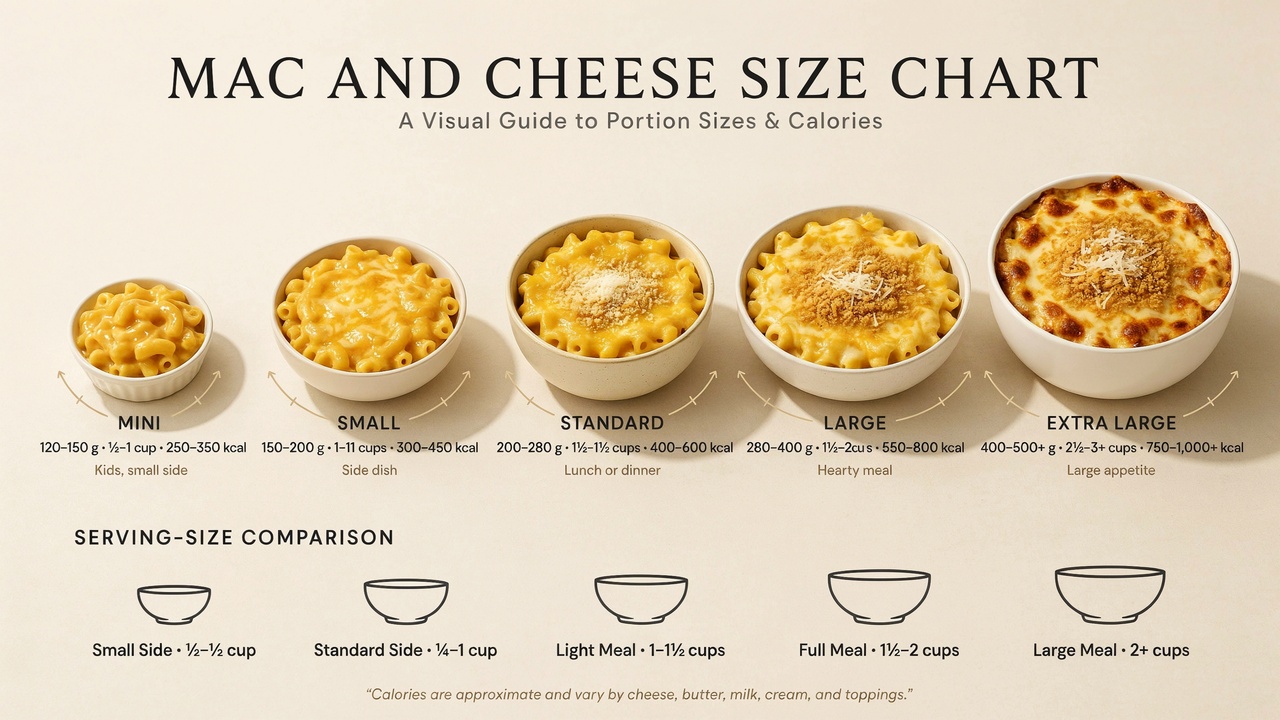
Mac and cheese is one of the most comforting and versatile pasta dishes, combining macaroni with a creamy cheese sauce. It can be served as a small side dish, a standard lunch, a hearty dinner, or a large family-style casserole. Understanding the mac and cheese size chart helps you compare portions, serving sizes, bowl capacity, calories, pasta amounts, and the right amount of cheese sauce for different occasions.
Why Mac and Cheese Size Matters
The size of a mac and cheese serving affects how filling the meal is and how much pasta, cheese, and sauce you need. A small portion works well as a side dish, while a larger serving can become a complete meal when paired with chicken, vegetables, or other ingredients.
Size is also important when preparing mac and cheese for parties or family gatherings. Knowing how much cooked pasta and cheese sauce you need helps prevent making too little—or ending up with a large amount of leftovers.
Standard Mac and Cheese Size Chart
| Mac and Cheese Size | Approx. Weight | Bowl Capacity | Calories* | Best For |
|---|---|---|---|---|
| Mini | 120–150 g | ¾–1 cup | 250–350 | Kids, small side |
| Small | 150–200 g | 1–1¼ cups | 300–450 | Side dish |
| Standard | 200–280 g | 1¼–1¾ cups | 400–600 | Lunch or dinner |
| Large | 280–400 g | 1¾–2½ cups | 550–800 | Hearty meal |
| Extra Large | 400–500+ g | 2½–3+ cups | 750–1,000+ | Large appetite |
*Approximate values for traditional mac and cheese. Actual calories vary according to pasta, cheese, butter, milk, cream, and toppings.
Mac and Cheese Serving Size Chart
| Serving Type | Approx. Amount | Best Use |
|---|---|---|
| Small Side | ½–¾ cup | With meat or vegetables |
| Standard Side | ¾–1 cup | Family dinner |
| Light Meal | 1–1¼ cups | Lunch |
| Full Meal | 1¼–2 cups | Dinner |
| Large Meal | 2+ cups | Large appetite |
Serving sizes can vary depending on what else is included in the meal.
Mac and Cheese Bowl Size Chart
| Bowl Size | Approx. Capacity | Best For |
|---|---|---|
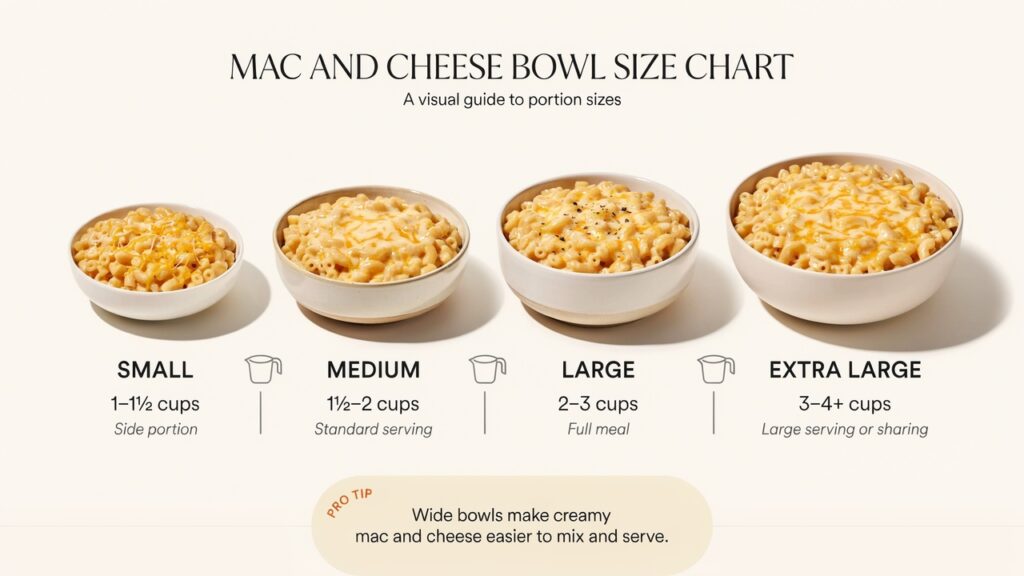
| Small | 1–1½ cups | Side portion |
| Medium | 1½–2 cups | Standard serving |
| Large | 2–3 cups | Full meal |
| Extra Large | 3–4+ cups | Large serving or sharing |
A wide bowl can make creamy mac and cheese easier to mix and serve.
Mac and Cheese Ingredient Chart
| Ingredient | Main Role |
|---|---|
| Elbow Macaroni | Pasta base |
| Cheddar Cheese | Main cheese flavor |
| Milk | Creamy sauce |
| Butter | Richness |
| Flour | Sauce thickener |
| Cream | Extra richness |
| Parmesan | Savory flavor |
| Mozzarella | Stretch & melting |
| Mustard | Flavor balance |
| Breadcrumbs | Crunchy topping |
Recipes vary widely, and different cheese combinations create different textures and flavors.
Mac and Cheese Pasta Portion Chart
The amount of dry pasta needed depends on the final serving size.
| Serving Size | Dry Pasta | Approx. Cooked Pasta |
|---|---|---|
| Small | 50–60 g | 100–130 g |
| Standard | 70–85 g | 140–180 g |
| Large | 90–110 g | 180–230 g |
| Extra Large | 120–150 g | 240–320 g |
Pasta absorbs water during cooking, so cooked weight is substantially higher than dry weight.
Mac and Cheese Cheese Amount Chart
The amount of cheese can be adjusted according to how rich and cheesy you want the dish.
| Batch Size | Approx. Cheese |
|---|---|
| 1 Small Serving | 40–60 g |
| 2–3 Servings | 100–150 g |
| 4 Servings | 180–250 g |
| 6 Servings | 250–350 g |
| 8+ Servings | 350–500+ g |
The exact amount depends on the type of cheese and the desired sauce consistency.
Mac and Cheese Cheese Type Chart
| Cheese | Flavor | Texture |
|---|---|---|
| Cheddar | Sharp & savory | Creamy |
| American Cheese | Mild & smooth | Very creamy |
| Monterey Jack | Mild & buttery | Excellent melting |
| Gruyère | Nutty & rich | Smooth |
| Gouda | Mild & slightly sweet | Creamy |
| Mozzarella | Mild | Stretchy |
| Parmesan | Salty & nutty | Finishing flavor |
| Colby | Mild & creamy | Smooth |
Blending cheeses can create a more complex flavor and smoother sauce.
Mac and Cheese Flavor Chart
| Flavor Style | Main Characteristics |
|---|---|
| Classic Cheddar | Sharp & creamy |
| Extra Cheesy | Rich & intense |
| Mild & Creamy | Smooth & gentle |
| Smoky | Smoked cheese or paprika |
| Spicy | Chili, jalapeño or hot sauce |
| Garlic Herb | Garlic & herbs |
| Bacon | Smoky & salty |
| Truffle | Earthy & aromatic |
The flavor can be customized without changing the basic pasta-and-cheese foundation.
Mac and Cheese Calories Chart
Mac and cheese can vary considerably in calories depending on the recipe.
| Portion | Approx. Calories |
|---|---|
| Small Side | 250–350 |
| Standard Side | 300–450 |
| Standard Meal | 400–600 |
| Large Meal | 550–800 |
| Extra Large | 750–1,000+ |
Cream, butter, large amounts of cheese, bacon, and breadcrumbs can increase the calorie content.
Baked Mac and Cheese Size Chart
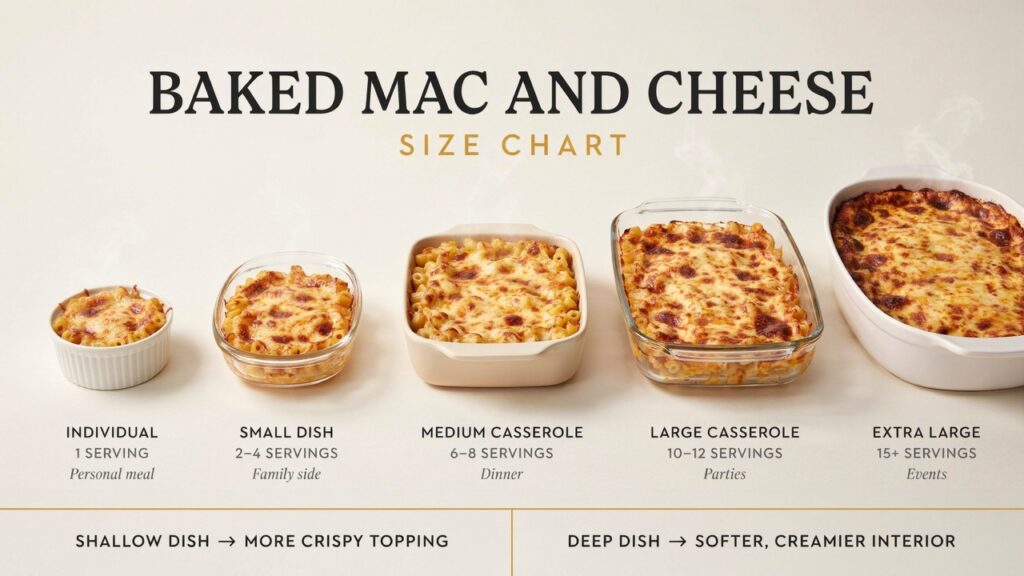
Baked mac and cheese usually has a firmer top and more concentrated texture than stovetop versions.
| Size | Approx. Serving | Best For |
|---|---|---|
| Individual | 1 serving | Personal meal |
| Small Dish | 2–4 servings | Family side |
| Medium Casserole | 6–8 servings | Dinner |
| Large Casserole | 10–12 servings | Parties |
| Extra Large | 15+ servings | Events |
A shallow baking dish generally creates more crispy topping, while a deeper dish produces a softer, creamier interior.
Mac and Cheese Baking Dish Chart
| Dish Size | Approx. Capacity | Servings |
|---|---|---|
| 1-Quart | 4 cups | 2–3 |
| 2-Quart | 8 cups | 4–6 |
| 3-Quart | 12 cups | 6–8 |
| 9 × 13 in | ~3 quarts | 8–12 |
| Large Catering Pan | Varies | 15+ |
Actual serving counts depend on portion size.
Stovetop Vs Baked Mac and Cheese
| Feature | Stovetop | Baked |
|---|---|---|
| Texture | Creamier | Firmer top |
| Preparation | Faster | Longer |
| Crust | None | Crisp topping |
| Best For | Quick meals | Family gatherings |
| Cheese Sauce | Very prominent | Absorbed into pasta |
| Topping | Optional | Common |
Both styles can be made with the same basic ingredients.
Mac and Cheese For Kids
Smaller portions can work well for children.
| Size | Approx. Serving | Use |
|---|---|---|
| Mini | ½ cup | Young children |
| Small | ¾ cup | Children |
| Standard | 1 cup | Older children |
Adding peas, broccoli, carrots, or other vegetables can increase variety.
Mac and Cheese For Adults
| Serving | Approx. Amount | Best Use |
|---|---|---|
| Side | ¾–1 cup | With protein |
| Light Meal | 1–1¼ cups | Lunch |
| Standard Meal | 1¼–1¾ cups | Dinner |
| Large | 2+ cups | Large appetite |
A protein or vegetable side can make a moderate serving more satisfying.
Mac and Cheese For Parties
For parties, mac and cheese is often served as a side dish.
| Guests | Approx. Prepared Mac and Cheese* |
|---|---|
| 4 | 4–5 cups |
| 6 | 6–7 cups |
| 10 | 10–12 cups |
| 15 | 15–18 cups |
| 20 | 20–24 cups |
| 30 | 30–36 cups |
*Assumes approximately 1 cup per guest. For buffet-style meals with several other dishes, smaller portions may be sufficient.
Mac and Cheese Topping Chart
| Topping | Texture/Flavor |
|---|---|
| Breadcrumbs | Crisp |
| Parmesan | Salty & nutty |
| Bacon | Smoky & salty |
| Jalapeños | Spicy |
| Green Onions | Fresh & sharp |
| Fried Onions | Crispy & savory |
| Pulled Pork | Rich & hearty |
| Broccoli | Fresh & savory |
| Crushed Crackers | Crunchy |
Toppings can transform a simple mac and cheese into a more substantial dish.
Mac and Cheese Protein Additions
Adding protein can turn mac and cheese into a complete meal.
| Protein | Flavor |
|---|---|
| Chicken | Mild & savory |
| Bacon | Smoky & salty |
| Ground Beef | Rich & hearty |
| Pulled Pork | Smoky & tender |
| Sausage | Spicy & savory |
| Shrimp | Mild & seafood-forward |
| Tuna | Savory |
| Beans | Mild & hearty |
The amount of added protein should be adjusted according to the serving size.
Mac and Cheese Vegetable Additions
| Vegetable | Best Character |
|---|---|
| Broccoli | Fresh & slightly bitter |
| Peas | Sweet & soft |
| Spinach | Mild & earthy |
| Cauliflower | Creamy & mild |
| Bell Peppers | Sweet & crisp |
| Jalapeños | Spicy |
| Tomatoes | Tangy & fresh |
Vegetables can add color, texture, and nutritional variety.
Mac and Cheese Side Dish Chart
Mac and cheese pairs well with both meat and vegetables.
| Main Dish | Mac and Cheese Pairing |
|---|---|
| Fried Chicken | Classic mac and cheese |
| BBQ Ribs | Baked mac and cheese |
| Grilled Chicken | Cheddar mac and cheese |
| Steak | Rich cheese mac |
| Pulled Pork | Smoked or spicy mac |
| Roasted Vegetables | Mild creamy mac |
| Burgers | Classic cheddar mac |
Because mac and cheese is rich, fresh vegetables or salads can provide a useful contrast.
Mac and Cheese Vs Pasta Bake
| Feature | Mac and Cheese | Pasta Bake |
|---|---|---|
| Main Sauce | Cheese-based | Tomato, cream, or cheese |
| Pasta | Usually Macaroni | Many shapes |
| Texture | Creamy | Firmer |
| Cheese | Main ingredient | Often topping/filling |
| Baking | Optional | Common |
| Flavor | Rich & cheesy | More varied |
Mac and cheese focuses primarily on the combination of pasta and cheese sauce.
Mac and Cheese Texture Chart
| Texture | Description |
|---|---|
| Creamy | Smooth cheese sauce |
| Gooey | Melted, stretchy cheese |
| Firm | Baked pasta structure |
| Crispy | Browned topping |
| Extra Creamy | High sauce-to-pasta ratio |
| Dense | Low sauce-to-pasta ratio |
The amount and type of cheese, milk, and cooking method all affect texture.
How To Make Creamy Mac and Cheese
A basic creamy mac and cheese follows several steps:
- Cook the macaroni until just tender.
- Prepare a cheese sauce with butter, flour, and milk or another dairy base.
- Add grated cheese gradually.
- Stir until smooth.
- Combine the sauce with the pasta.
- Serve immediately or transfer to a baking dish.
- Add breadcrumbs or extra cheese if baking.
Avoid overheating the cheese sauce because excessive heat can cause the sauce to separate.
Mac and Cheese Sauce Ratio
A balanced cheese sauce needs enough liquid to coat the pasta without becoming watery.
| Component | General Role |
|---|---|
| Milk | Main liquid |
| Butter | Richness |
| Flour | Thickening |
| Cheese | Flavor & body |
| Seasoning | Flavor balance |
The exact ratio depends on whether you prefer a thick, baked-style sauce or a loose stovetop version.
Mac and Cheese Baking Temperature
Many baked mac and cheese recipes use an oven temperature around 175–200°C (350–400°F).
The exact temperature and baking time depend on the recipe, dish depth, and whether the pasta is already hot when placed in the oven.
Mac and Cheese Baking Time Chart
| Preparation | General Time |
|---|---|
| Stovetop | 15–25 min |
| Baked From Warm | 20–30 min |
| Baked From Refrigerated | 30–45 min |
| Large Casserole | 35–50+ min |
Always check that the center is thoroughly heated before serving.
Common Mistakes When Making Mac and Cheese
Overcooking the pasta: It can become mushy after being mixed with hot sauce or baked.
Using too little sauce: The pasta may become dry.
Adding cheese over very high heat: This can cause the sauce to become greasy or grainy.
Using only one cheese: A cheese blend can provide better flavor and melting characteristics.
Overbaking: Excessive baking can dry out the dish.
Adding too many toppings: Heavy toppings can overpower the cheese sauce.
Tips For Better Mac and Cheese
Cook pasta slightly below fully tender: Especially when baking, it will continue cooking in the oven.
Grate cheese yourself: Freshly grated cheese often melts more smoothly.
Use a cheese blend: Combining sharp and mild cheeses can create a balanced flavor.
Don’t overheat the sauce: Gentle heat helps maintain a smooth texture.
Season gradually: Cheese already contains salt, so taste before adding more.
Add toppings just before baking: This helps preserve their texture.
Mac and Cheese Nutrition Chart
| Nutrient | General Character |
|---|---|
| Carbohydrates | High from pasta |
| Protein | Moderate from cheese and milk |
| Fat | Moderate–High |
| Fiber | Usually Low–Moderate |
| Calcium | Often High |
| Sodium | Can be High |
| Calories | Increase with cheese and butter |
Using whole-grain pasta, vegetables, or lean protein can change the nutritional profile.
Healthier Mac and Cheese Options
| Change | Potential Benefit |
|---|---|
| Whole-Grain Pasta | More fiber |
| Reduced-Fat Cheese | Less fat |
| More Vegetables | More fiber & micronutrients |
| Greek Yogurt | Creaminess & protein |
| Lean Chicken | More protein |
| Less Butter | Lower fat |
| Smaller Portion | Lower calorie intake |
The overall nutritional value depends on the complete recipe and serving size.
Mac and Cheese Storage Chart
| Storage Method | General Guidance |
|---|---|
| Room Temperature | Avoid prolonged storage |
| Refrigerator | Store in a covered container |
| Freezer | Suitable for longer storage |
| Airtight Container | Helps prevent drying |
Perishable leftovers should be refrigerated promptly and reheated thoroughly.
How To Reheat Mac and Cheese
Stovetop: Add a small amount of milk and heat gently while stirring.
Oven: Cover with foil to prevent drying.
Microwave: Heat in short intervals and stir between intervals.
Air fryer: Useful for restoring crisp toppings on baked mac and cheese.
Adding a little milk before reheating can help restore creaminess.
The History Behind Mac and Cheese
Macaroni combined with cheese has a long history in European cooking, while the modern American-style version became especially popular as a convenient comfort food. Over time, mac and cheese evolved into countless regional and family variations.
Today, it ranges from simple stovetop macaroni with cheddar to elaborate baked casseroles featuring multiple cheeses, meats, vegetables, spices, and crunchy toppings.
Frequently Asked Questions
What Is A Standard Serving Of Mac And Cheese?
A typical serving can be around 1 cup, although a side portion may be closer to ½–¾ cup and a large meal portion can exceed 1½ cups.
How Many Calories Are In Mac And Cheese?
A serving can contain approximately 250–800+ calories, depending on portion size, cheese, butter, cream, and toppings.
How Much Dry Pasta Do I Need For One Serving?
Around 70–85 grams of dry pasta can produce a standard meal-sized portion once cooked, although recipes vary.
What Is The Best Cheese For Mac And Cheese?
Cheddar is one of the most popular choices. Monterey Jack, Gruyère, Gouda, American cheese, and Parmesan can also be combined for different flavors and textures.
How Much Cheese Should I Use For Mac And Cheese?
A standard serving might use around 40–60 grams of cheese, while larger batches can require several hundred grams depending on how cheesy you want the dish.
Is Baked Mac And Cheese Better Than Stovetop?
Neither is universally better. Stovetop mac and cheese is usually creamier, while baked mac and cheese develops a firmer texture and crispy top.
What Size Baking Dish Is Best For Mac And Cheese?
A 2-quart dish can work well for a small family batch, while a 9 × 13-inch dish is convenient for larger gatherings.
How Much Mac And Cheese Should I Make For A Party?
For a buffet with several other dishes, around ½–1 cup per guest is a useful planning range. If mac and cheese is the main side, plan toward the larger end.
Can Mac And Cheese Be Frozen?
Yes. Mac and cheese can be frozen, although creamy sauces may change texture slightly after thawing and reheating.
How Do I Keep Mac And Cheese Creamy?
Use enough sauce, avoid overheating the cheese, and don’t overbake it. When reheating, adding a small amount of milk can help restore moisture.
Can I Add Chicken To Mac And Cheese?
Yes. Chicken, bacon, shrimp, sausage, beans, and other proteins can turn mac and cheese into a more substantial meal.
Mac and cheese can be anything from a small side dish to a large family-style meal, and the right portion depends on the occasion, appetite, and toppings. Understanding the mac and cheese size chart helps you plan pasta quantities, cheese amounts, bowl sizes, calories, serving portions, and casserole sizes for everyday meals, family dinners, parties, or special gatherings.
