
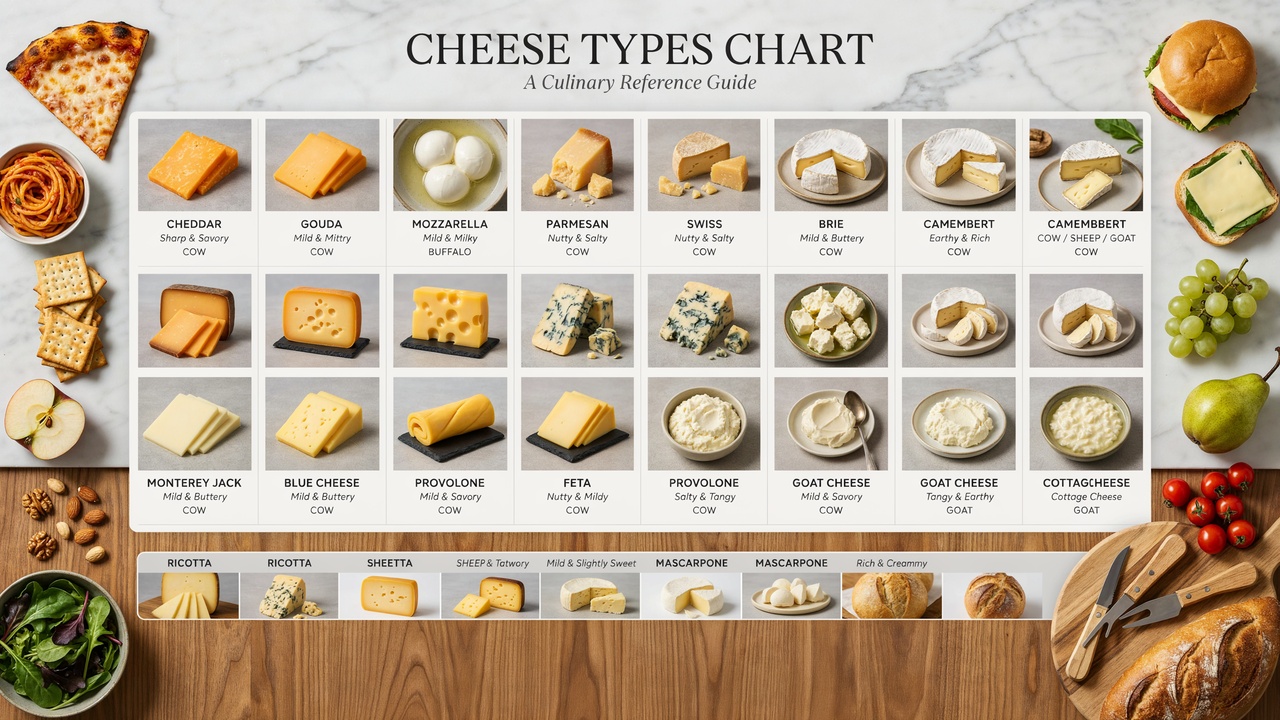
Cheese comes in countless varieties, from soft and creamy Brie to firm and salty Parmesan. Different cheeses can vary greatly in flavor, texture, aging time, milk type, and melting ability. Understanding the cheese types chart makes it easier to compare popular cheeses and choose the right one for sandwiches, pasta, pizza, salads, snacks, cheese boards, and cooking.
Why Cheese Types Matter
Cheese is made from milk and can be transformed through different cultures, aging methods, moisture levels, and production techniques. These differences create cheeses ranging from fresh and mild to aged, sharp, crumbly, and intensely flavored.
Soft cheeses are often creamy and spreadable, while hard cheeses tend to have stronger flavors and firmer textures. Some cheeses melt beautifully, while others are better suited to salads or cheese boards.
Standard Cheese Types Chart
There are many types of cheese, but several varieties are especially popular around the world.
Cheese Types Chart
| Cheese | Texture | Flavor Profile | Milk Type | Best Uses |
|---|---|---|---|---|
| Cheddar | Firm | Sharp & savory | Cow | Burgers, sandwiches |
| Mozzarella | Soft & stretchy | Mild & milky | Cow/Buffalo | Pizza, pasta |
| Parmesan | Hard & crumbly | Nutty & salty | Cow | Pasta, soups |
| Brie | Soft & creamy | Mild & buttery | Cow | Cheese boards |
| Camembert | Soft & creamy | Earthy & rich | Cow | Cheese boards |
| Gouda | Semi-firm | Mild & nutty | Cow | Sandwiches, snacks |
| Swiss | Firm | Nutty & mild | Cow | Sandwiches |
| Blue Cheese | Soft/crumbly | Strong & tangy | Cow/Sheep/Goat | Salads, sauces |
| Feta | Crumbly | Salty & tangy | Sheep/Goat | Salads |
| Goat Cheese | Soft | Tangy & earthy | Goat | Salads, spreads |
| Monterey Jack | Semi-soft | Mild & buttery | Cow | Melting, nachos |
| Provolone | Semi-firm | Mild & savory | Cow | Sandwiches |
| Ricotta | Soft & creamy | Mild & slightly sweet | Cow/Sheep | Pasta, desserts |
| Mascarpone | Very soft | Rich & creamy | Cow | Desserts |
| Cottage Cheese | Soft & lumpy | Mild & fresh | Cow | Breakfast, salads |
The exact flavor and texture can vary depending on the producer and aging process.
Choosing The Right Cheese
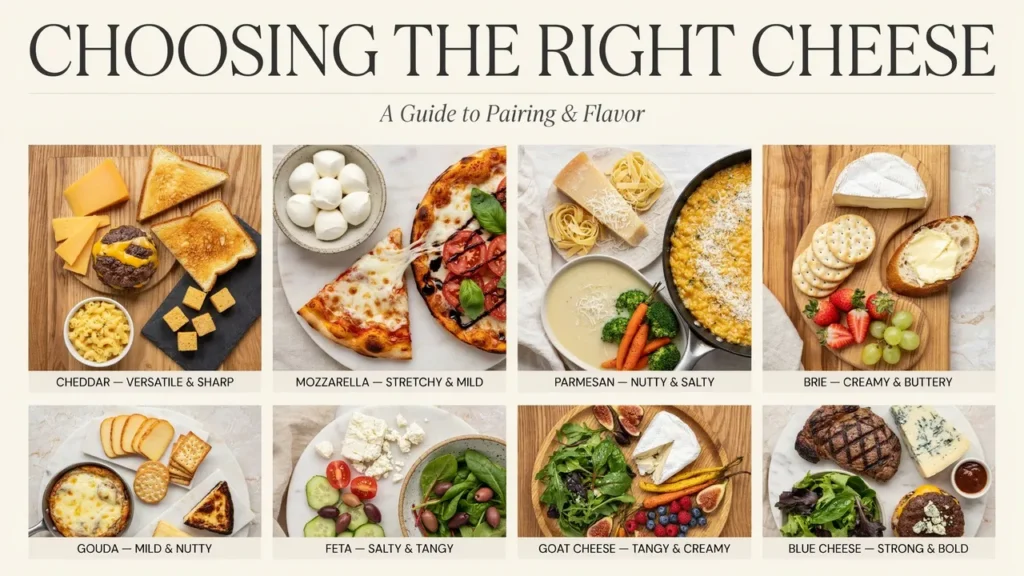
The best cheese depends on how you plan to use it.
Cheddar: A versatile option for sandwiches, burgers, macaroni and cheese, and snacks.
Mozzarella: Excellent for pizza, baked pasta, caprese salads, and dishes where a stretchy melt is desired.
Parmesan: Ideal for grating over pasta, soups, vegetables, and risotto.
Brie: A creamy choice for cheese boards, crackers, fruit, and sandwiches.
Gouda: Mild and nutty, making it suitable for snacking and melting.
Feta: Salty and tangy, especially good with tomatoes, cucumbers, olives, and salads.
Goat Cheese: Tangy and creamy, working particularly well with salads, roasted vegetables, and fruit.
Blue Cheese: Strong and bold, making it a good choice for steak, salads, burgers, and rich sauces.
Cheese By Texture Chart
Texture is one of the easiest ways to categorize cheese.
| Cheese Texture | Examples | Characteristics |
|---|---|---|
| Fresh | Ricotta, cottage cheese | Soft & moist |
| Soft | Brie, Camembert | Creamy & spreadable |
| Semi-Soft | Havarti, Monterey Jack | Smooth & flexible |
| Semi-Firm | Gouda, Provolone | Firm but sliceable |
| Firm | Cheddar, Swiss | Dense & sliceable |
| Hard | Parmesan, Pecorino | Firm & grateable |
| Crumbly | Feta, some blue cheeses | Breaks apart easily |
| Stretchy | Mozzarella | Elastic & melty |
Texture can change as cheese ages, with many varieties becoming firmer and more concentrated over time.
Fresh Cheese Chart
Fresh cheeses are generally not aged for long periods.
| Cheese | Texture | Flavor | Common Uses |
|---|---|---|---|
| Ricotta | Soft & creamy | Mild | Lasagna, desserts |
| Cottage Cheese | Soft & lumpy | Mild | Breakfast, salads |
| Mascarpone | Rich & creamy | Mild & sweet | Tiramisu |
| Cream Cheese | Smooth & creamy | Tangy | Bagels, desserts |
| Fresh Mozzarella | Soft & moist | Milky | Caprese, pizza |
| Burrata | Creamy center | Rich & milky | Salads, appetizers |
| Fresh Goat Cheese | Soft | Tangy | Salads, spreads |
Fresh cheeses are often more delicate than aged varieties and are usually best consumed relatively soon after production.
Soft Cheese Chart
Soft cheeses have higher moisture levels and are often creamy or spreadable.
| Cheese | Flavor | Texture | Best Pairings |
|---|---|---|---|
| Brie | Mild & buttery | Creamy | Apple, crackers |
| Camembert | Earthy & rich | Creamy | Pear, bread |
| Goat Cheese | Tangy | Soft | Honey, berries |
| Boursin | Herby & creamy | Spreadable | Crackers, vegetables |
| Taleggio | Savory & earthy | Soft | Bread, fruit |
Soft cheeses are excellent additions to appetizer boards and sandwiches.
Semi-Soft Cheese Chart
Semi-soft cheeses are firmer than Brie but softer than many aged cheeses.
| Cheese | Flavor | Best Uses |
|---|---|---|
| Havarti | Mild & buttery | Sandwiches |
| Monterey Jack | Mild & creamy | Nachos, burgers |
| Fontina | Nutty & rich | Pizza, sauces |
| Muenster | Mild & savory | Sandwiches |
| Taleggio | Rich & earthy | Melting, cheese boards |
Many semi-soft cheeses melt smoothly, making them useful for cooking.
Firm And Hard Cheese Chart
Firm and hard cheeses are often aged longer, resulting in concentrated flavors.
| Cheese | Texture | Flavor | Best Uses |
|---|---|---|---|
| Cheddar | Firm | Sharp & savory | Burgers, sauces |
| Gouda | Firm | Nutty & slightly sweet | Snacking |
| Swiss | Firm | Nutty & mild | Sandwiches |
| Parmesan | Hard | Salty & nutty | Pasta |
| Pecorino Romano | Hard | Salty & sharp | Pasta |
| Asiago | Firm-hard | Nutty & savory | Pasta, salads |
| Manchego | Firm | Nutty & buttery | Cheese boards |
Hard cheeses are often grated or shaved over dishes.
Cheese By Flavor
Different cheeses can be grouped by their main flavor characteristics.
| Flavor Profile | Popular Cheeses |
|---|---|
| Mild | Mozzarella, Monterey Jack |
| Creamy | Brie, Mascarpone |
| Nutty | Parmesan, Gouda, Swiss |
| Sharp | Aged Cheddar, Pecorino |
| Salty | Feta, Parmesan |
| Tangy | Goat Cheese, Cream Cheese |
| Smoky | Smoked Gouda, Smoked Cheddar |
| Earthy | Camembert, Taleggio |
| Sweet | Young Gouda, Mascarpone |
| Strong | Blue Cheese, Aged Cheeses |
A cheese’s flavor can become stronger and more complex as it ages.
Cheese Melting Chart
Not every cheese melts in the same way.
| Cheese | Melting Ability | Best Uses |
|---|---|---|
| Mozzarella | Excellent | Pizza |
| Cheddar | Excellent | Burgers, sauces |
| Monterey Jack | Excellent | Nachos |
| Provolone | Excellent | Sandwiches |
| Gouda | Very Good | Grilled cheese |
| Fontina | Excellent | Pasta, sauces |
| Swiss | Very Good | Sandwiches |
| Brie | Good | Baked cheese |
| Feta | Limited | Salads |
| Goat Cheese | Limited | Spreads, toppings |
| Parmesan | Melts/gratins well | Pasta, casseroles |
| Ricotta | Does not melt like stretchy cheese | Lasagna |
Cheeses with good melting characteristics are especially useful for pizza, grilled sandwiches, casseroles, and sauces.
Best Cheese For Pizza
Pizza usually benefits from cheeses that melt smoothly and provide good stretch.
| Cheese | Pizza Use | Result |
|---|---|---|
| Mozzarella | Classic topping | Stretchy & mild |
| Provolone | Blend | Savory & smooth |
| Parmesan | Finishing | Salty & nutty |
| Fontina | Specialty pizza | Rich & creamy |
| Cheddar | Specialty pizzas | Sharp & savory |
| Gouda | Specialty pizzas | Nutty & rich |
Mozzarella remains one of the most common choices because of its mild flavor and excellent melting properties.
Best Cheese For Burgers
Cheese can add creaminess and flavor to burgers.
| Cheese | Burger Style | Flavor |
|---|---|---|
| Cheddar | Classic burger | Sharp |
| American | Classic cheeseburger | Mild & creamy |
| Swiss | Mushroom burger | Nutty |
| Pepper Jack | Spicy burger | Spicy & creamy |
| Blue Cheese | Gourmet burger | Strong & tangy |
| Gouda | Premium burger | Nutty & rich |
| Provolone | Italian-style burger | Mild & savory |
Cheese Pairing With Fruits
Fruit can balance the richness and saltiness of cheese.
| Cheese | Best Fruits |
|---|---|
| Brie | Apple, pear, grapes |
| Cheddar | Apple, pear |
| Goat Cheese | Strawberry, fig, pear |
| Blue Cheese | Pear, apple, grapes |
| Gouda | Apple, grapes |
| Parmesan | Pear, fig |
| Feta | Watermelon, grapes |
| Mascarpone | Berries, peach |
Sweet fruit can create a pleasant contrast with salty or tangy cheeses.
Cheese Pairing With Nuts
Nuts add crunch and complement the richness of cheese.
| Cheese | Best Nuts |
|---|---|
| Brie | Almonds, walnuts |
| Cheddar | Pecans, almonds |
| Goat Cheese | Walnuts, pistachios |
| Blue Cheese | Walnuts, pecans |
| Gouda | Hazelnuts, almonds |
| Parmesan | Almonds, walnuts |
| Feta | Pistachios, almonds |
| Mascarpone | Hazelnuts, pistachios |
Cheese Pairing With Meats
Cheese and meat are classic combinations in sandwiches, appetizers, and main dishes.
| Meat | Best Cheese |
|---|---|
| Beef | Cheddar, Swiss, blue cheese |
| Chicken | Mozzarella, provolone, cheddar |
| Turkey | Swiss, cheddar, Gouda |
| Ham | Swiss, cheddar, Gruyère |
| Bacon | Cheddar, blue cheese, Gouda |
| Salami | Provolone, mozzarella |
| Prosciutto | Mozzarella, Parmesan |
| Steak | Blue cheese, provolone |
The best combination depends on whether you want mild, sharp, creamy, or bold flavors.
Cheese Board Chart
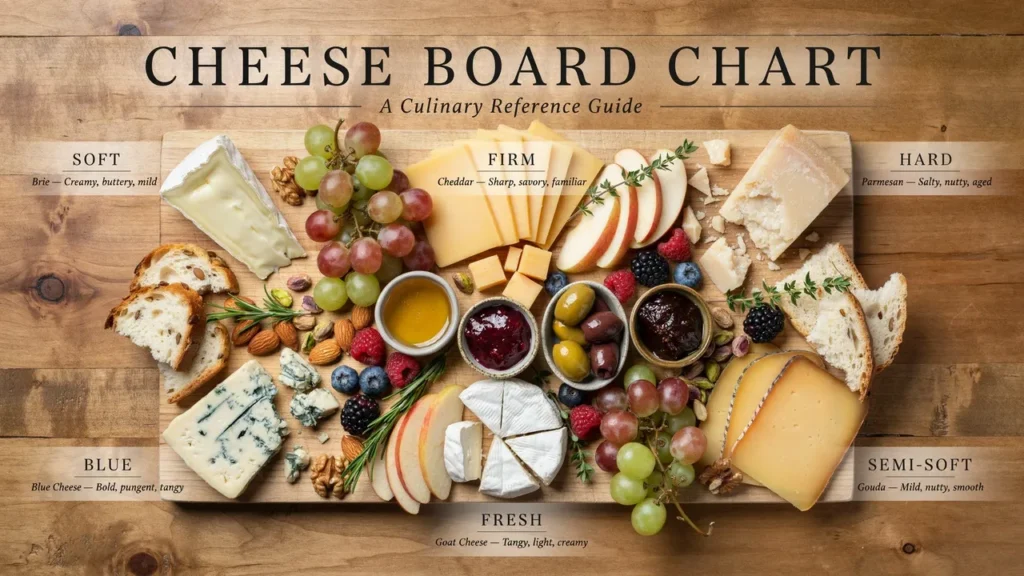
A good cheese board usually benefits from variety.
| Cheese Type | Example | Purpose |
|---|---|---|
| Soft | Brie | Creamy texture |
| Firm | Cheddar | Familiar flavor |
| Hard | Parmesan | Salty & nutty |
| Blue | Blue Cheese | Strong flavor |
| Fresh | Goat Cheese | Tangy & light |
| Semi-Soft | Gouda | Mild & nutty |
Add fruit, nuts, crackers, bread, olives, and spreads to create different flavor and texture combinations.
Cheese And Wine Pairing Chart
Different cheeses can complement different wine styles.
| Cheese | General Wine Pairing |
|---|---|
| Brie | Sparkling or light white wine |
| Cheddar | Medium/full-bodied red |
| Gouda | White or red wine |
| Blue Cheese | Sweet dessert wine |
| Goat Cheese | Crisp white wine |
| Parmesan | Red or full-bodied white |
| Feta | Crisp white wine |
| Mozzarella | Light white wine |
The best pairing depends on the specific cheese, wine, and personal preference.
Cheese For Pasta
Cheese plays an important role in many pasta dishes.
| Cheese | Pasta Use |
|---|---|
| Parmesan | Grated topping |
| Pecorino Romano | Carbonara-style dishes |
| Ricotta | Lasagna, stuffed pasta |
| Mozzarella | Baked pasta |
| Mascarpone | Creamy sauces |
| Fontina | Rich sauces |
| Goat Cheese | Creamy pasta |
| Gorgonzola | Strong cheese sauces |
Hard cheeses are often grated, while soft cheeses can be incorporated into sauces or fillings.
Cheese For Salads
Cheese can add protein, creaminess, saltiness, and richness to salads.
| Cheese | Best Salad Pairings |
|---|---|
| Feta | Tomato, cucumber, olives |
| Goat Cheese | Spinach, berries, walnuts |
| Parmesan | Caesar salad |
| Blue Cheese | Pear, apple, walnuts |
| Mozzarella | Tomato, basil |
| Cheddar | Lettuce, corn, tomato |
| Halloumi | Greens, cucumber, vegetables |
Cheese By Milk Type
Cheese can be made from several types of milk.
| Milk Type | Examples | General Characteristics |
|---|---|---|
| Cow | Cheddar, Brie, Gouda | Mild to rich |
| Goat | Goat Cheese, some Chevre | Tangy & earthy |
| Sheep | Pecorino, Manchego | Rich & nutty |
| Buffalo | Buffalo Mozzarella | Creamy & rich |
Milk type is one factor that contributes to a cheese’s flavor and texture.
Cheese Aging Chart
Aging can dramatically change cheese characteristics.
| Aging Level | Texture | Flavor |
|---|---|---|
| Fresh | Soft & moist | Mild |
| Young | Soft to firm | Mild & milky |
| Medium-Aged | Firm | Rich & nutty |
| Aged | Firm/hard | Strong & complex |
| Very Aged | Hard & crumbly | Intense & savory |
As many cheeses age, moisture decreases and flavors become more concentrated.
Tips For Choosing Cheese
Consider the recipe: Use melting cheeses for pizza and sauces and firm cheeses for grating.
Balance flavors: Pair salty cheese with sweet fruit or rich cheese with acidic ingredients.
Think about texture: A cheese board is more interesting when it includes soft, firm, and crumbly varieties.
Use strong cheese carefully: Blue cheese and aged cheeses can dominate delicate ingredients.
Try combinations: Mixing mozzarella with Parmesan can provide both stretch and savory flavor.
Serve at an appropriate temperature: Many cheeses show more aroma and flavor when not served straight from the refrigerator.
Common Mistakes When Choosing Cheese
Using the wrong melting cheese: Some crumbly cheeses do not melt into a smooth sauce.
Overusing strong cheese: A small amount of blue cheese or aged cheese can go a long way.
Ignoring texture: A dish can become too soft if every ingredient has the same consistency.
Pairing too many salty ingredients: Feta, Parmesan, olives, and cured meats together can become very salty.
Storing cheese incorrectly: Poor storage can affect texture, aroma, and freshness.
Assuming all cheeses taste the same: Even cheeses in the same category can vary significantly between producers.
How To Store Different Cheeses
Different cheese types have different storage needs.
Soft cheeses: Keep refrigerated and use relatively quickly.
Fresh cheeses: Usually have shorter storage lives and should be kept well chilled.
Firm cheeses: Wrap properly and refrigerate to help prevent drying.
Hard cheeses: Can generally keep longer when stored correctly.
Blue cheeses: Store separately when possible because their strong aromas can transfer to other foods.
Always follow the storage instructions provided on the package.
The History Behind Cheese Types
Cheese has been produced for thousands of years, with evidence of early cheesemaking dating back to ancient civilizations. Different regions developed their own cheese-making traditions based on local milk sources, climate, cultures, and preservation techniques.
Over time, cheesemakers developed countless varieties ranging from fresh cheeses to highly aged and fermented styles.
Today, cheeses from Europe, the Middle East, Asia, and the Americas are enjoyed around the world, and modern cheesemaking continues to create new varieties and flavor combinations.
Frequently Asked Questions
What Are The Main Types Of Cheese?
Cheese can be grouped into categories such as fresh, soft, semi-soft, semi-firm, firm, hard, and blue cheeses.
What Is The Most Popular Cheese?
Popular varieties include Cheddar, Mozzarella, Parmesan, American cheese, Gouda, Swiss, and Brie, although popularity varies by country.
What Cheese Melts Best?
Mozzarella, Cheddar, Monterey Jack, Provolone, and Fontina are excellent melting cheeses.
What Is The Best Cheese For Pizza?
Mozzarella is a classic choice because it melts smoothly and provides excellent stretch. Parmesan, Provolone, and other cheeses can be added for extra flavor.
What Is The Best Cheese For Burgers?
Cheddar, American, Swiss, Pepper Jack, Gouda, and Provolone are all popular choices for burgers.
What Is The Difference Between Hard And Soft Cheese?
Soft cheeses generally contain more moisture and have a softer, creamier texture, while hard cheeses are typically firmer, often more aged, and more concentrated in flavor.
What Cheese Is Best For Salads?
Feta, goat cheese, Parmesan, blue cheese, and mozzarella are popular salad choices.
What Cheese Is Best For A Cheese Board?
A balanced cheese board can include a combination of Brie, Cheddar, Gouda, Parmesan, goat cheese, and blue cheese to provide different textures and flavors.
Which Cheese Has The Strongest Flavor?
Blue cheeses and highly aged cheeses can have particularly strong, complex flavors, although intensity varies significantly between individual cheeses.
What Is The Creamiest Cheese?
Mascarpone, cream cheese, Brie, and some fresh goat cheeses are known for creamy textures, while the exact consistency varies by product.
Cheese offers an incredible range of flavors, textures, and uses. From soft Brie and creamy Mozzarella to sharp Cheddar, nutty Gouda, crumbly Feta, and intense blue cheese, every type brings something different to the table. Understanding the cheese types chart makes it easier to choose the right cheese for cooking, melting, snacking, salads, sandwiches, pasta, desserts, and beautifully balanced cheese boards.
