
Olive oil is one of the most versatile cooking oils in the world. But the different labels on olive oil bottles can make choosing the right one confusing. Extra virgin, virgin, refined, light, and cold-extracted olive oils can differ in flavor, processing, acidity, and ideal cooking applications. Understanding the olive oil comparison chart makes it easier to select the right oil for salads, dipping, sautéing, roasting, baking, and everyday cooking.
Why Olive Oil Type Matters
Olive oil is not a single product. The way olives are processed can affect the oil’s flavor, aroma, color, and nutritional characteristics.
Extra virgin olive oil is generally the least processed edible grade and is valued for its fresh, fruity, bitter, and peppery characteristics. Refined olive oils have a milder flavor and are often chosen when a neutral-tasting cooking oil is preferred.
The right choice depends on whether you want to taste the olive oil itself or simply use it as a cooking fat.
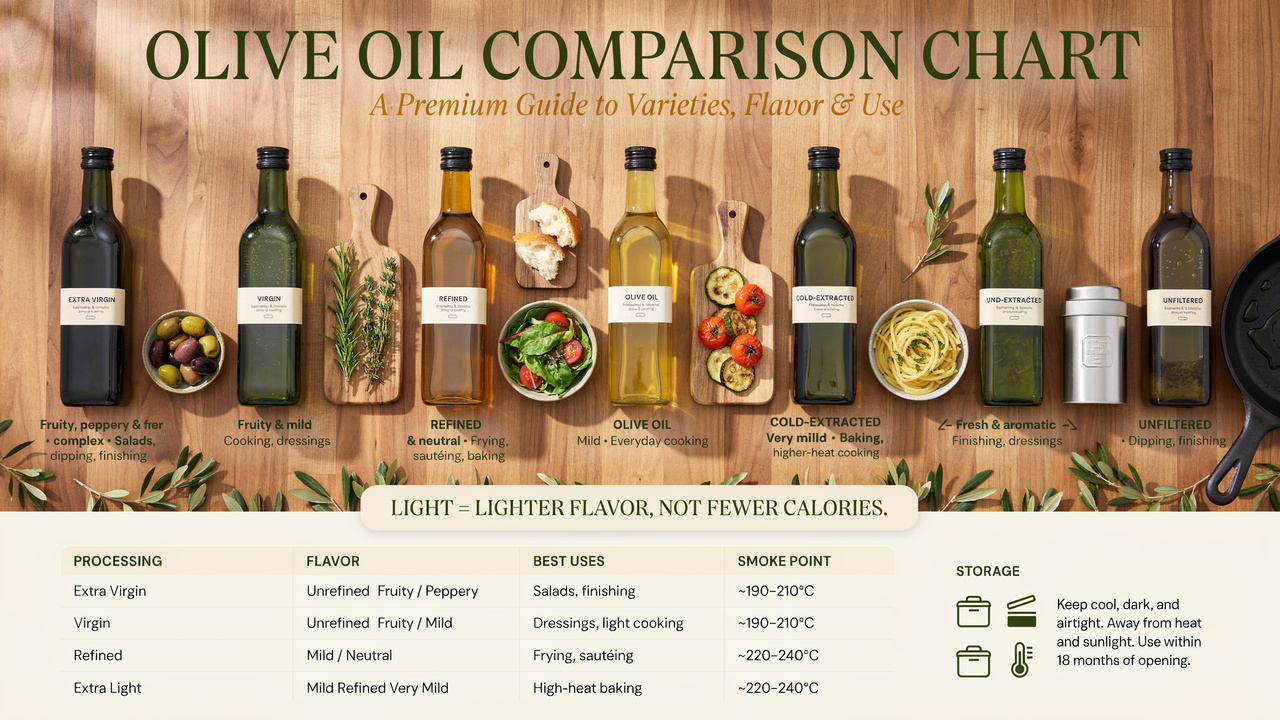
Standard Olive Oil Comparison Chart
| Olive Oil Type | Processing | Flavor | Best Uses |
|---|---|---|---|
| Extra Virgin Olive Oil | Mechanical extraction, no refining | Fruity, peppery & complex | Salads, dipping, finishing |
| Virgin Olive Oil | Mechanical extraction | Fruity & mild | Cooking, dressings |
| Refined Olive Oil | Refined | Mild & neutral | Frying, sautéing, baking |
| Olive Oil | Usually refined olive oil blended with virgin oil | Mild | Everyday cooking |
| Extra Light Olive Oil | Highly refined | Very mild | Baking, high-heat cooking |
| Cold-Extracted Olive Oil | Mechanical extraction at controlled temperatures | Fresh & aromatic | Finishing, dressings |
| Unfiltered Olive Oil | Minimal filtration | Robust & fresh | Dipping, finishing |
The exact terminology and labeling requirements can vary by country.
Extra Virgin Vs Virgin Vs Refined Olive Oil
| Feature | Extra Virgin | Virgin | Refined |
|---|---|---|---|
| Refining | No | No | Yes |
| Flavor | Stronger | Moderate | Mild |
| Aroma | Fruity | Fruity | Subtle |
| Acidity Limit | ≤0.8% free acidity | ≤2.0% free acidity | Higher/regulated differently |
| Best For | Dressings & finishing | Cooking & dressings | High-heat cooking |
| Price | Usually Higher | Moderate | Usually Lower |
Acidity is only one quality measure and does not by itself determine whether an olive oil tastes good.
Olive Oil Flavor Chart
Different olive oils can have noticeably different flavor profiles.
| Flavor Profile | Characteristics | Best Pairing |
|---|---|---|
| Mild | Soft & delicate | Fish, baking |
| Fruity | Fresh olive & fruit notes | Salads |
| Peppery | Spicy finish | Bread, vegetables |
| Bitter | Green & intense | Hearty dishes |
| Herbaceous | Fresh, grassy notes | Salads, pesto |
| Buttery | Smooth & rounded | Pasta, vegetables |
| Robust | Strong & complex | Grilled meats |
Flavor depends on olive variety, harvest time, origin, processing, and storage.
Olive Oil Color Chart
Color can range from green to golden yellow.
| Color | Common Impression |
|---|---|
| Bright Green | Often associated with early-harvest oils |
| Green-Gold | Fruity & balanced |
| Golden | Often associated with riper olives |
| Pale Yellow | Usually mild-looking |
Color is not a reliable indicator of olive oil quality. Professional tasting is often performed in colored glasses specifically to prevent color from influencing evaluation.
Olive Oil Smoke Point Chart
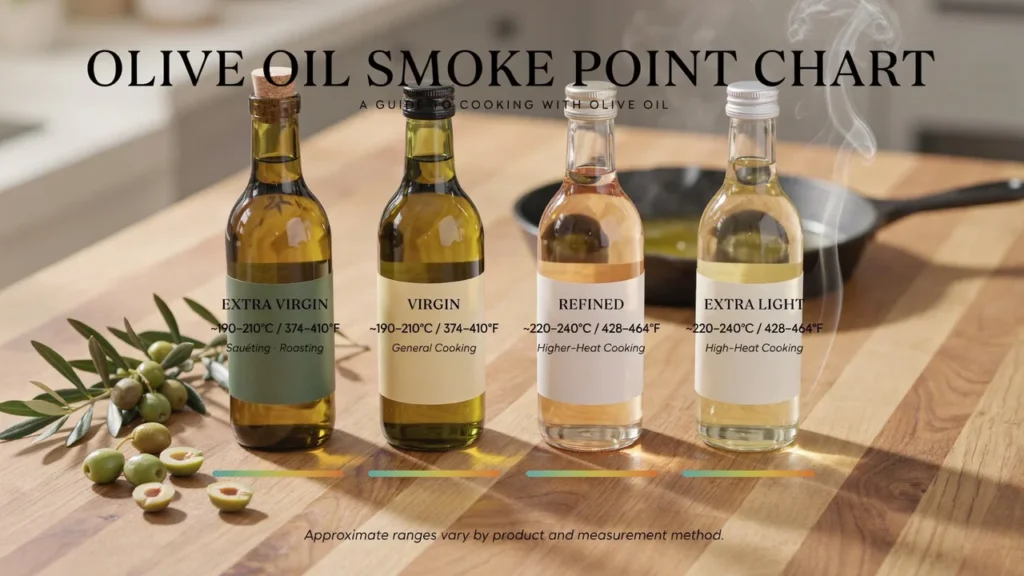
Smoke point varies depending on the oil’s quality, refinement, free fatty acids, and other factors.
| Olive Oil Type | Approx. Smoke Point* | Cooking Use |
|---|---|---|
| Extra Virgin Olive Oil | ~190–210°C / 374–410°F | Sautéing, roasting |
| Virgin Olive Oil | ~190–210°C / 374–410°F | General cooking |
| Refined Olive Oil | ~220–240°C / 428–464°F | Higher-heat cooking |
| Extra Light Olive Oil | ~220–240°C / 428–464°F | High-heat cooking |
*Approximate ranges vary by product and measurement method. Smoke point should not be treated as a precise universal number.
Modern cooking research generally supports using extra virgin olive oil for many everyday cooking methods, provided the oil is not overheated to the point of smoking.
Olive Oil Cooking Chart
| Cooking Method | Recommended Olive Oil |
|---|---|
| Salad Dressing | Extra Virgin |
| Bread Dipping | Extra Virgin |
| Drizzling | Extra Virgin |
| Sautéing | Extra Virgin or Refined |
| Roasting | Extra Virgin |
| Grilling | Extra Virgin or Refined |
| Baking | Extra Virgin or Mild Olive Oil |
| Pan Frying | Extra Virgin or Refined |
| Higher-Heat Cooking | Refined Olive Oil |
For dishes where olive oil is a major flavor component, extra virgin olive oil is usually the preferred choice.
Olive Oil For Salads
Extra virgin olive oil is especially useful for salad dressings because its flavor remains noticeable.
| Salad Type | Suggested Olive Oil |
|---|---|
| Green Salad | Mild or fruity extra virgin |
| Greek Salad | Robust extra virgin |
| Tomato Salad | Fruity extra virgin |
| Pasta Salad | Medium-bodied extra virgin |
| Grain Salad | Robust extra virgin |
| Mediterranean Salad | Fruity extra virgin |
A good olive oil can contribute fruitiness, bitterness, and peppery notes to a simple dressing.
Olive Oil For Dipping
For dipping bread, flavor is usually more important than high-heat performance.
Extra virgin olive oil is generally the best choice because it offers a more pronounced aroma and flavor.
You can also combine it with:
- Garlic
- Black pepper
- Chili flakes
- Fresh herbs
- Balsamic vinegar
- Lemon zest
The quality of the olive oil becomes especially noticeable when it is served directly.
Olive Oil For Frying
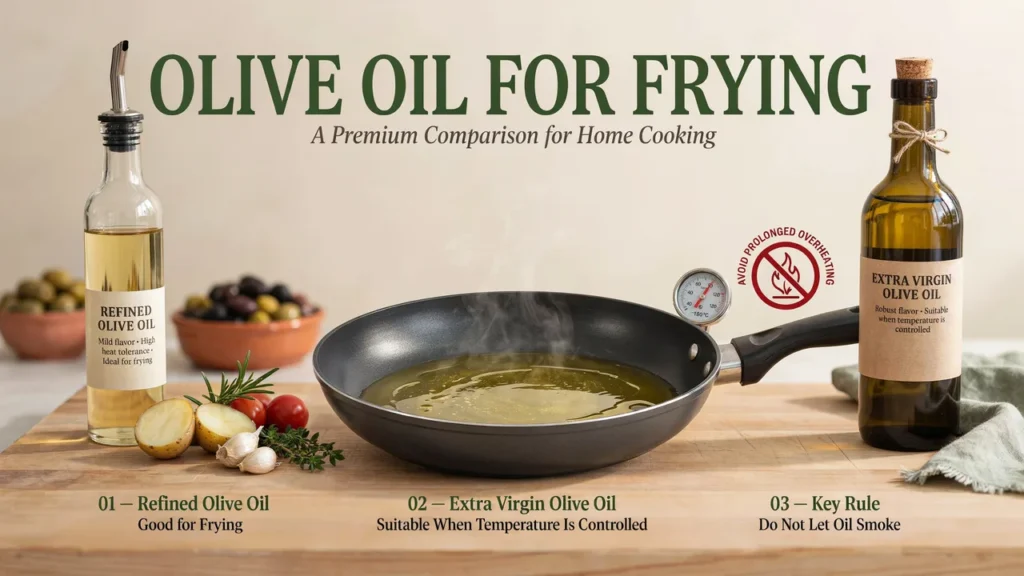
Refined olive oil is often chosen for frying because it has a mild flavor and relatively high heat tolerance.
However, extra virgin olive oil can also be used for many frying and sautéing applications when the cooking temperature is controlled and the oil is not allowed to smoke.
The most important factor is avoiding prolonged overheating.
Olive Oil For Baking
Olive oil can replace butter or other oils in many baked goods.
| Baking Item | Olive Oil Choice |
|---|---|
| Cakes | Mild olive oil |
| Muffins | Mild or extra virgin |
| Bread | Extra virgin |
| Focaccia | Extra virgin |
| Savory Pastries | Extra virgin |
| Cookies | Mild olive oil |
A mild oil is useful when you don’t want a strong olive flavor in delicate desserts.
Olive Oil Acidity Chart
Acidity is commonly expressed as free oleic acid.
| Olive Oil Grade | Maximum Free Acidity |
|---|---|
| Extra Virgin | 0.8% |
| Virgin | 2.0% |
| Ordinary Virgin | Up to 3.3% under international standards |
| Refined Olive Oil | Different regulatory specification |
Acidity alone does not tell you the complete quality or flavor of an olive oil.
Olive Oil Processing Chart
| Processing Method | Description | Flavor |
|---|---|---|
| Mechanical Extraction | Oil separated without chemical refining | Fresh & complex |
| Cold Extraction | Controlled-temperature mechanical process | Fresh & aromatic |
| Refining | Oil processed to remove defects | Mild & neutral |
| Blending | Different olive oils combined | Depends on blend |
| Filtration | Suspended particles removed | Cleaner appearance |
Extra virgin olive oil is produced without refining and must also meet chemical and sensory standards.
Extra Virgin Olive Oil Flavor Intensity
Extra virgin oils can range from delicate to robust.
| Intensity | Flavor | Best Foods |
|---|---|---|
| Delicate | Soft & fruity | Fish, salads |
| Medium | Balanced | Pasta, vegetables |
| Robust | Peppery & bitter | Steak, beans, hearty soups |
A strong olive oil can overpower delicate ingredients, while a mild oil may disappear in a strongly flavored dish.
Olive Oil Pairing Chart
| Food | Recommended Olive Oil |
|---|---|
| Tomatoes | Fruity Extra Virgin |
| Fish | Delicate Extra Virgin |
| Steak | Robust Extra Virgin |
| Pasta | Medium Extra Virgin |
| Bread | Fruity Extra Virgin |
| Vegetables | Medium or Robust |
| Beans | Robust Extra Virgin |
| Cheese | Fruity Extra Virgin |
| Soup | Medium Extra Virgin |
| Chocolate Desserts | Mild Olive Oil |
Olive Oil Vs Other Cooking Oils
| Oil | General Flavor | Main Use |
|---|---|---|
| Extra Virgin Olive Oil | Fruity & peppery | Dressings & cooking |
| Refined Olive Oil | Mild | High-heat cooking |
| Canola Oil | Neutral | Baking & frying |
| Avocado Oil | Mild | Cooking & dressings |
| Coconut Oil | Distinctive | Baking & cooking |
| Sesame Oil | Nutty | Asian-inspired dishes |
| Sunflower Oil | Mild | Frying & baking |
Olive oil is especially distinctive because many varieties contribute significant flavor rather than simply acting as a neutral cooking fat.
Olive Oil Storage Chart
| Storage Condition | Effect |
|---|---|
| Cool & Dark | Best |
| Away From Heat | Helps preserve quality |
| Away From Light | Reduces oxidation |
| Airtight Bottle | Limits air exposure |
| Near Stove | Not Ideal |
| Direct Sunlight | Poor |
| Open Container For Long Periods | Quality Declines |
Heat, light, and oxygen can gradually cause olive oil to lose freshness.
How Long Does Olive Oil Last?
Olive oil does not improve with age. It is generally best used while fresh, especially extra virgin olive oil.
Look for a harvest date when available, and store the bottle in a cool, dark place. Once opened, minimizing exposure to air and heat helps preserve flavor.
The exact shelf life depends on the oil’s freshness when purchased and how it is stored.
Olive Oil Bottle Size Chart
| Bottle Size | Best For |
|---|---|
| 250 ml | Occasional use |
| 500 ml | Small household |
| 750 ml | Regular cooking |
| 1 liter | Frequent use |
| 2–5 liters | Heavy household or restaurant use |
Buying a larger bottle is not always better if you use olive oil slowly, because freshness matters.
How To Choose Good Olive Oil
Look for extra virgin: If you want the highest-grade olive oil category for flavor and finishing.
Check the harvest date: A recent harvest can help you judge freshness.
Choose dark packaging: Dark glass or tins can protect the oil from light.
Look for a clear origin: More specific origin information can provide useful traceability.
Avoid excessive heat: Store the bottle away from the stove.
Buy an appropriate size: Choose a bottle you can use while the oil is still fresh.
Taste matters: Good extra virgin olive oil can have fruity, bitter, and peppery characteristics.
Common Mistakes When Buying Olive Oil
Choosing by color: Color does not reliably indicate quality.
Assuming expensive means better: Price alone doesn’t guarantee freshness or quality.
Keeping it beside the stove: Heat can accelerate deterioration.
Buying too much: A large bottle may lose freshness before you finish it.
Ignoring the label: Processing method, origin, grade, and dates can provide useful information.
Using extra virgin only for salads: Quality extra virgin olive oil can also be suitable for many cooking methods.
Olive Oil Nutrition Chart
| Nutrient | General Character |
|---|---|
| Calories | High, like other cooking oils |
| Fat | Predominantly monounsaturated fat |
| Carbohydrates | 0 g |
| Protein | 0 g |
| Fiber | 0 g |
| Cholesterol | 0 mg |
Olive oil is calorie-dense because it is almost entirely fat. Exact nutritional values depend on the serving size and product.
Olive Oil Serving Size Chart
A typical serving for nutrition labeling is around 1 tablespoon (15 ml).
| Amount | Approx. Use |
|---|---|
| 1 teaspoon | Light drizzle |
| 1 tablespoon | Dressing or cooking |
| 2 tablespoons | Larger dressing or marinade |
| ¼ cup | Recipe ingredient |
Because olive oil is calorie-dense, measuring it can be useful when portion control matters.
Olive Oil Quality Comparison
| Feature | Extra Virgin | Virgin | Refined |
|---|---|---|---|
| Sensory Quality | High | Good | Mild |
| Fruity Aroma | Stronger | Present | Limited |
| Bitterness | Possible | Possible | Very Low |
| Peppery Finish | Possible | Possible | Usually Low |
| Refining | No | No | Yes |
| Best Flavor Use | Finishing | Cooking | Neutral cooking |
Extra virgin olive oil must meet specific chemical and sensory requirements to qualify for that grade.
Extra Virgin Olive Oil Vs “Light” Olive Oil
The term “light” olive oil generally refers to flavor and color, not lower calories.
| Feature | Extra Virgin | Light Olive Oil |
|---|---|---|
| Flavor | Stronger | Mild |
| Processing | Unrefined | Refined |
| Calories | Similar | Similar |
| Olive Flavor | Noticeable | Subtle |
| Best Use | Finishing & cooking | Neutral cooking |
“Light” olive oil is still an oil and is not a low-calorie food.
Frequently Asked Questions
What Is The Best Type Of Olive Oil?
For flavor, dressings, dipping, and finishing, extra virgin olive oil is generally the preferred choice.
Is Extra Virgin Olive Oil Good For Cooking?
Yes. Extra virgin olive oil can be used for many everyday cooking methods, including sautéing and roasting, as long as it is not overheated until smoking.
What Is The Difference Between Extra Virgin And Regular Olive Oil?
Extra virgin olive oil is unrefined and must meet stricter chemical and sensory standards, while regular olive oil commonly contains refined olive oil, often blended with some virgin olive oil.
Is Light Olive Oil Healthier?
“Light” refers primarily to lighter flavor and color, not fewer calories. Like other olive oils, it is still calorie-dense.
Which Olive Oil Is Best For Salad Dressing?
Extra virgin olive oil is usually the best choice because its fruity, peppery, and sometimes bitter flavors contribute directly to the dressing.
Which Olive Oil Is Best For Frying?
Both extra virgin and refined olive oil can be used for frying, depending on the cooking temperature and desired flavor. Refined olive oil has a milder taste and generally handles higher temperatures well.
Does Olive Oil Have A High Smoke Point?
Olive oil has a moderate-to-high smoke point depending on the type and quality. The exact point varies, so avoid heating any olive oil until it visibly smokes.
Does Olive Oil Go Bad?
Yes. Olive oil gradually oxidizes and loses freshness. Heat, light, and oxygen accelerate this process.
Should Olive Oil Be Refrigerated?
Refrigeration is generally unnecessary for everyday storage. A cool, dark pantry is usually more practical. Cold temperatures can cause olive oil to become cloudy or solidify temporarily.
How Should Olive Oil Be Stored?
Keep it tightly sealed in a cool, dark place away from heat and direct sunlight.
Is Olive Oil Better Than Other Cooking Oils?
“Better” depends on the intended use and dietary needs. Olive oil is particularly valued for its flavor and high proportion of monounsaturated fat, while other oils may have different flavor, cost, or cooking characteristics.
Olive oil offers much more variety than a simple bottle of cooking oil might suggest. Extra virgin olive oil is prized for its fresh and complex flavor, while refined and light varieties provide a milder option for everyday cooking. By understanding the olive oil comparison chart, including processing, flavor, acidity, heat tolerance, nutrition, storage, and food pairings, you can choose the right olive oil for almost any recipe.
