
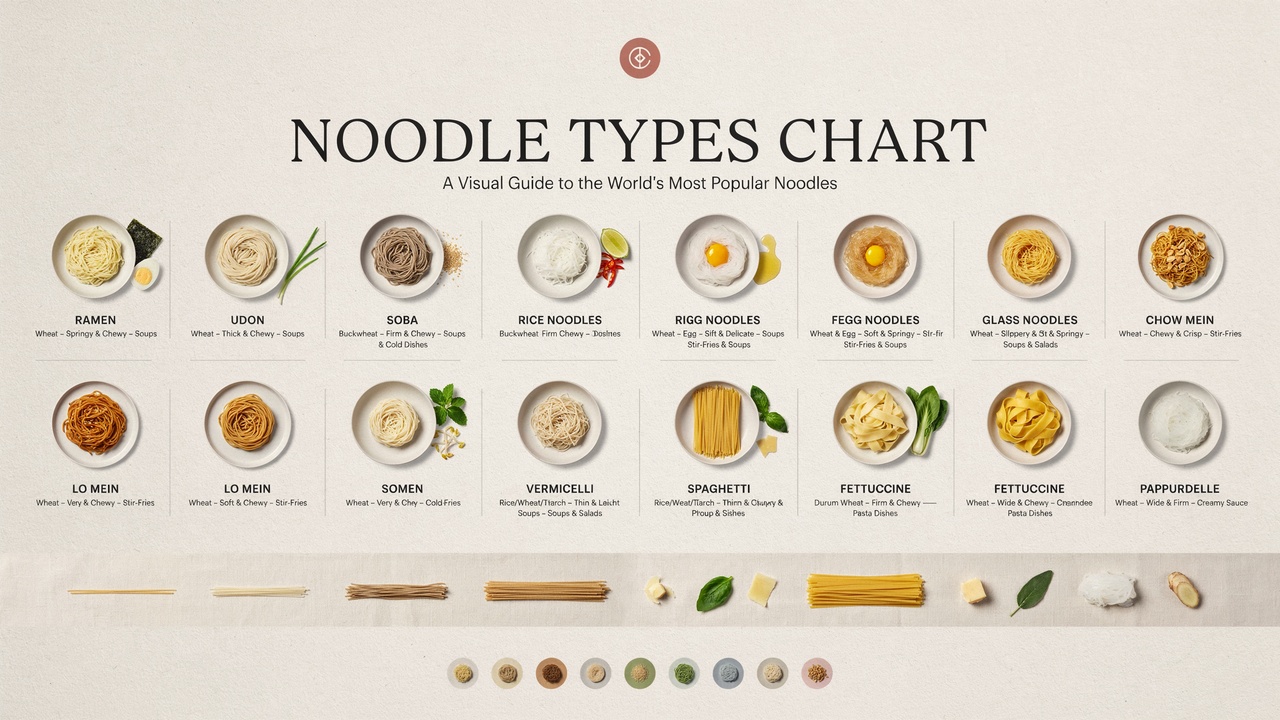
Noodles are one of the most versatile foods in the world, appearing in dishes across Asia, Europe, and many other cuisines. They come in different shapes, thicknesses, colors, ingredients, and textures. Some noodles are thin and delicate, while others are thick, chewy, or wide enough to hold rich sauces. Understanding the noodle types chart makes it easier to compare popular noodles and choose the right type for soups, stir-fries, salads, sauces, and traditional dishes.
Why Noodle Types Matter
The type of noodle can completely change a dish. Thick noodles often work well with hearty sauces and broths, while thin noodles can absorb lighter sauces and cook quickly.
Noodles can also be made from different ingredients, including wheat, rice, buckwheat, mung beans, potatoes, and other starches. These ingredients affect their texture, flavor, and cooking characteristics.
For home cooks, knowing the difference between noodle types makes choosing the right noodle for a recipe much easier.
Standard Noodle Types Chart
There are hundreds of noodle varieties, but several are especially popular around the world.
Noodle Types Chart
| Noodle Type | Main Ingredient | Texture | Best Uses |
|---|---|---|---|
| Ramen | Wheat | Springy & chewy | Soups |
| Udon | Wheat | Thick & chewy | Soups, stir-fries |
| Soba | Buckwheat | Firm & nutty | Soups, cold dishes |
| Rice Noodles | Rice | Soft & delicate | Stir-fries, soups |
| Glass Noodles | Starch | Slippery & chewy | Soups, salads |
| Egg Noodles | Wheat & egg | Soft & springy | Stir-fries, soups |
| Chow Mein | Wheat | Chewy & crisp | Stir-fries |
| Lo Mein | Wheat | Soft & chewy | Stir-fries |
| Somen | Wheat | Very thin & delicate | Cold dishes, soups |
| Vermicelli | Rice/wheat/starch | Thin & light | Soups, salads |
| Spaghetti | Durum wheat | Firm & chewy | Pasta dishes |
| Fettuccine | Wheat | Wide & firm | Creamy sauces |
| Pappardelle | Wheat | Very wide & chewy | Rich sauces |
| Shirataki | Konjac | Soft & springy | Stir-fries, soups |
Ingredients and textures can vary depending on the brand, recipe, and preparation method.
Choosing The Right Noodle
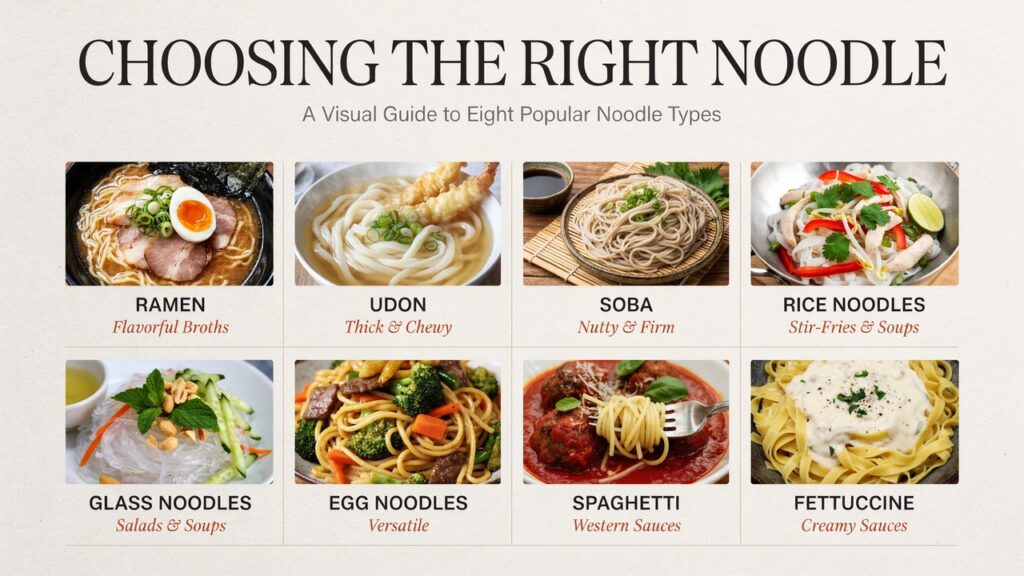
The best noodle depends on the dish you’re preparing.
Ramen: Ideal for flavorful broths and hearty toppings.
Udon: Great when you want thick, soft, chewy noodles.
Soba: A good choice for a slightly nutty flavor and firm texture.
Rice Noodles: Excellent for stir-fries, soups, and Southeast Asian dishes.
Glass Noodles: Useful for salads, spring rolls, and soups because they become translucent when cooked.
Egg Noodles: A versatile option for stir-fries and noodle soups.
Spaghetti: Works best with tomato, meat, seafood, and other Western-style sauces.
Fettuccine: Excellent for thick and creamy sauces.
Asian Noodle Types Chart
Asia is home to an enormous variety of noodles.
| Noodle | Country/Region | Main Ingredient | Common Dish |
|---|---|---|---|
| Ramen | Japan | Wheat | Ramen soup |
| Udon | Japan | Wheat | Udon soup |
| Soba | Japan | Buckwheat | Soba noodles |
| Somen | Japan | Wheat | Cold somen |
| Rice Vermicelli | Southeast Asia | Rice | Soups, salads |
| Pad Thai Noodles | Thailand | Rice | Pad Thai |
| Chow Mein | China | Wheat | Stir-fry |
| Lo Mein | China | Wheat | Stir-fry |
| Glass Noodles | China/Asia | Starch | Soups, salads |
| Dan Dan Noodles | China | Wheat | Spicy noodle dishes |
| Japchae Noodles | Korea | Sweet potato starch | Japchae |
| Naengmyeon | Korea | Buckwheat/starch | Cold noodle dishes |
Japanese Noodle Chart
Japanese cuisine uses several distinct noodle varieties.
| Japanese Noodle | Thickness | Texture | Popular Use |
|---|---|---|---|
| Ramen | Thin-medium | Springy | Broth |
| Udon | Thick | Soft & chewy | Soup |
| Soba | Thin | Firm | Hot/cold dishes |
| Somen | Very thin | Smooth | Cold dishes |
| Hiyamugi | Thin | Smooth & chewy | Cold dishes |
| Shirataki | Thin | Springy | Hot pots, stir-fries |
Each noodle provides a different eating experience.
Chinese Noodle Chart
China has an especially large variety of regional noodles.
| Chinese Noodle | Main Ingredient | Texture | Common Use |
|---|---|---|---|
| Chow Mein | Wheat | Chewy/crispy | Stir-fry |
| Lo Mein | Wheat | Soft & chewy | Stir-fry |
| Dan Dan Noodles | Wheat | Chewy | Spicy sauce |
| Hand-Pulled Noodles | Wheat | Elastic | Soup |
| Knife-Cut Noodles | Wheat | Thick & chewy | Soups |
| Rice Noodles | Rice | Soft | Soups/stir-fries |
| Glass Noodles | Starch | Slippery | Soups/salads |
Regional preparation methods can make the same general noodle category taste and feel very different.
Korean Noodle Chart
Korean cuisine also includes many unique noodle varieties.
| Korean Noodle | Main Ingredient | Texture | Popular Dish |
|---|---|---|---|
| Japchae Noodles | Sweet potato starch | Chewy & slippery | Japchae |
| Naengmyeon | Buckwheat/starch | Firm & chewy | Cold noodles |
| Kalguksu | Wheat | Soft & chewy | Noodle soup |
| Jajangmyeon Noodles | Wheat | Thick & chewy | Black bean noodles |
| Somyeon | Wheat | Thin & soft | Spicy noodle dishes |
Thai Noodle Chart
Thai cuisine uses noodles in soups, stir-fries, salads, and street food.
| Thai Noodle | Main Ingredient | Common Dish |
|---|---|---|
| Rice Stick Noodles | Rice | Pad Thai |
| Rice Vermicelli | Rice | Salads, soups |
| Egg Noodles | Wheat & egg | Noodle soups |
| Glass Noodles | Starch | Salads, soups |
| Wide Rice Noodles | Rice | Pad See Ew |
| Thin Rice Noodles | Rice | Soups, stir-fries |
Thai noodle dishes often combine sweet, salty, sour, spicy, and savory flavors.
Noodle Texture Chart
Texture is one of the most important differences between noodle varieties.
| Texture | Noodle Examples |
|---|---|
| Soft | Rice noodles, some egg noodles |
| Chewy | Udon, ramen |
| Springy | Ramen, egg noodles |
| Firm | Soba, spaghetti |
| Slippery | Glass noodles, shirataki |
| Elastic | Hand-pulled noodles |
| Delicate | Somen, rice vermicelli |
| Thick & Hearty | Udon, pappardelle |
Cooking time and method can also change the final texture.
Noodle Thickness Chart
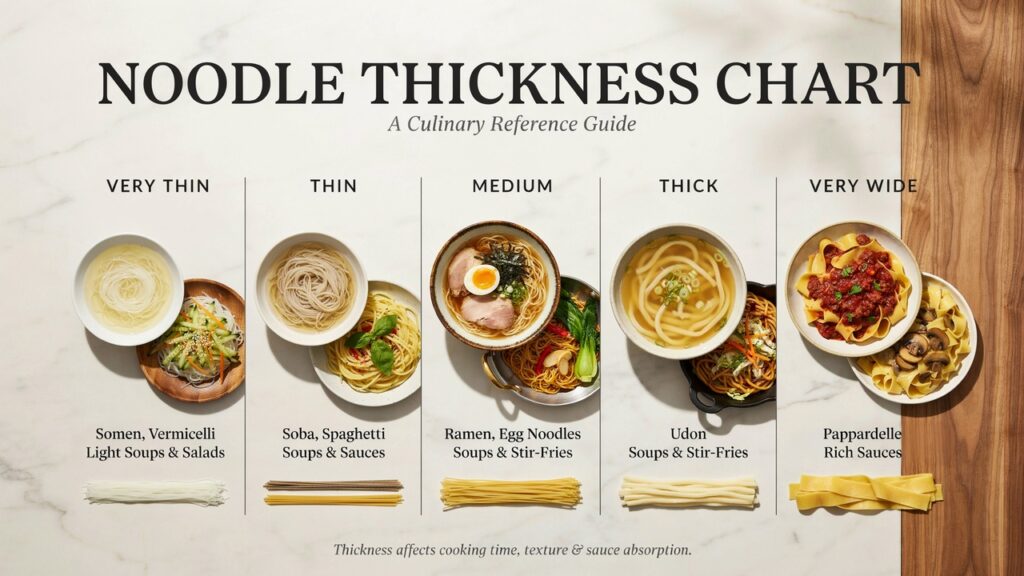
Noodle thickness affects cooking time, texture, and sauce absorption.
| Noodle Size | Examples | Best Uses |
|---|---|---|
| Very Thin | Somen, vermicelli | Light soups, salads |
| Thin | Soba, spaghetti | Soups, sauces |
| Medium | Ramen, egg noodles | Soups, stir-fries |
| Thick | Udon | Soups, stir-fries |
| Very Wide | Pappardelle | Rich sauces |
Thin noodles generally cook quickly, while thick noodles often require more time to reach the desired texture.
Noodles For Soup Chart
Some noodles are especially suited to broths.
| Noodle | Soup Style | Best Pairings |
|---|---|---|
| Ramen | Rich or light broth | Egg, pork, vegetables |
| Udon | Dashi-based broth | Tempura, green onion |
| Soba | Light broth | Green onion, tofu |
| Rice Noodles | Asian soups | Beef, chicken, herbs |
| Egg Noodles | Chicken/beef soup | Meat, vegetables |
| Kalguksu | Korean broth | Chicken, seafood |
| Hand-Pulled Noodles | Chinese broth | Beef, vegetables |
Noodles For Stir-Frying
Stir-fried noodles need to withstand high heat without becoming too soft.
| Noodle | Best Stir-Fry Use | Texture |
|---|---|---|
| Chow Mein | Chinese stir-fries | Chewy |
| Lo Mein | Saucy stir-fries | Soft & chewy |
| Udon | Japanese stir-fries | Thick & chewy |
| Rice Noodles | Thai/Vietnamese dishes | Soft |
| Egg Noodles | Asian stir-fries | Springy |
| Glass Noodles | Vegetable stir-fries | Slippery |
| Pad Thai Noodles | Pad Thai | Soft & chewy |
Noodle And Sauce Pairing Chart
Different noodles work better with certain sauce styles.
| Noodle | Sauce | Why It Works |
|---|---|---|
| Spaghetti | Tomato sauce | Balanced coating |
| Fettuccine | Alfredo | Wide surface |
| Pappardelle | Meat sauce | Holds rich sauce |
| Ramen | Broth | Absorbs savory flavors |
| Udon | Soy-based sauce | Thick texture |
| Soba | Dipping sauce | Firm texture |
| Rice Noodles | Peanut/chili sauce | Light texture |
| Egg Noodles | Soy/oyster-style sauce | Springy texture |
Italian Pasta Noodle Chart
Pasta is often considered part of the broader noodle family in everyday food discussions, although traditional culinary classifications distinguish pasta from many Asian noodles.
| Pasta Type | Shape | Best Sauce |
|---|---|---|
| Spaghetti | Long & thin | Tomato, meat |
| Linguine | Long & flat | Seafood, pesto |
| Fettuccine | Wide & flat | Cream sauces |
| Pappardelle | Very wide | Meat sauces |
| Tagliatelle | Medium-wide | Meat, cream |
| Angel Hair | Very thin | Light sauces |
| Bucatini | Thick & hollow | Tomato sauces |
| Lasagna | Wide sheets | Meat, cheese |
| Macaroni | Short & curved | Cheese sauces |
| Rigatoni | Large tubes | Thick sauces |
Noodle Ingredients Chart
Noodles can be made from several different base ingredients.
| Main Ingredient | Noodle Examples | General Characteristics |
|---|---|---|
| Wheat | Ramen, udon | Chewy & elastic |
| Rice | Rice noodles | Light & delicate |
| Buckwheat | Soba | Nutty & firm |
| Egg & Wheat | Egg noodles | Rich & springy |
| Sweet Potato Starch | Japchae noodles | Chewy & translucent |
| Mung Bean Starch | Glass noodles | Slippery & light |
| Konjac | Shirataki | Springy & low-calorie |
| Durum Wheat | Spaghetti | Firm & chewy |
Noodles For Cold Dishes
Some noodles are particularly good when served chilled.
| Noodle | Cold Dish | Characteristics |
|---|---|---|
| Soba | Cold soba | Firm & nutty |
| Somen | Cold somen | Thin & delicate |
| Naengmyeon | Korean cold noodles | Firm & chewy |
| Rice Vermicelli | Noodle salads | Light & fresh |
| Glass Noodles | Cold salads | Slippery & chewy |
Cold noodle dishes often include refreshing vegetables, herbs, dipping sauces, or broths.
Noodle Serving Size Chart
Serving sizes vary depending on whether noodles are served as a main dish, soup, or side.
| Serving Type | Approx. Dry Noodles |
|---|---|
| Small Side | 40–60 g |
| Light Meal | 60–75 g |
| Standard Main Dish | 75–100 g |
| Large Meal | 100–125 g |
| Soup With Toppings | 70–100 g |
These are general cooking portions and can vary by noodle type and recipe.
Noodle Cooking Chart
Different noodles require different preparation methods.
| Noodle Type | Typical Preparation |
|---|---|
| Ramen | Boil, then add to broth |
| Udon | Boil or simmer |
| Soba | Boil, then rinse for cold dishes |
| Rice Noodles | Soak or boil |
| Glass Noodles | Soak or boil |
| Egg Noodles | Boil |
| Spaghetti | Boil in salted water |
| Shirataki | Rinse and heat |
Always follow the package instructions because cooking times vary between brands and thicknesses.
Noodle Pairing With Protein
Noodles can be paired with many types of protein.
| Protein | Good Noodles |
|---|---|
| Chicken | Ramen, rice noodles, egg noodles |
| Beef | Udon, ramen, hand-pulled noodles |
| Pork | Ramen, soba, egg noodles |
| Shrimp | Rice noodles, linguine |
| Salmon | Soba, ramen |
| Tofu | Soba, rice noodles |
| Egg | Ramen, udon, soba |
| Duck | Soba, egg noodles |
Vegetarian Noodle Chart
Many noodle dishes can be prepared with vegetables and plant-based ingredients.
| Noodle | Vegetarian Pairings |
|---|---|
| Udon | Tofu, mushrooms, green onion |
| Soba | Tofu, vegetables |
| Rice Noodles | Herbs, tofu, vegetables |
| Glass Noodles | Mushrooms, cabbage, carrots |
| Ramen | Corn, mushrooms, tofu |
| Spaghetti | Tomato, basil, vegetables |
| Egg Noodles | Mixed vegetables, tofu |
Some noodles contain egg, so ingredients should be checked if following a strict vegan diet.
Noodles For Beginners
If you’re new to different noodle varieties, some options are easier to start with.
Spaghetti: Familiar texture and easy to pair with many sauces.
Ramen: A popular introduction to Japanese noodles.
Udon: Thick and chewy with a mild flavor.
Egg Noodles: Soft, springy, and versatile.
Rice Noodles: Light and delicate.
Chow Mein: Great for people who enjoy stir-fried foods.
Soba: A good choice if you want something firmer with a nutty flavor.
Common Mistakes When Choosing Noodles
Using the wrong noodle for the sauce: Thin noodles may not hold thick sauces as well as wide noodles.
Overcooking noodles: Many varieties become soft and lose their ideal texture when cooked too long.
Not rinsing certain noodles: Some noodles, especially those intended for cold dishes, benefit from rinsing after cooking.
Ignoring noodle thickness: Thick and thin noodles require different cooking times.
Adding noodles too early to soup: Some noodles can become overly soft if left in hot broth for too long.
Assuming all noodles are interchangeable: Different ingredients create significantly different textures and flavors.
Tips For Cooking Noodles
Use enough water: This helps noodles cook evenly.
Watch the texture: Don’t rely only on cooking time; taste the noodles to check doneness.
Avoid overcooking: Remove noodles when they reach the desired texture.
Rinse when appropriate: Cold noodle dishes often benefit from rinsing.
Prepare sauce first: Have your sauce ready so cooked noodles don’t sit too long.
Match noodle thickness to the dish: Wide noodles are useful for rich sauces, while thin noodles work well with lighter sauces and broths.
The History Behind Noodles
Noodles have a long history across Asia and Europe, with different cultures developing their own ingredients, shapes, and cooking techniques.
Wheat noodles became important in many parts of Asia, while rice-based noodles developed widely in regions where rice was a major crop. Buckwheat noodles became associated with Japanese cuisine, while pasta developed into a diverse family of shapes and styles in Italy.
Today, noodles are enjoyed worldwide and are used in everything from soups and stir-fries to salads, casseroles, and pasta dishes.
Frequently Asked Questions
What Are The Most Popular Types Of Noodles?
Popular varieties include ramen, udon, soba, rice noodles, egg noodles, glass noodles, chow mein, lo mein, spaghetti, and fettuccine.
What Is The Difference Between Ramen And Udon?
Ramen noodles are generally thinner and springier, while udon noodles are much thicker, softer, and chewier.
What Are Rice Noodles Made Of?
Rice noodles are primarily made from rice flour and water, although recipes can vary.
What Are Soba Noodles Made Of?
Soba noodles are traditionally made primarily from buckwheat flour, although some varieties also contain wheat flour.
Which Noodles Are Best For Stir-Frying?
Chow mein, lo mein, egg noodles, udon, and rice noodles are popular choices for stir-frying.
Which Noodles Are Best For Soup?
Ramen, udon, soba, rice noodles, and egg noodles are commonly used in soups.
What Are Glass Noodles?
Glass noodles are translucent noodles made from starch, commonly from ingredients such as mung beans or other starch sources. They become transparent when cooked.
Which Noodles Are The Thickest?
Udon is one of the best-known thick Japanese noodles, while pappardelle is among the widest traditional Italian pasta varieties.
Which Noodles Are Gluten-Free?
Noodles made from rice, certain starches, buckwheat, and konjac can be gluten-free, but ingredients and manufacturing should always be checked.
What Noodles Are Best For Beginners?
Spaghetti, ramen, udon, egg noodles, rice noodles, and chow mein are approachable options for people exploring different noodle varieties.
Noodles offer an incredible range of ingredients, shapes, textures, and cooking styles. From chewy ramen and udon to nutty soba, delicate rice noodles, slippery glass noodles, and classic Italian pasta, each type brings something different to the table. Understanding the noodle types chart makes it easier to choose the right noodle for soups, stir-fries, sauces, salads, and complete meals.
