
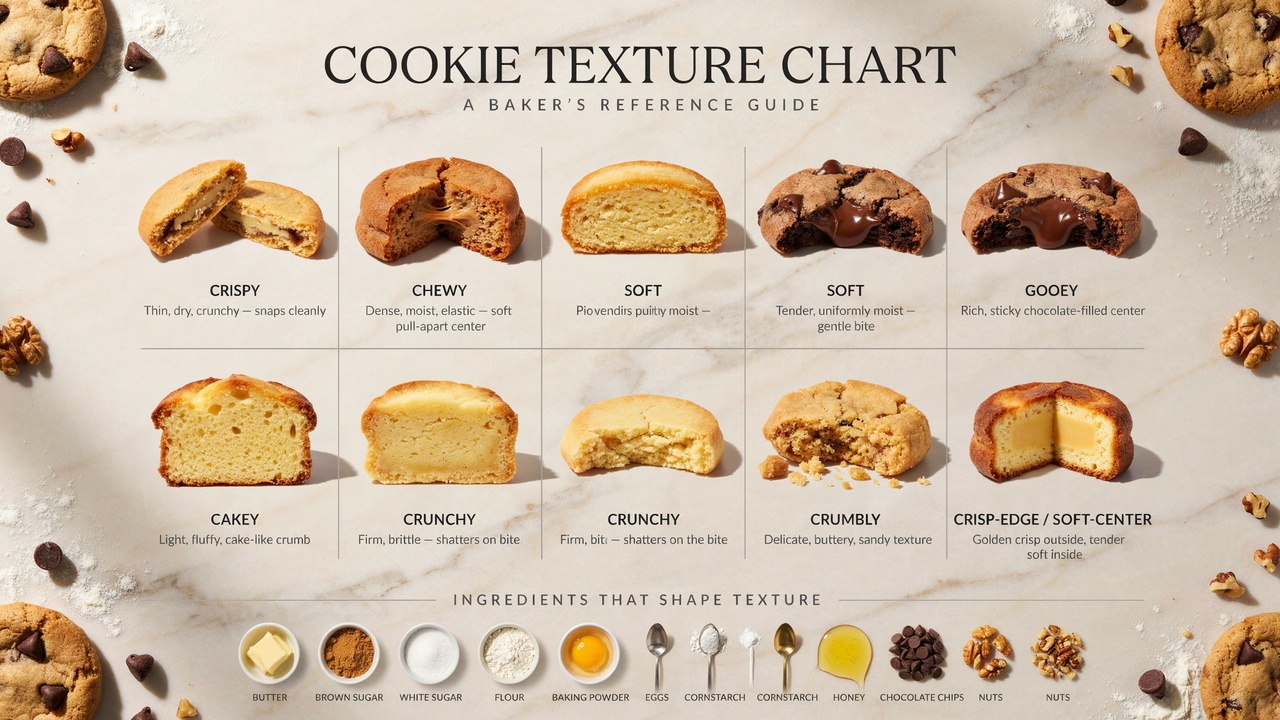
Cookies are loved for more than just their flavor—their texture can completely change the eating experience. Some cookies are crisp and delicate, while others are soft, chewy, gooey, or cakey in the center. But what makes one cookie crunchy while another stays soft and chewy? Understanding the cookie texture chart helps home bakers choose the right ingredients, baking methods, and recipes to create the exact texture they want.
Why Cookie Texture Matters
Texture is one of the most important characteristics of a good cookie. A crisp cookie provides a light, crunchy bite, while a chewy cookie feels denser and more satisfying. Soft cookies tend to have a tender center, while cakey cookies have a lighter, bread-like texture.
Ingredients such as butter, sugar, flour, eggs, and moisture all influence the final texture. Baking temperature and time also play an important role.
Standard Cookie Texture Chart
Cookies can have several different textures, and many recipes combine more than one.
Cookie Texture Chart
| Cookie Texture | Main Characteristics | Common Ingredients | Typical Result |
|---|---|---|---|
| Crispy | Thin, dry, crunchy | White sugar, butter | Crisp throughout |
| Chewy | Dense, moist, elastic | Brown sugar, butter | Soft & chewy center |
| Soft | Tender & moist | Brown sugar, eggs | Soft bite |
| Gooey | Moist, rich, sticky center | Butter, sugar, chocolate | Soft center |
| Cakey | Light & fluffy | Flour, eggs, leavening | Cake-like texture |
| Crunchy | Firm & brittle | Sugar, nuts | Strong crunch |
| Crumbly | Delicate & sandy | Butter, flour | Breaks easily |
| Crisp-Edge Soft-Center | Crisp outside, tender inside | Butter, sugar, eggs | Mixed texture |
These characteristics can vary depending on the recipe, ingredient ratios, and baking time.
Choosing The Right Cookie Texture
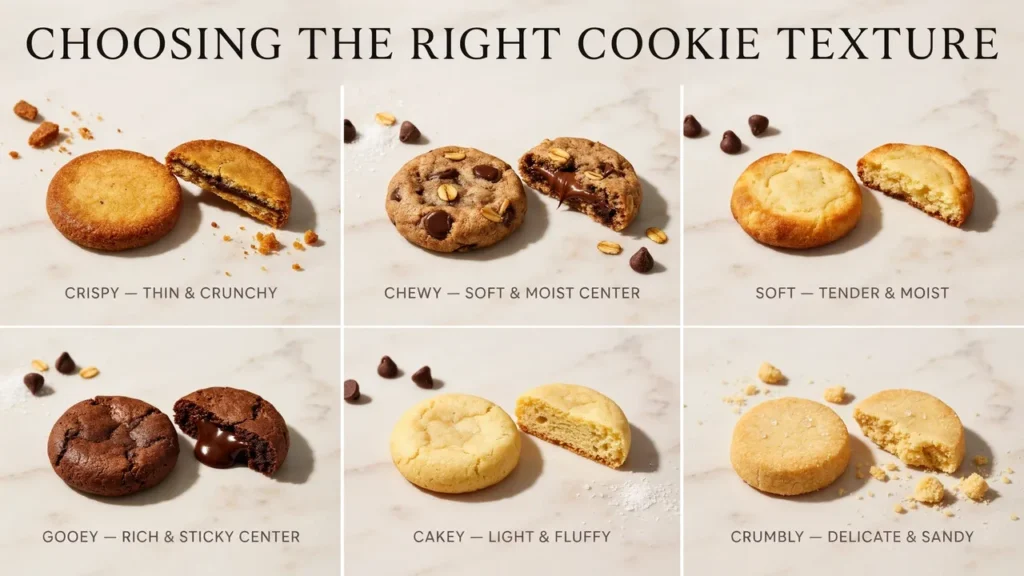
The best cookie texture depends on personal preference and the type of cookie you want to make.
Crispy Cookies: Great for thin cookies, wafer-style cookies, and cookies that need to stay crunchy.
Chewy Cookies: Ideal for chocolate chip cookies, oatmeal cookies, and cookies with a soft center.
Soft Cookies: Perfect when you want a tender, moist bite.
Gooey Cookies: Best for rich chocolate cookies, stuffed cookies, and freshly baked desserts.
Cakey Cookies: Useful when you prefer a lighter, fluffy cookie.
Crumbly Cookies: Common in shortbread and butter cookies.
Cookie Texture And Ingredients
Different ingredients influence the final texture in different ways.
| Ingredient | Texture Effect |
|---|---|
| Butter | Adds tenderness & spread |
| Brown Sugar | Promotes moisture & chewiness |
| White Sugar | Helps create crispness |
| Flour | Provides structure |
| Eggs | Add moisture & structure |
| Egg Yolks | Increase richness & tenderness |
| Egg Whites | Can create a lighter structure |
| Baking Soda | Promotes spread & browning |
| Baking Powder | Creates a lighter, cakier texture |
| Cornstarch | Can make cookies tender |
| Honey | Adds moisture & softness |
| Chocolate Chips | Add pockets of softness and texture |
| Nuts | Add crunch |
The exact effect depends on the amount used and the other ingredients in the recipe.
Chewy Cookie Texture
Chewy cookies are usually moist in the center with a slightly dense bite.
Brown sugar is commonly used in chewy cookies because it contains molasses and helps retain moisture. A higher proportion of brown sugar compared with white sugar can contribute to a softer, chewier result.
Chewy Cookie Characteristics
- Moist center
- Slightly dense texture
- Soft bite
- Often crisp around the edges
- Works well with chocolate chips and nuts
Chocolate chip, oatmeal, and molasses cookies are common examples of cookies that can have a chewy texture.
Crispy Cookie Texture
Crispy cookies are usually thinner and contain less retained moisture.
White sugar can encourage spreading and crispness, while longer baking times can remove more moisture from the cookie.
Crispy Cookie Characteristics
- Thin structure
- Dry surface
- Crunchy bite
- Golden edges
- Low moisture
Crispy textures are common in thin sugar cookies, butter cookies, and some wafer-style cookies.
Soft Cookie Texture
Soft cookies have a tender texture and generally retain more moisture than crispy cookies.
Ingredients such as brown sugar, eggs, and sometimes cornstarch can help produce a softer cookie.
Soft Cookie Characteristics
- Tender center
- Moist texture
- Gentle bite
- Less crunch
- Often thicker than crispy cookies
Soft cookies are especially popular when served shortly after baking.
Gooey Cookie Texture
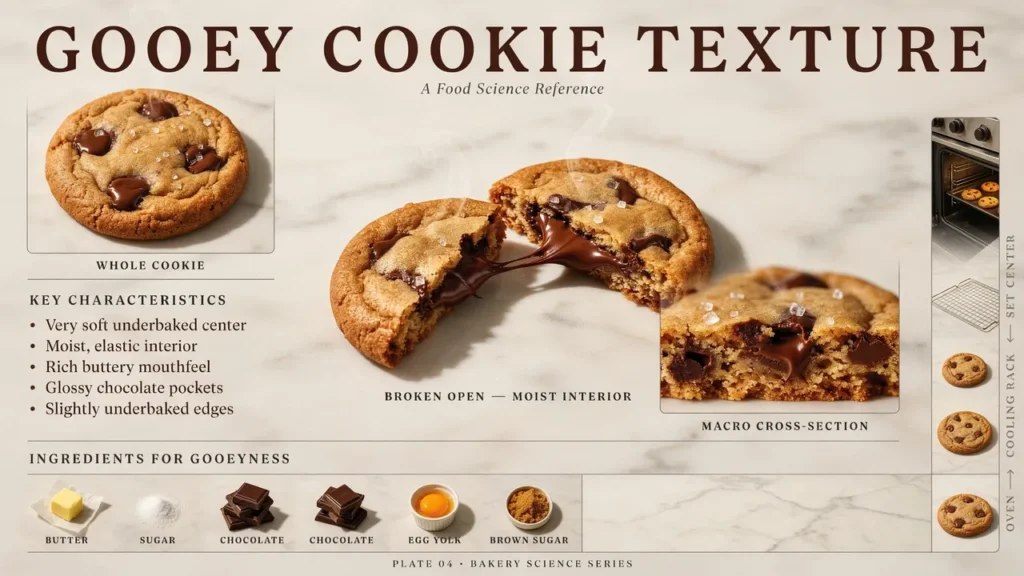
Gooey cookies have a moist, rich center that remains very soft after baking.
This texture is often created by using plenty of butter, sugar, chocolate, or other moisture-retaining ingredients and removing the cookies from the oven before the center becomes fully firm.
Gooey Cookie Characteristics
- Very soft center
- Moist interior
- Rich mouthfeel
- Often slightly underbaked in appearance
- Common with chocolate-based cookies
Allowing the cookies to cool slightly can help the center set while remaining soft.
Cakey Cookie Texture
Cakey cookies have a lighter and fluffier texture that resembles a small piece of cake.
A higher amount of flour, eggs, or chemical leavening can contribute to this texture.
Cakey Cookie Characteristics
- Light interior
- Fluffy crumb
- Thicker shape
- Less dense than chewy cookies
- Soft bite
Cake-like cookies are useful when you prefer a fluffy rather than dense cookie.
Crumbly Cookie Texture
Crumbly cookies are delicate and break apart easily.
Shortbread is a classic example. A higher butter-to-flour ratio and limited moisture can create a tender, sandy texture.
Crumbly Cookie Characteristics
- Delicate structure
- Buttery flavor
- Sandy or tender texture
- Breaks easily
- Usually not very chewy
These cookies are often enjoyed with tea, coffee, or other beverages.
Cookie Texture Comparison
| Texture | Moisture | Density | Crunch | Typical Cookie |
|---|---|---|---|---|
| Crispy | Low | Light | High | Thin sugar cookie |
| Chewy | Medium-high | Dense | Low-medium | Chocolate chip |
| Soft | Medium-high | Medium | Low | Soft sugar cookie |
| Gooey | High | Dense | Very low | Chocolate cookie |
| Cakey | Medium | Light | Low | Cake-like cookie |
| Crunchy | Low | Firm | Very high | Biscotti |
| Crumbly | Low-medium | Delicate | Medium | Shortbread |
Cookie Texture And Sugar
Sugar plays a major role in determining cookie texture.
Sugar Texture Chart
| Sugar Type | Common Texture Effect |
|---|---|
| White Granulated Sugar | Crispness & spreading |
| Brown Sugar | Moisture & chewiness |
| Powdered Sugar | Tender, delicate texture |
| Raw Sugar | Crunchy exterior |
| Honey | Softness & moisture |
| Molasses | Chewiness & moisture |
Changing the ratio of white sugar to brown sugar can noticeably change the final texture of many cookie recipes.
Cookie Texture And Flour
Flour provides structure, but different flour choices can influence the finished cookie.
| Flour Type | General Texture Effect |
|---|---|
| All-Purpose Flour | Balanced structure |
| Cake Flour | Softer & lighter |
| Bread Flour | Chewier & stronger |
| Whole Wheat Flour | Denser & more hearty |
| Almond Flour | Tender & moist |
| Oat Flour | Soft & slightly crumbly |
The amount of flour matters just as much as the type. Too much flour can produce a dry or cakey cookie, while too little can cause excessive spreading.
Cookie Texture And Baking Time
Baking time is one of the easiest ways to change cookie texture.
| Baking Time | Typical Result |
|---|---|
| Shorter | Softer & chewier |
| Medium | Balanced texture |
| Longer | Crispier & firmer |
Cookies often continue to firm up as they cool, so removing them from the oven when the centers are still slightly soft can produce a softer final texture.
Cookie Texture And Temperature
Oven temperature can affect spreading, browning, and moisture loss.
A hotter oven can set the outside of a cookie quickly, while a lower temperature may allow more spreading depending on the recipe.
For consistent results, always follow the recipe’s recommended temperature rather than changing it dramatically.
Cookie Texture By Type
Different cookie styles are naturally associated with different textures.
| Cookie Type | Typical Texture |
|---|---|
| Chocolate Chip | Chewy or crisp |
| Sugar Cookie | Soft or crisp |
| Shortbread | Crumbly |
| Oatmeal Cookie | Chewy |
| Snickerdoodle | Soft & chewy |
| Biscotti | Very crunchy |
| Peanut Butter Cookie | Soft or crumbly |
| Gingerbread Cookie | Soft or crisp |
| Macaron | Crisp shell, soft center |
| Brownie Cookie | Fudgy or chewy |
| Wafer Cookie | Thin & crisp |
| Whoopie Pie Cookie | Soft & cakey |
Recipes can produce different results, so the same cookie type may have several possible textures.
How To Make Cookies More Chewy
If you prefer chewy cookies, several recipe adjustments can help.
Use more brown sugar: Brown sugar helps retain moisture.
Avoid overbaking: Remove cookies while the centers are still slightly soft.
Use egg yolks: Additional yolk can add richness and tenderness.
Chill the dough: Chilling can change spreading and help create a thicker cookie.
Measure flour carefully: Too much flour can make cookies dry and cakey.
How To Make Cookies More Crispy
For a crispier cookie, focus on moisture and baking time.
Use more white sugar: It can encourage spreading and crisp edges.
Bake slightly longer: More moisture loss generally creates a firmer texture.
Make thinner cookies: Thin dough spreads and dries more quickly.
Cool completely: Cookies often become crispier as they cool.
How To Make Cookies Softer
For softer cookies, retaining moisture is important.
Use brown sugar: It can help maintain moisture.
Avoid excessive baking: Overbaking removes moisture.
Use an appropriate amount of flour: Too much flour can create a dry texture.
Store properly: Airtight storage helps prevent soft cookies from drying out.
How To Make Cookies Cakey
Cakey cookies generally require more structure and lift.
Use baking powder: It can create a lighter texture.
Use enough flour: Flour provides the structure needed for a thicker cookie.
Use eggs: Eggs can contribute to structure and a lighter crumb.
Avoid excessive spreading: Chilling dough can help produce thicker cookies.
Tips For Controlling Cookie Texture
Measure ingredients accurately: Small changes in flour, sugar, and liquid can affect texture.
Use room-temperature ingredients when the recipe specifies: This helps ingredients combine consistently.
Watch the baking time: A minute or two can make a noticeable difference in some cookie recipes.
Let cookies cool properly: Texture often changes as cookies cool.
Store cookies correctly: Airtight containers help preserve the intended texture.
Experiment gradually: Change one ingredient or technique at a time so you can identify what caused the texture change.
Common Cookie Texture Mistakes
Adding too much flour: Can create dry, thick, or cakey cookies.
Overbaking: Often results in hard or overly crisp cookies.
Under-measuring sugar: Can affect spreading, browning, and texture.
Using the wrong flour: Different flours absorb moisture differently.
Skipping chill time: Some recipes depend on chilled dough for proper spreading.
Storing cookies incorrectly: Exposure to air can make soft cookies hard and crisp cookies stale.
Cookie Texture For Different Occasions
| Occasion | Recommended Texture |
|---|---|
| Lunchbox | Soft or chewy |
| Holiday Cookie Tray | Crisp, soft & crumbly |
| Gift Box | Firm or crisp |
| Ice Cream Sandwich | Soft & chewy |
| Coffee Pairing | Crisp or crumbly |
| Dessert Plate | Gooey or soft |
| Dipping Cookies | Crisp & firm |
| Party Cookies | Chewy or soft |
The ideal texture often depends on whether the cookie will be eaten immediately or stored for later.
The Science Behind Cookie Texture
Cookie texture comes from the interaction between ingredients, moisture, heat, and structure.
When cookie dough enters the oven, butter melts, sugars dissolve, flour develops structure, eggs set, and leavening agents can create air pockets. As water evaporates, the cookie becomes firmer.
The balance between these processes determines whether the final cookie is crisp, chewy, soft, cakey, or crumbly.
That is why even a small change in sugar, flour, butter, or baking time can noticeably change the final result.
Frequently Asked Questions
What Makes A Cookie Chewy?
Brown sugar, adequate moisture, the right amount of flour, and avoiding overbaking can all contribute to a chewy cookie.
What Makes A Cookie Crispy?
Lower moisture, more white sugar, thinner dough, and longer baking can contribute to a crisp texture.
Why Are My Cookies Cakey?
Cookies can become cakey when they contain relatively more flour, eggs, or leavening than needed for a dense or chewy texture.
Why Are My Cookies Hard?
Overbaking, too much flour, or improper storage can make cookies harder than intended.
How Do I Make Cookies Softer?
Try using brown sugar, avoiding overbaking, measuring flour accurately, and storing the cookies in an airtight container.
How Do I Make Cookies Crunchier?
Using more white sugar, making thinner cookies, baking them longer, and allowing them to cool completely can encourage a crunchier texture.
What Makes Cookies Gooey?
A high-moisture dough, rich ingredients such as butter and chocolate, and shorter baking can help create a gooey center.
What Makes Shortbread Crumbly?
Shortbread typically has a high proportion of butter relative to flour and relatively little moisture, creating its characteristic delicate and crumbly texture.
Does Chilling Cookie Dough Change Texture?
Yes. Chilling can reduce spreading and help produce thicker cookies. It can also affect browning and the final balance between crisp edges and soft centers.
Cookie texture can be just as important as flavor. Whether you prefer crispy, chewy, soft, gooey, cakey, crunchy, or crumbly cookies, understanding how ingredients and baking techniques affect texture gives you much more control over the final result. The cookie texture chart provides a simple reference for comparing textures and choosing the right ingredients and methods for the perfect cookie.
