
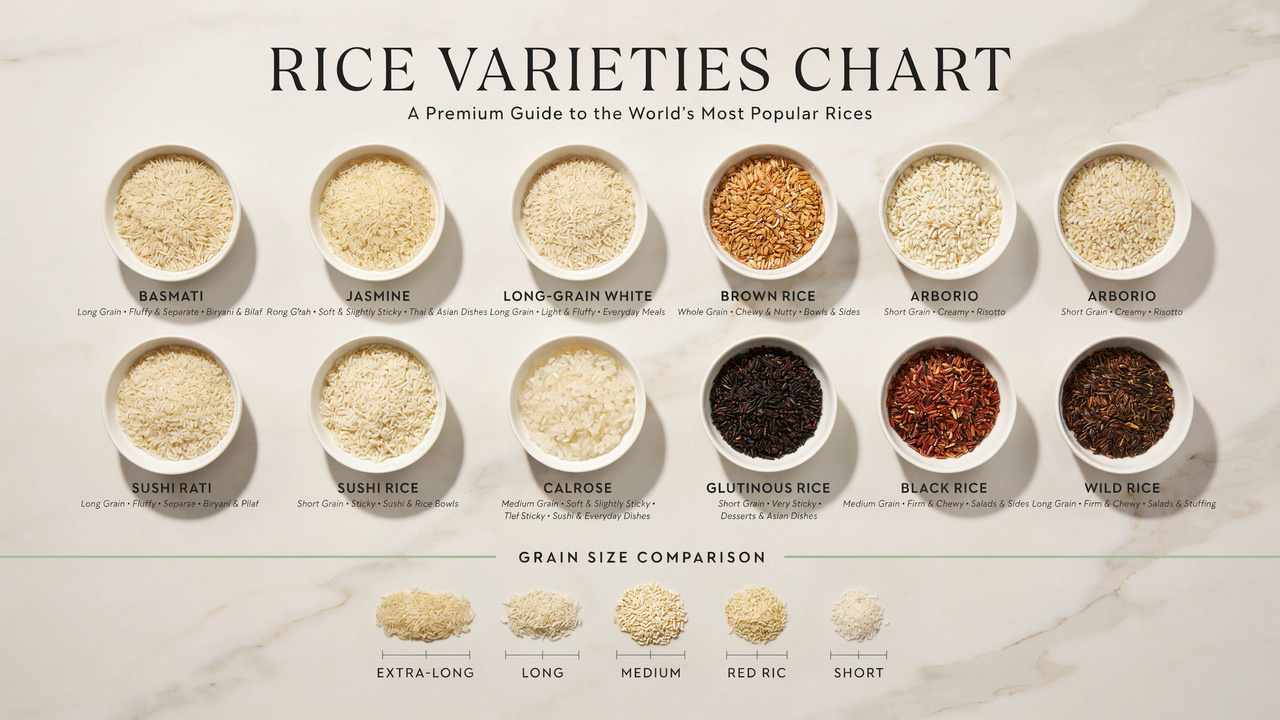
Rice is one of the most versatile staple foods in the world, but not all rice cooks the same way. From long-grain basmati and fragrant jasmine rice to sticky short-grain varieties and creamy Arborio, each type has its own texture, flavor, appearance, and ideal use. But have you ever wondered which rice is best for biryani, sushi, risotto, fried rice, or everyday meals? Understanding the rice varieties chart makes it easier to choose the right rice for every dish. Let’s explore popular rice varieties, grain sizes, cooking characteristics, and the best ways to use them.
Why Rice Variety Matters
Rice variety affects much more than appearance. The size and structure of the grain influence how much water it absorbs, how fluffy or sticky it becomes, and how well it works with different recipes.
Long-grain rice generally cooks into separate, fluffy grains, while short-grain rice tends to become softer and stickier. Medium-grain rice sits somewhere between the two.
The variety also affects flavor. Basmati has a distinctive aroma, jasmine rice has a floral fragrance, and brown rice has a nuttier, chewier character.
For home cooks, choosing the right variety can make a major difference in the final dish.
Standard Rice Varieties And Grain Sizes
Rice is commonly categorized as long-grain, medium-grain, or short-grain based on the shape and proportions of the grain.
Rice Varieties Chart
| Rice Variety | Grain Type | Texture When Cooked | Best Use |
|---|---|---|---|
| Basmati | Long grain | Fluffy, separate | Biryani, pilaf, curries |
| Jasmine | Long grain | Soft, slightly sticky | Thai & Asian dishes |
| Long-Grain White | Long grain | Light, fluffy | Everyday meals |
| Brown Rice | Long grain | Chewy, nutty | Healthy bowls & sides |
| Arborio | Short/medium grain | Creamy | Risotto |
| Sushi Rice | Short grain | Sticky | Sushi & rice bowls |
| Calrose | Medium grain | Soft, slightly sticky | Sushi & everyday dishes |
| Glutinous Rice | Short grain | Very sticky | Desserts & Asian dishes |
| Black Rice | Short/medium grain | Chewy | Salads & bowls |
| Red Rice | Medium/long grain | Firm, chewy | Salads & side dishes |
| Wild Rice | Long, slender grain | Firm & chewy | Salads & stuffing |
The exact characteristics can vary between cultivars, brands, and processing methods.
Choosing The Right Rice Variety
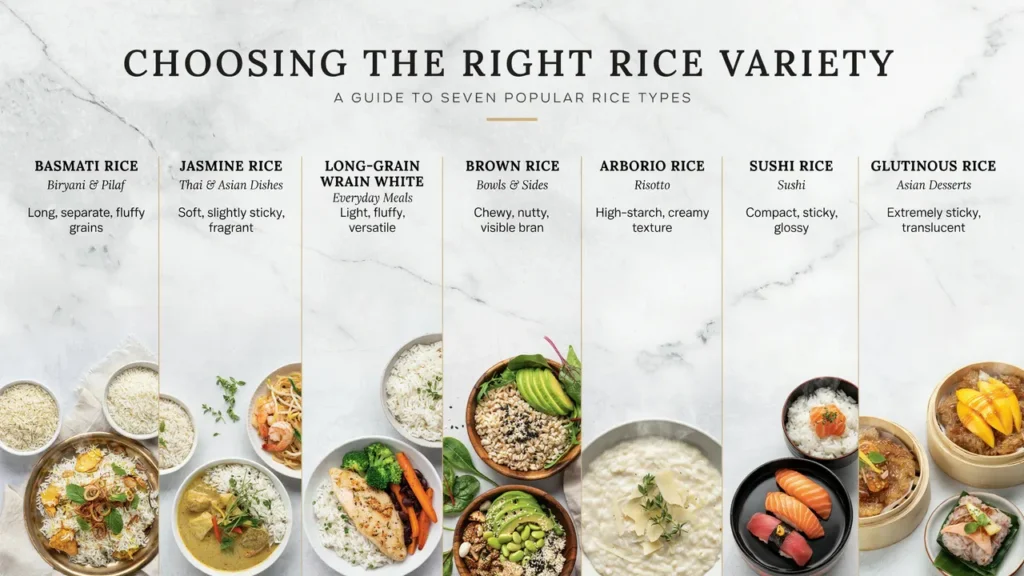
The best rice depends on the dish you are preparing.
Basmati Rice: Excellent for biryani, pilaf, pulao, and dishes where you want long, separate grains.
Jasmine Rice: A fragrant choice for Thai, Southeast Asian, and many Asian-inspired dishes. It becomes softer and slightly sticky when cooked.
Long-Grain White Rice: A versatile everyday option that works well with vegetables, meat, fish, beans, and sauces.
Brown Rice: Retains its bran layer, giving it a chewier texture and nuttier flavor than white rice.
Arborio Rice: High in starch and especially suited to creamy risotto.
Sushi Rice: Short-grain rice that becomes sticky enough to hold together for sushi and other Japanese dishes.
Glutinous Rice: Extremely sticky when cooked and commonly used in traditional Asian desserts and savory dishes.
Rice Grain Size Chart
The physical shape of rice has a major effect on its cooking characteristics.
| Grain Type | Shape | Typical Texture |
|---|---|---|
| Long Grain | Long and slender | Fluffy & separate |
| Medium Grain | Shorter and wider | Soft & slightly sticky |
| Short Grain | Short and rounded | Sticky & tender |
| Extra Long Grain | Very long and slender | Light & fluffy |
Long-grain varieties are generally preferred when individual grains should remain separate, while short-grain varieties are useful when a sticky texture is desirable.
Basmati Vs Jasmine Rice
Basmati and jasmine rice are two of the most popular aromatic rice varieties, but they have noticeable differences.
| Feature | Basmati Rice | Jasmine Rice |
|---|---|---|
| Grain | Long & slender | Long & slightly plumper |
| Aroma | Distinctive, nutty | Floral & fragrant |
| Cooked Texture | Fluffy, separate | Soft & slightly sticky |
| Best For | Biryani, pilaf | Thai & Southeast Asian dishes |
| Origin Association | South Asia | Southeast Asia |
Basmati is especially popular for Indian and South Asian dishes, while jasmine rice is closely associated with Thai and Southeast Asian cuisine.
White Rice Vs Brown Rice
The main difference between white and brown rice is how the grain is processed.
| Feature | White Rice | Brown Rice |
|---|---|---|
| Processing | Bran and germ removed | Bran and germ retained |
| Texture | Soft & fluffy | Chewy |
| Flavor | Mild | Nutty |
| Cooking Time | Usually shorter | Usually longer |
| Best Use | Everyday meals | Bowls, salads & sides |
Brown rice generally takes longer to cook because its outer layers remain intact.
Rice Variety And Cooking Time
Different rice varieties require different cooking methods and amounts of water. Cooking times can also vary depending on whether the rice is soaked, steamed, boiled, or prepared in a rice cooker.
Rice Cooking Time Chart
| Rice Variety | Approximate Cooking Time |
|---|---|
| White Long-Grain Rice | 15–20 minutes |
| Basmati Rice | 15–20 minutes |
| Jasmine Rice | 15–20 minutes |
| Brown Rice | 35–45 minutes |
| Sushi Rice | 15–20 minutes |
| Arborio Rice | 18–25 minutes |
| Wild Rice | 40–50 minutes |
| Black Rice | 30–40 minutes |
| Red Rice | 30–40 minutes |
| Glutinous Rice | Usually steamed rather than boiled |
Cooking times vary by brand and preparation method, so package instructions should always be checked for the specific rice being used.
Rice Varieties For Different Dishes
Different dishes are traditionally associated with particular rice varieties.
Rice Pairing Chart
| Dish | Best Rice Varieties | Why |
|---|---|---|
| Biryani | Basmati | Long, aromatic grains |
| Pulao | Basmati | Fluffy & fragrant |
| Fried Rice | Jasmine or long-grain | Firm, separate grains |
| Sushi | Sushi rice | Sticky texture |
| Risotto | Arborio | High starch content |
| Rice Pudding | Short-grain or Arborio | Creamy texture |
| Thai Curry | Jasmine | Fragrant & soft |
| Rice Salad | Brown, wild, or long-grain | Firm texture |
| Rice Bowl | Jasmine, brown, or short-grain | Versatile texture |
| Sticky Rice Desserts | Glutinous rice | Very sticky texture |
Choosing a variety that matches the dish helps produce the right texture without having to rely on complicated preparation techniques.
Rice Varieties And Texture
Texture is one of the biggest differences between rice varieties.
| Rice Type | Texture | Stickiness |
|---|---|---|
| Basmati | Light & fluffy | Low |
| Jasmine | Soft | Moderate |
| Long-Grain White | Fluffy | Low |
| Brown Rice | Chewy | Low |
| Arborio | Creamy | High |
| Sushi Rice | Soft & sticky | High |
| Glutinous Rice | Very sticky | Very high |
| Wild Rice | Firm & chewy | Very low |
| Black Rice | Chewy | Moderate |
The amount and type of starch in the grain play a major role in determining how sticky or fluffy cooked rice becomes.
Rice Varieties For Breakfast
Rice can be used in both sweet and savory breakfast dishes.
Brown Rice: Can be used in breakfast bowls with fruit, nuts, and milk.
White Rice: Works well with eggs, vegetables, and savory breakfast dishes.
Sticky Rice: Popular in several Asian breakfast and snack traditions.
Black Rice: Can be used for colorful sweet rice bowls and porridge-style dishes.
Jasmine Rice: Useful for savory breakfast meals with eggs and vegetables.
Rice Varieties For Salads
Rice salads benefit from varieties that remain firm after cooking.
Best Rice For Salads
| Rice Variety | Why It Works |
|---|---|
| Brown Rice | Chewy & hearty |
| Wild Rice | Firm & nutty |
| Long-Grain Rice | Separate grains |
| Black Rice | Firm texture & striking color |
| Red Rice | Chewy & slightly nutty |
For salads, rice should generally be cooled properly before mixing with other ingredients to maintain a pleasant texture.
Rice Varieties For Desserts
Rice is also used in many traditional desserts around the world.
Glutinous Rice: Excellent for sticky rice desserts and sweet rice cakes.
Short-Grain Rice: Works well in creamy rice pudding.
Arborio Rice: Its high starch content can create a creamy dessert texture.
Black Rice: Often used in colorful sweet dishes and puddings.
White Rice: A versatile option for traditional rice pudding recipes.
The best choice depends on whether the dessert needs a creamy, chewy, or sticky texture.
Rice Variety And Serving Size
A common serving guideline for dry rice is around ¼ to ½ cup per person, depending on whether rice is being served as a side dish or as the main part of the meal.
Rice expands considerably during cooking, but the exact cooked yield varies by variety and preparation method.
Rice Serving Size Chart
| Serving | Dry Rice | Approximate Cooked Amount |
|---|---|---|
| Small Side | ¼ cup | About ¾ cup |
| Standard Side | ⅓ cup | About 1 cup |
| Large Side | ½ cup | About 1½ cups |
| Main Meal Portion | ½–¾ cup | About 1½–2¼ cups |
These are general serving estimates. Actual cooked volume can vary depending on the rice variety, water absorption, and cooking method.
Popular Rice Varieties Around The World
Rice is cultivated in many regions, and different varieties have become closely associated with particular cuisines.
| Rice Variety | Common Regional Association | Popular Dishes |
|---|---|---|
| Basmati | South Asia | Biryani, pulao |
| Jasmine | Southeast Asia | Thai curries, fried rice |
| Arborio | Italy | Risotto |
| Sushi Rice | Japan | Sushi, rice bowls |
| Calrose | United States/Japan-influenced cuisine | Sushi, bowls |
| Glutinous Rice | East & Southeast Asia | Sticky rice dishes |
| Black Rice | Asia | Porridge, bowls, desserts |
| Red Rice | Asia & Africa | Salads, side dishes |
| Wild Rice | North America | Salads, stuffing |
The names and culinary traditions can vary by region, but these varieties are widely recognized for their characteristic textures and uses.
Rice Varieties Vs Rice Processing
Rice varieties can also be categorized according to how much of the grain is removed during processing.
| Rice Type | Processing | Appearance |
|---|---|---|
| Brown Rice | Hull removed, bran retained | Tan/brown |
| White Rice | Bran and germ removed | White |
| Parboiled Rice | Partially cooked before milling | Light golden |
| Wild Rice | Different aquatic grass grain | Dark brown/black |
| Black Rice | Naturally dark outer layers | Deep purple-black |
| Red Rice | Naturally red outer layer | Reddish-brown |
Processing can affect cooking time, texture, flavor, and nutritional composition.
Tips For Choosing Rice Varieties
Match rice to the recipe: Choose sticky rice for sushi and glutinous dishes, but fluffy rice for biryani and pilaf.
Consider texture: Think about whether you want separate, creamy, chewy, or sticky grains.
Check cooking instructions: Different varieties can require noticeably different amounts of water and cooking time.
Rinse when appropriate: Some rice varieties benefit from rinsing to remove excess surface starch.
Don’t mix varieties randomly: Combining rice types can lead to uneven cooking because different grains may require different cooking times.
Store rice properly: Keep dry rice in a cool, dry place and protect it from moisture and pests.
Common Mistakes When Choosing Rice Varieties
Using short-grain rice for fluffy biryani: Short-grain varieties tend to become stickier.
Using basmati for risotto: Basmati does not provide the same creamy starch release expected from risotto rice.
Overcooking jasmine rice: Too much water or excessive cooking can make it overly soft.
Treating brown rice like white rice: Brown rice generally requires more cooking time.
Ignoring rice age and storage: Older or poorly stored rice can cook differently and develop undesirable flavors.
Assuming every rice variety needs the same water ratio: Water requirements vary between rice types and cooking methods.
Basmati Vs Brown Rice Vs Jasmine Rice
These three varieties are popular choices for everyday meals but offer very different characteristics.
| Feature | Basmati | Jasmine | Brown Rice |
|---|---|---|---|
| Grain | Long & slender | Long | Usually long |
| Texture | Fluffy | Soft & slightly sticky | Chewy |
| Aroma | Strong | Floral | Nutty |
| Cooking Time | Moderate | Moderate | Longer |
| Best For | Biryani & curries | Asian dishes | Bowls & sides |
| Color | White | White | Brown |
Choosing between them largely comes down to the dish and the texture you want.
The History Behind Rice Varieties
Rice has been cultivated for thousands of years and has become a fundamental food in many cultures. Over time, farmers selected and developed varieties suited to different climates, soils, growing conditions, and culinary traditions.
This long history has resulted in thousands of rice varieties worldwide. Some are valued for their aroma, some for their stickiness, others for their color, nutritional characteristics, or ability to grow in particular environments.
Today, rice remains one of the world’s most important staple grains and appears in everything from simple side dishes to elaborate traditional meals.
Frequently Asked Questions
What Are The Main Types Of Rice?
The major grain categories are long-grain, medium-grain, and short-grain rice. Rice can also be classified by processing, color, aroma, and culinary use.
Which Rice Is Best For Biryani?
Basmati rice is one of the most popular choices for biryani because its long, slender grains become fragrant and relatively separate when properly cooked.
Which Rice Is Best For Sushi?
Short-grain sushi rice is traditionally used because it develops the sticky texture needed to hold sushi together.
Which Rice Is Best For Risotto?
Arborio rice is a popular choice for risotto because its high starch content helps create the dish’s characteristic creamy texture.
What Is The Difference Between Basmati And Jasmine Rice?
Basmati rice is generally longer and more slender with a distinctive aroma and fluffy texture. Jasmine rice is fragrant as well but tends to be softer and somewhat stickier when cooked.
Is Brown Rice Different From White Rice?
Yes. Brown rice retains the bran and germ layers, while white rice has those outer layers removed during milling. This gives brown rice a chewier texture and nuttier flavor.
Which Rice Is The Stickiest?
Glutinous rice, also called sticky rice, is particularly sticky when cooked. Short-grain varieties such as sushi rice are also considerably stickier than typical long-grain rice.
Which Rice Is Best For Fried Rice?
Jasmine or other long-grain rice can work very well for fried rice because the grains can remain relatively separate. Using properly cooled cooked rice can also help achieve a better fried-rice texture.
How Much Rice Is One Serving?
A general guideline is around ¼–½ cup of dry rice per person, depending on whether it is served as a side dish or the main component of the meal.
Rice varieties may look similar when sitting in a bag, but their differences become obvious once they are cooked. From fragrant basmati for biryani to floral jasmine for Asian dishes, creamy Arborio for risotto, and sticky rice for sushi and desserts, each variety has its own strengths. Understanding the rice varieties chart makes it easier to choose the right grain for your recipe, achieve the texture you want, and make every rice-based meal more successful.
