The average kitchen knife is typically sharpened to an angle between 15 and 20 degrees per side. This range offers a good balance of sharpness for precise slicing and durability for everyday kitchen tasks.
Ever found yourself staring at your kitchen knives, wondering if they’re truly as sharp as they could be? It’s a common kitchen puzzle! You want that effortless glide through a ripe tomato or a perfectly sliced onion, but sometimes, your knife just doesn’t cooperate. Don’t worry, you’re not alone. Understanding the “why” behind your knife’s performance can make a world of difference. We’re about to uncover the simple truth about the angle of your everyday kitchen knife, and by the end, you’ll feel confident about keeping your blades in tip-top shape!
The Secret Angle: What Degree is the Average Kitchen Knife?
Let’s get straight to the point: the “sweet spot” for most kitchen knives, especially the ones you’ll find in your average home kitchen, is an angle of about 15 to 20 degrees per side. This might sound technical, but it’s a surprisingly straightforward concept that impacts how your knife cuts. Think of it as the perfect tilt for your blade.
Why this specific range? It’s all about finding that ideal balance. A sharper angle (lower degrees) means a keener edge, great for delicate tasks and achieving paper-thin slices. However, a very acute angle can be more prone to chipping or dulling quickly with heavy use. On the flip side, a wider angle (higher degrees) makes the edge more robust and durable, but it won’t feel as razor-sharp. The 15-20 degree range is the culinary happy medium, offering excellent cutting ability without sacrificing too much strength.
This angle is often referred to as the “European” or “Western” style of sharpening. Many brands produce their knives with this angle already set, assuming everyday home use.
Understanding Knife Angles: A Visual Guide
Imagine holding your knife flat on a cutting board. Now, lift the spine of the knife slightly. The angle between the blade’s edge and the cutting board is the sharpening angle.
Lower Angle (e.g., 10-15 degrees): Creates a very fine, sharp edge. Think of Japanese knives, often used for sushi or intricate cuts. They require more care.
Mid-Range Angle (e.g., 15-20 degrees): This is our “average” zone. It’s sharp enough for most tasks and holds up well.
Higher Angle (e.g., 20-25 degrees): Offers a more durable edge, often found on utility knives or knives intended for tougher materials.
It’s helpful to visualize this. If you’ve ever tried to sharpen a knife, you’ve likely had to maintain a consistent angle.
Why Does This Angle Matter to You?
Knowing the angle of your kitchen knife isn’t just for knife nerds! It directly impacts your cooking experience.
Effortless Cutting: A properly angled knife glides through ingredients, making prep work faster and more enjoyable.
Safety: A sharp knife is a safer knife. It requires less force, reducing the chance of slips. A dull knife can often cause more accidents.
Longevity of Your Knives: Understanding the angle helps you choose the right sharpening method and avoid damaging your blades.
Cooking Satisfaction: There’s a certain joy in using a knife that performs beautifully. It makes the entire process of cooking more satisfying.
Let’s break down the factors that influence this average angle and what you can expect from your own knives.
The Anatomy of a Kitchen Knife Edge
Before we dive deeper, let’s talk about what makes up a knife’s edge. It’s not just a single flat surface.
The Bevel: This is the angled surface that slopes down from the spine of the knife to the very thin edge. Most kitchen knives have a primary bevel, and some might have a secondary bevel (a smaller bevel at the very edge for extra sharpness and durability).
The Apex: This is the very tip of the bevel, where the two sides of the blade meet. This is what actually does the cutting.
The angle we’ve been discussing is the angle of this bevel.
Factors Influencing the “Average” Angle
While 15-20 degrees is the general ballpark, several factors can lead to slight variations:
Knife Type: A chef’s knife might be sharpened differently than a paring knife or a serrated bread knife.
Brand and Manufacturing: Different manufacturers have their own specifications.
Intended Use: A knife designed for heavy chopping might have a slightly different angle than one for delicate filleting.
Sharpening History: If you’ve sharpened your knives yourself or had them sharpened, the angle might have been adjusted.
For instance, many Western-style chef’s knives, like those from Wüsthof or Zwilling J.A. Henckels, are often factory-sharpened to around 20 degrees per side. Japanese knives, on the other hand, are frequently sharpened to a more acute 10-15 degrees per side.
A Look at Common Knife Angles
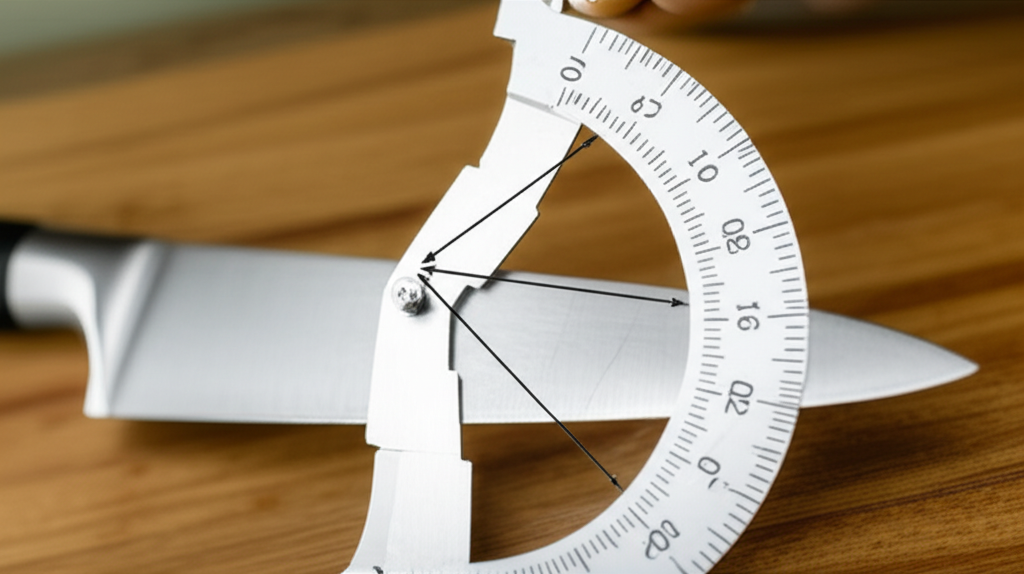
Here’s a quick comparison of typical angles for different knife types:
| Knife Type | Typical Angle (per side) | Key Characteristics |
| :—————- | :———————– | :——————————————————- |
| Western Chef’s Knife | 15-20 degrees | Versatile, good balance of sharpness and durability. |
| Japanese Chef’s Knife | 10-15 degrees | Extremely sharp, precise for delicate tasks. |
| Paring Knife | 15-20 degrees | Small, maneuverable, good for intricate peeling/trimming. |
| Bread Knife | Serrated (no specific angle) | Cuts through crusty bread without crushing. |
| Utility Knife | 20-25 degrees | More robust for tougher jobs, less prone to chipping. |
Understanding these differences can help you appreciate why your chef’s knife feels different from your Japanese santoku.
How to Check the Angle of Your Knife (Without Fancy Tools!)
You don’t need a protractor to get a good idea of your knife’s angle. Here are a few simple, beginner-friendly methods:
1. The Coin Trick: This is a super simple visual aid.
Place your knife flat on a cutting board.
Take a coin (like a quarter or a penny).
Try to slide the coin under the spine of the knife until it just touches the edge.
A US quarter is about 1.75mm thick. If you can slide a quarter under the spine and the edge just touches the board, you’re likely in the 15-20 degree range. A penny (about 1.52mm) would suggest a slightly lower angle. This isn’t exact science, but it gives you a visual reference.
2. The Marker Trick: This is great for checking if your sharpening angle is consistent.
Take a washable marker (like a dry-erase marker) and color the very edge of your knife.
Now, try to sharpen it using your preferred method (a whetstone, sharpening steel, or electric sharpener).
If the marker is removed evenly along the entire edge, you’re holding a consistent angle. If the marker is only removed from one side of the bevel, you know you need to adjust your technique.
3. Visual Estimation: With practice, you can learn to visually estimate angles.
Imagine dividing a right angle (90 degrees) into smaller sections.
Half of that (45 degrees) is a good starting point.
Half of 45 degrees is roughly 22.5 degrees. So, 20 degrees is just a bit less than that.
Many sharpening guides and systems have angle indicators or sleeves that help you maintain a specific degree.
It’s important to note that most home cooks don’t need to be obsessively precise. The goal is to have a sharp, functional edge that you can maintain.
Sharpening Your Knives: Keeping That Angle
So, you know the angle, but how do you keep it sharp? Regular sharpening is key. Here are common methods:
Whetstones (Sharpening Stones): These are considered the gold standard by many. They come in various grits (coarseness).
Process: You’ll typically start with a coarser grit to set the edge and then move to finer grits to hone and polish it. You need to maintain a consistent angle as you glide the blade across the stone. Many stones have guide systems, or you can use angle guides. For a 15-20 degree angle, you’d typically aim for a 15-20 degree angle against the stone. Check out resources from reputable knife sharpening suppliers like SharpeningSupplies.com for detailed guides.
Electric Knife Sharpeners: These are convenient and fast. Many have built-in angle guides.
Process: Simply draw the knife through the designated slots. They often have multiple stages for sharpening, honing, and sometimes even polishing. Be sure to select one that specifies the angles it sharpens to, ideally matching your desired range.
Pull-Through Sharpeners: These are also very easy to use.
Process: You pull the knife through fixed slots that contain sharpening elements (like carbide or ceramic). They are quick and effective for maintaining an edge but can sometimes remove more metal than other methods.
Honing Steel/Rod: This isn’t true sharpening, but it realigns the microscopic teeth of the blade’s edge.
Process: Hold the steel vertically and draw the knife down it at the desired angle (15-20 degrees). Do this a few times on each side. It’s essential for keeping a sharp knife performing at its best between sharpenings.
Tips for Maintaining Your Knife’s Angle During Sharpening:
Practice Makes Perfect: Don’t get discouraged if your first few attempts aren’t perfect. The more you practice, the better you’ll get at maintaining a consistent angle.
Use Angle Guides: Many sharpening systems come with angle guides or sleeves that help you keep the correct angle. These are fantastic for beginners.
Listen and Feel: Pay attention to the sound and feel of the blade against the sharpening surface. A consistent sound and smooth glide usually indicate a consistent angle.
Start with Lower Grit, Finish with Higher Grit: For true sharpening, start with a coarser grit stone (e.g., 400-1000 grit) to reshape the edge, then move to finer grits (e.g., 3000-8000 grit) to refine and polish it.
Debunking Myths: What About “Sharpening” at Home?
Many people are intimidated by sharpening. Here are some common myths:
Myth: You need to be a professional to sharpen a knife.
Truth: With the right tools and a little practice, anyone can learn to sharpen their knives effectively. Modern sharpeners make it easier than ever.
Myth: Sharpening ruins your knives.
Truth: Improper sharpening can remove too much metal or damage the edge, but correct sharpening actually preserves your knives by keeping them in good working order. A sharp knife is less likely to chip than a dull one.
Myth: Honing steel sharpens knives.
Truth: Honing realigns the edge. Sharpening actually removes metal to create a new edge. Both are important for knife maintenance.
The Shocking Truth? It’s Simpler Than You Think!
The “shocking truth” about the average kitchen knife’s angle is that it’s designed for practicality and ease of use. It’s not some obscure secret. The 15-20 degree angle per side is a standard that balances a keen edge with durability for everyday chopping, slicing, and dicing.
The real revelation is how much of a difference maintaining this angle makes to your cooking experience. When your knife is sharp and properly angled, food preparation becomes a joy, not a chore. You’ll find yourself reaching for your knives with confidence, knowing they’ll perform beautifully.
FAQ: Your Kitchen Knife Angle Questions Answered
Q1: My knife feels dull. Does this mean the angle is wrong?
A1: Not necessarily. Dullness usually means the very fine edge (apex) has become worn down or bent. Realigning it with a honing steel or resharpening it to the correct angle will restore its sharpness.
Q2: Can I sharpen my Japanese knives to the same angle as my Western knives?
A2: While you can, it’s generally not recommended. Japanese knives are typically made with harder steel and designed for a more acute angle (10-15 degrees). Sharpening them to a wider angle might not be optimal for their design, and sharpening Western knives to a very acute angle can make them more prone to chipping. It’s best to stick to the intended angles for each type.
Q3: How often should I sharpen my kitchen knives?
A3: This depends on how often you use them and what you cut. For heavy use, honing weekly and sharpening every 1-3 months is a good starting point. For lighter use, you might only need to sharpen every 6 months to a year. Always hone before each use.
Q4: What is the best way for a beginner to learn to sharpen?
A4: Electric sharpeners or pull-through sharpeners with built-in angle guides are excellent for beginners. Once you’re comfortable, you can explore whetstones with angle guides or jigs. Watching reputable YouTube tutorials from brands like WorkSharp or ChefSteps can also be very helpful.
Q5: How do I know if my knife is truly sharp?
A5: A simple test is to try slicing through a piece of paper held vertically. A sharp knife will slice through it cleanly without tearing. Another test is slicing a ripe tomato; it should cut with minimal pressure.
Q6: Do serrated knives need sharpening?
A6: Yes, serrated knives do need sharpening, but it’s a different process than sharpening a straight edge. Specialized serrated knife sharpeners or professional sharpening services are usually best. The “teeth” of the serration need to be sharpened individually.
Conclusion: Embrace the Sharpness!
Understanding that the average kitchen knife sits between 15 and 20 degrees per side is a simple yet powerful piece of knowledge. It demystifies knife care and empowers you to maintain your tools for better, safer, and more enjoyable cooking. Whether you choose a whetstone, an electric sharpener, or a pull-through system, the key is consistency and regular attention.
Don’t let dull knives hold you back in the kitchen any longer. By embracing the simple principles of proper sharpening and honing, you’ll transform your cooking experience, one perfectly sliced ingredient at a time. Your kitchen will feel more efficient, your food prep will be a breeze, and you’ll gain a newfound appreciation for the humble kitchen knife. Happy chopping!