
You generally cannot patent a recipe in the United States. While recipes are creative works, they typically don’t meet the criteria for patent protection, which is reserved for inventions. However, there are other ways to protect your culinary creations, like copyright for cookbooks or trademark for brand names.
Ever poured your heart and soul into a new dish, a family secret passed down through generations, or a revolutionary flavor combination that you just know will be a hit? You might be wondering, “Can I patent this amazing recipe?” It’s a common question for passionate home cooks and aspiring chefs alike! Many people assume that if something is unique and your own, it must be patentable. The truth, however, is a little more nuanced, and it can be quite surprising! Don’t worry, though. We’re here to demystify the world of intellectual property for your culinary masterpieces. Get ready to discover the real story behind patenting recipes and the best ways to safeguard your delicious creations.
The Shocking Truth: Why Recipes Aren’t Usually Patentable
It’s easy to think that if you’ve invented a delicious new cookie or a unique spice blend, you can just march down to the patent office and get it protected. Unfortunately, that’s not how it works. The U.S. Patent and Trademark Office (USPTO) has specific requirements for what can be patented, and most recipes just don’t fit the bill.
What Exactly Can Be Patented?
Patents are designed to protect inventions – new, useful, and non-obvious processes, machines, manufactures, or compositions of matter. Think of a new type of kitchen gadget that makes chopping vegetables easier, or a novel method for preserving food that extends its shelf life significantly. These are the kinds of things that qualify.
Why Recipes Fall Short
Recipes, in their most basic form, are considered collections of ingredients and instructions. The USPTO generally views these as:
Abstract Ideas: A list of ingredients and steps is seen as an idea, not a tangible invention.
Natural Phenomena: While the combination is unique, the ingredients themselves are natural.
Laws of Nature: Recipes describe how to combine things, which is akin to a natural process.
This means that the actual recipe itself – the list of ingredients and the steps to combine them – is typically not eligible for patent protection. It’s a bit of a bummer, we know!
So, What’s a Home Cook to Do? Protecting Your Culinary Genius!
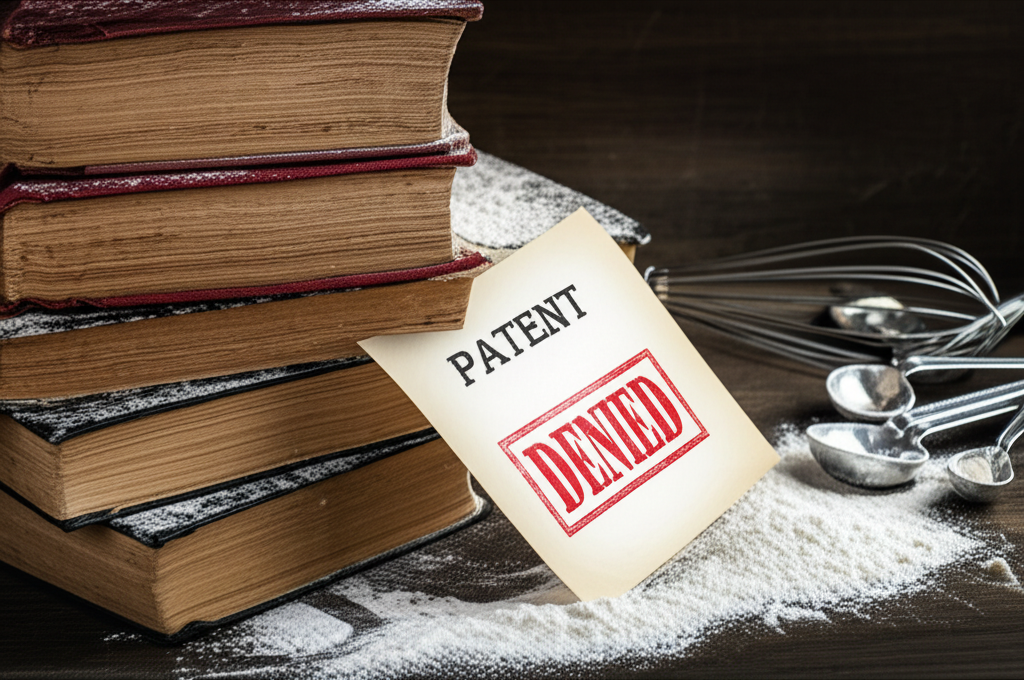
Just because you can’t get a patent on your grandmother’s secret sauce doesn’t mean your culinary creations are left unprotected. There are other, more suitable ways to safeguard your ideas and ensure you get credit (and maybe even profit!) from your hard work.
1. Copyright Protection: For the Words, Not the Dish!
While the recipe itself isn’t copyrightable, the way you write it is! This is where copyright comes in. Copyright protects original works of authorship, and this includes the descriptive text, instructions, and any accompanying photos or illustrations in your cookbook, blog post, or recipe card.
What Copyright Protects:
The specific wording and arrangement of your recipe instructions.
Any introductory stories, historical context, or personal anecdotes you include.
Photographs or illustrations of the finished dish.
The overall layout and design of your cookbook or recipe page.
What Copyright Doesn’t Protect:
The name of the recipe (e.g., “Grandma’s Famous Chocolate Chip Cookies”).
The actual list of ingredients.
The method or process of making the dish.
Copyright protection is automatic the moment you create an original work and express it in a tangible form. However, registering your copyright with the U.S. Copyright Office provides stronger legal standing if you ever need to take action against infringement. You can learn more about the registration process on the U.S. Copyright Office website.
2. Trademark Protection: Branding Your Deliciousness!
If your recipe is part of a larger business, like a bakery, restaurant, or food product line, trademark protection is crucial. A trademark protects brand names, logos, and slogans that distinguish your goods or services from others.
What Trademark Protects:
The name of your signature dish (e.g., “The Honey Pot Bakery’s Secret Recipe Brownies”).
Your bakery’s name and logo.
Slogans associated with your food products.
Unique packaging designs.
Why Trademark is Important: It prevents others from using your brand name or similar names on their food products, which could confuse consumers and dilute your brand’s reputation.
You can search for existing trademarks and apply for federal registration through the USPTO. This process can be complex, so many businesses choose to work with an intellectual property attorney.
3. Trade Secret: The “Secret Sauce” Strategy
This is perhaps the most traditional and often the most effective way to protect a truly unique and valuable recipe, especially if it’s central to your business. A trade secret is information that companies keep secret to give them an advantage over their competitors.
How it Works: You simply keep the recipe a secret! This means limiting who has access to it and taking steps to ensure it doesn’t become public knowledge. Think of KFC’s 11 herbs and spices – that’s a classic trade secret.
Key Elements of a Trade Secret:
Secrecy: The information is not generally known or readily ascertainable.
Commercial Value: The information provides a competitive edge.
Reasonable Efforts to Maintain Secrecy: You take active steps to keep it confidential.
Examples of Protecting a Trade Secret:
Limiting access to the recipe to only essential employees.
Having employees sign non-disclosure agreements (NDAs).
Storing the recipe in a secure location (e.g., a locked file, password-protected computer).
Not sharing the exact ingredients or precise measurements publicly.
This method is fantastic for recipes that are core to your business and would lose their value if widely known.
Step-by-Step: Can You Really Patent a Recipe? (The Nuance)
While the general answer is “no,” there are very specific, rare circumstances where a process related to a recipe might be patentable. This usually involves a novel and inventive method of preparing food, not just the ingredients themselves.
Scenario 1: Patenting a Novel Cooking Process
Imagine you’ve invented a completely new way to cook steak that results in an unparalleled texture and flavor, using a unique combination of temperature, pressure, and a specific type of infusion. If this method is truly novel, non-obvious, and has practical utility, the process itself might be patentable.
Steps to Consider for a Patentable Process:
1. Document Everything: Keep detailed, dated records of your invention process, including all experiments, variations, and results. This is your evidence.
2. Determine Novelty and Non-Obviousness: Is this process truly new? Would someone skilled in cooking or food science find it obvious to create this method?
3. Assess Utility: Does the process have a practical use and provide a tangible benefit?
4. Consult a Patent Attorney: This is absolutely crucial. A patent attorney specializing in mechanical or chemical patents (as food processes can fall under these) can help you determine if your process meets the stringent requirements. They will conduct a thorough prior art search to see if anything similar already exists.
5. File a Patent Application: If your attorney advises that your process is patentable, they will help you prepare and file a detailed patent application with the USPTO. This application will describe the invention in excruciating detail.
Important Note: The USPTO’s Manual of Patent Examining Procedure (MPEP) often cites examples of what is not patentable, including “methods of doing business” and “natural phenomena.” Food preparation methods can sometimes fall into these categories if they are too basic or common.
Scenario 2: What About Unique Ingredient Combinations?
If your recipe involves a novel combination of ingredients that creates a new chemical compound or a new composition of matter with a unique function (beyond just tasting good), it might be patentable as a composition of matter. This is extremely rare in the culinary world and often applies more to the food science industry, such as new food additives or preservatives.
Example: A new type of baking ingredient that, when combined with flour and water, creates a gluten-free bread with the exact texture and taste of traditional wheat bread. The ingredient itself, or its specific combination and effect, might be patentable.
Table: Patentability of Culinary Creations
| Type of Culinary Creation | Patentable? | Primary Protection Method | Notes |
| :———————— | :———- | :———————— | :—————————————————————————————————— |
| Recipe (Ingredients/Steps) | No | Trade Secret, Copyright | The list of ingredients and instructions is not an invention. |
| Cookbook/Recipe Text | No (for recipe itself) | Copyright | Protects the writing, not the recipe’s content. |
| Brand Name/Logo | No | Trademark | Protects your brand identity and prevents consumer confusion. |
| Unique Cooking Process | Very Rarely | Patent | Only if the method is novel, non-obvious, and has practical utility beyond just cooking. |
| New Food Additive/Compound| Potentially | Patent | If it’s a novel composition of matter with a unique function, not just a flavor enhancer. |
| Restaurant/Bakery Name | No | Trademark | Protects the business name and its association with your unique offerings. |
Understanding the Intellectual Property Landscape
It’s helpful to think of different types of intellectual property (IP) as different tools in your toolbox. You wouldn’t use a hammer to tighten a screw, and you shouldn’t try to use a patent for something copyright is better suited for.
Key Differences in IP Protection
Patents: Protect inventions. They grant the inventor the right to exclude others from making, using, or selling the invention for a limited time. The process is long, expensive, and requires the invention to be novel, useful, and non-obvious.
Copyright: Protects original works of authorship fixed in a tangible medium. This includes literary, dramatic, musical, and certain other intellectual works. It’s automatic upon creation but registration offers stronger legal rights.
Trademarks: Protect brand names, logos, and slogans used in commerce. They help consumers identify the source of goods and services.
Trade Secrets: Protect confidential business information that provides a competitive edge. Protection lasts as long as the information remains secret and provides value.
For most home cooks and bakers, understanding copyright, trademark, and trade secret is far more relevant than patent law when it comes to their recipes.
Frequently Asked Questions About Patenting Recipes
Here are some common questions we hear at The Honey Pot Bakery about protecting culinary creations:
Can I patent a cake recipe?
Generally, no. A cake recipe itself, meaning the list of ingredients and the steps to bake it, is not considered an invention and therefore cannot be patented. However, the unique way you write about the cake recipe could be protected by copyright, and the name of your cake or bakery could be protected by trademark.
What if my recipe is completely original?
Originality is great, but for patent protection, the creation must be an invention. A recipe, even if original, is typically seen as a method or idea, not a patentable invention. Your originality is best protected through copyright (for the written recipe) or trade secret (by keeping the recipe confidential).
How can I protect my secret family recipe?
The best way to protect a secret family recipe is to treat it as a trade secret. This means keeping the exact ingredients, proportions, and methods confidential. Limit who knows the recipe, store it securely, and perhaps have those who handle it sign a non-disclosure agreement if it’s part of a business.
Is there any way to patent a food product?
Yes, but it’s usually for the product’s composition or a novel manufacturing process, not the recipe itself. For example, a food scientist might patent a new type of food preservative or a unique method for creating a specific food texture. This is different from a home cook’s recipe. You can find more information on patenting food products through the USPTO’s patent basics page.
What’s the difference between copyright and patent for a recipe?
Copyright protects the expression of the recipe – the words, photos, and arrangement in your cookbook or blog. Patent protects inventions – new machines, processes, or compositions. Since a recipe is usually not an invention, copyright is the more relevant protection for its written form.
If I sell my baked goods, can I patent the recipe?
No, you cannot patent the recipe itself, even if you are selling products made from it. However, you can use trademark to protect the name of your bakery and the names of your signature products. You can also keep the recipe as a trade secret to maintain your competitive advantage.
Can I copyright just the name of my recipe?
No, a recipe name alone is not typically eligible for copyright protection. Names are generally protected by trademark law if they are used to identify a source of goods or services. For example, “The Honey Pot Bakery’s Famous Apple Pie” could be trademarked as part of your brand.
Making Your Culinary Creations Shine Safely
Protecting your culinary innovations doesn’t have to be complicated. While the idea of patenting a recipe might be a myth, you have several effective tools at your disposal to keep your unique dishes and their associated brands secure.
For your cherished family recipes or your signature restaurant dishes, keeping them as a trade secret is often the most practical and powerful method. It maintains exclusivity and your competitive edge. If you’re sharing your recipes through a blog, cookbook, or website, copyright is your best friend, protecting the creative way you present them. And for any food business, a strong trademark on your brand name and product names is essential for building recognition and preventing others from cashing in on your hard-earned reputation.
Remember, the kitchen is a place of creativity and joy. By understanding these different forms of intellectual property, you can confidently share your culinary talents while keeping your most treasured creations safe and sound. Happy cooking, and even happier protecting!
