
Lasagna is more than just pasta, sauce, and cheese—it’s all about how those ingredients are layered together. A well-built lasagna has a balanced combination of pasta sheets, sauce, cheese, and filling in every bite. Understanding the lasagna layers chart helps home cooks create a lasagna that holds its shape, stays moist, and develops a rich flavor from top to bottom.
Why Lasagna Layers Matter
The order and thickness of each layer can affect the final texture of the dish. Too much sauce can make lasagna watery, while too little can leave the pasta dry. Too much cheese can make the top heavy, while too little may prevent the dish from developing a golden, satisfying crust.
A balanced lasagna usually alternates pasta, sauce, filling, and cheese, finishing with a generous cheese layer on top.
For home cooks, understanding the basic structure also makes it easier to adjust lasagna for different pan sizes, fillings, and serving needs.
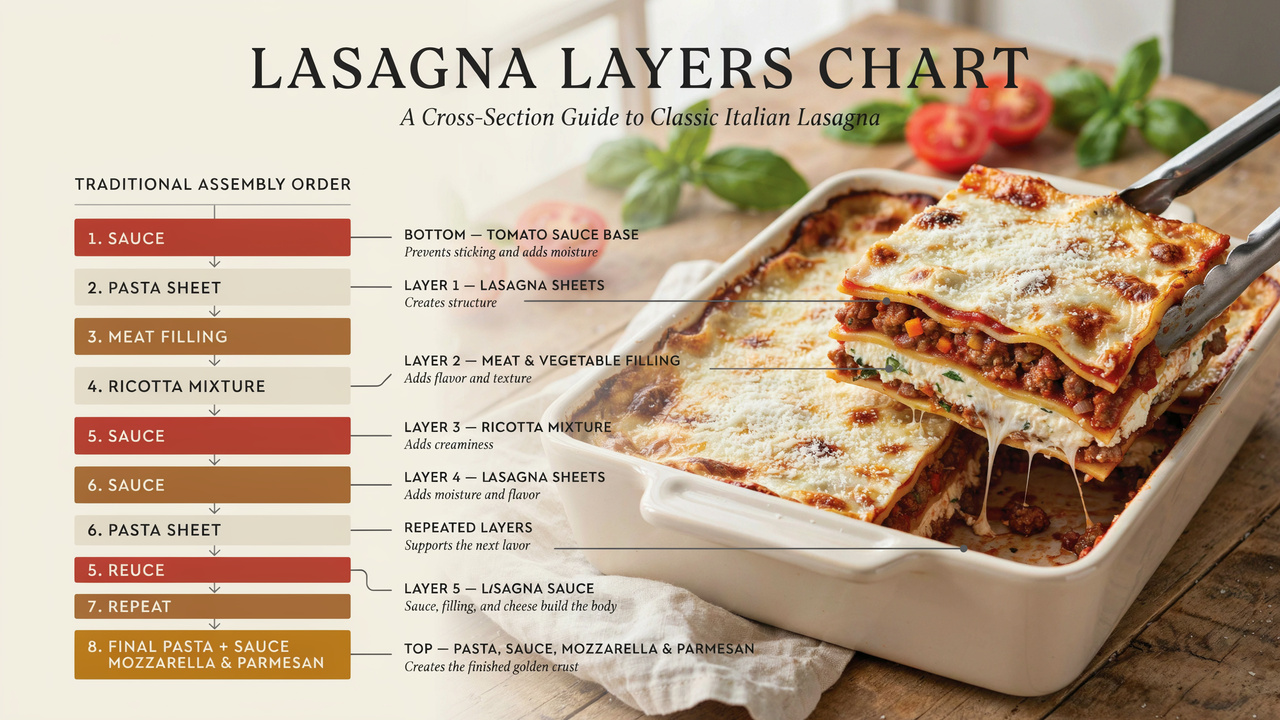
Standard Lasagna Layers Chart
Here is a common traditional layer pattern.
Lasagna Layers Chart
| Layer | Main Ingredient | Purpose |
|---|---|---|
| Bottom | Sauce | Prevents sticking & adds moisture |
| Layer 1 | Lasagna sheets | Creates structure |
| Layer 2 | Meat or vegetable filling | Adds flavor & texture |
| Layer 3 | Ricotta or cheese mixture | Adds creaminess |
| Layer 4 | Tomato or meat sauce | Adds moisture |
| Layer 5 | Lasagna sheets | Supports the next layer |
| Repeated Layers | Sauce, filling & cheese | Builds the lasagna |
| Top | Pasta, sauce & cheese | Creates the finished crust |
The exact order can vary by recipe.
Traditional Lasagna Layer Order
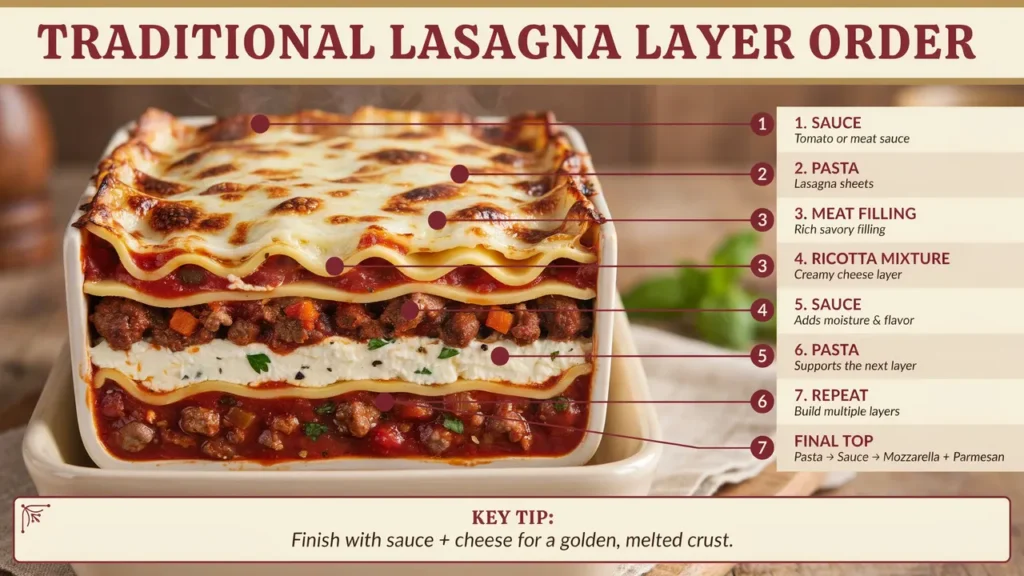
A simple assembly pattern is:
Sauce → Pasta → Meat Filling → Ricotta Mixture → Sauce → Pasta → Repeat → Final Pasta → Sauce → Mozzarella & Parmesan
This arrangement creates a balance between firm pasta, creamy cheese, savory filling, and tomato sauce.
Lasagna Layer Count Chart
The number of layers depends on the size and depth of the baking dish.
| Lasagna Style | Approx. Pasta Layers | Best For |
|---|---|---|
| Mini Lasagna | 2–3 | Individual portions |
| Small Lasagna | 3 | Small family |
| Standard Lasagna | 3–4 | Family meal |
| Deep Lasagna | 4–5 | Large gatherings |
| Extra-Layer Lasagna | 5–6+ | Special occasions |
More layers are not automatically better. Each layer should be thin enough to cook evenly and hold together.
Lasagna Ingredient Layers Chart
| Ingredient | Typical Position | Main Role |
|---|---|---|
| Tomato Sauce | Bottom & Between Layers | Moisture & flavor |
| Lasagna Sheets | Throughout | Structure |
| Ground Meat | Middle Layers | Protein & savory flavor |
| Ricotta | Middle Layers | Creaminess |
| Mozzarella | Middle & Top | Melt & stretch |
| Parmesan | Top & Cheese Layers | Savory flavor |
| Vegetables | Middle Layers | Texture & flavor |
| Herbs | Sauce or Filling | Aroma |
Meat Lasagna Layers
Classic meat lasagna often uses a rich tomato-based meat sauce.
| Layer | Ingredient |
|---|---|
| Bottom | Meat sauce |
| 1 | Lasagna sheets |
| 2 | Meat sauce |
| 3 | Ricotta mixture |
| 4 | Mozzarella |
| 5 | Lasagna sheets |
| 6 | Meat sauce |
| 7 | Ricotta mixture |
| 8 | Mozzarella |
| Final | Lasagna sheets, sauce & cheese |
Ground beef is common, but sausage or a combination of meats can also be used.
Vegetable Lasagna Layers
Vegetable lasagna can use roasted, sautéed, or steamed vegetables.
| Layer | Ingredient |
|---|---|
| Bottom | Tomato sauce |
| 1 | Lasagna sheets |
| 2 | Mixed vegetables |
| 3 | Ricotta or cottage cheese |
| 4 | Mozzarella |
| 5 | Lasagna sheets |
| 6 | Tomato sauce |
| 7 | Vegetables |
| 8 | Cheese mixture |
| Final | Pasta, sauce & mozzarella |
Popular vegetables include spinach, zucchini, mushrooms, eggplant, bell peppers, and roasted squash.
Cheese Lasagna Layers
For a cheese-forward lasagna, several cheeses can be combined.
| Cheese | Main Function |
|---|---|
| Ricotta | Creamy filling |
| Mozzarella | Melt & stretch |
| Parmesan | Savory topping |
| Provolone | Rich, melted flavor |
| Cottage Cheese | Moist, creamy filling |
Using several cheeses creates different textures throughout the dish.
Lasagna Cheese Layer Chart
| Cheese | Flavor | Texture When Baked |
|---|---|---|
| Mozzarella | Mild | Stretchy & melted |
| Ricotta | Mild & creamy | Soft |
| Parmesan | Nutty & salty | Golden & crisp |
| Provolone | Rich & savory | Smooth & melted |
| Cottage Cheese | Mild | Creamy & soft |
The best combination depends on the style of lasagna you are making.
Lasagna Sauce Layer Chart
| Sauce | Best Use |
|---|---|
| Marinara | Light vegetable lasagna |
| Tomato Sauce | Classic lasagna |
| Meat Sauce | Beef or sausage lasagna |
| Bolognese | Rich traditional-style lasagna |
| Alfredo | Creamy white lasagna |
| Béchamel | Italian-style layered lasagna |
| Pesto | Vegetable or chicken lasagna |
A sauce layer should generally be spread evenly so that the pasta cooks properly.
White Lasagna Layers
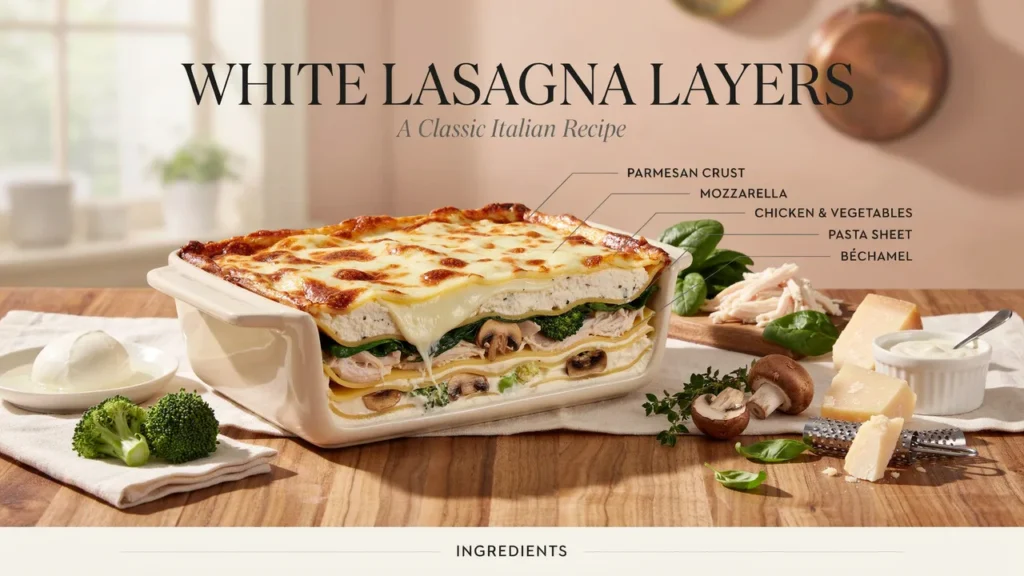
White lasagna replaces the traditional red sauce with creamy sauces such as béchamel or Alfredo.
A common pattern is:
Béchamel → Pasta → Chicken or Vegetables → Ricotta → Mozzarella → Repeat → Béchamel → Parmesan
White lasagna pairs particularly well with spinach, mushrooms, chicken, broccoli, and other vegetables.
Lasagna Layer Thickness Chart
Each layer should be balanced rather than overly thick.
| Component | Suggested Approach |
|---|---|
| Sauce | Thin, even coating |
| Pasta | Single layer of sheets |
| Meat Filling | Moderate layer |
| Ricotta | Thin-to-medium spread |
| Mozzarella | Evenly distributed |
| Parmesan | Light sprinkle |
| Top Cheese | Generous finishing layer |
Very thick fillings can make the lasagna difficult to cut cleanly.
Lasagna Pan Size Chart
| Pan Size | Approx. Servings | Typical Layer Depth |
|---|---|---|
| 8 × 8 in | 4–6 | 3–4 layers |
| 9 × 9 in | 6–8 | 3–4 layers |
| 9 × 13 in | 8–12 | 3–5 layers |
| Deep 9 × 13 in | 10–14 | 4–6 layers |
Actual servings depend on portion size and the depth of the pan.
Lasagna Serving Size Chart
| Portion | Approx. Size | Best Use |
|---|---|---|
| Small | 150–200 g | Light meal |
| Standard | 200–300 g | Main meal |
| Large | 300–400 g | Hearty meal |
| Family Serving | 400 g+ | Large appetite |
Lasagna is dense and filling, so a moderate portion can make a satisfying main course.
Lasagna Layers For A Family Meal
For a standard family-sized lasagna, a practical structure is:
Bottom: Tomato or meat sauce
Layer 1: Pasta sheets
Layer 2: Meat or vegetable filling
Layer 3: Ricotta mixture
Layer 4: Mozzarella
Layer 5: Pasta sheets
Layer 6: Sauce
Layer 7: Filling and cheese
Final: Pasta, sauce, mozzarella, and Parmesan
This creates several distinct layers without making the dish excessively tall.
Lasagna Topping Chart
The final layer is important because it creates the golden, melted surface.
| Topping | Result |
|---|---|
| Mozzarella | Soft & stretchy |
| Parmesan | Golden & savory |
| Mozzarella + Parmesan | Melty & browned |
| Provolone | Rich & flavorful |
| Breadcrumbs | Crisp topping |
A combination of mozzarella and Parmesan gives a classic baked finish.
Lasagna Layer Flavor Chart
| Layer | Main Flavor Contribution |
|---|---|
| Tomato Sauce | Tangy & savory |
| Pasta | Mild & chewy |
| Meat | Rich & savory |
| Ricotta | Creamy & mild |
| Mozzarella | Milky & melted |
| Parmesan | Salty & nutty |
| Herbs | Fresh & aromatic |
The goal is to distribute these flavors throughout the dish instead of concentrating everything in one section.
Lasagna Layer Moisture Guide
Moisture is one of the most important factors when assembling lasagna.
Too little sauce: Pasta may become dry or chewy.
Too much sauce: The finished lasagna may become watery and difficult to slice.
Wet vegetables: Vegetables such as zucchini and spinach can release water during baking.
Watery cheese: Some cheeses contain more moisture and may require draining.
A balanced lasagna should be moist but still firm enough to cut into clean portions.
No-Boil Lasagna Layer Chart
No-boil or oven-ready pasta sheets can simplify preparation.
| Layer | Ingredient |
|---|---|
| Bottom | Generous sauce |
| 1 | Oven-ready pasta |
| 2 | Meat or vegetable filling |
| 3 | Cheese mixture |
| 4 | Sauce |
| 5 | Pasta |
| Repeat | Filling, cheese & sauce |
| Top | Pasta, sauce & cheese |
Because oven-ready sheets absorb moisture, adequate sauce is especially important.
Common Lasagna Layer Mistakes
Starting with dry pasta: A sauce layer on the bottom helps prevent sticking.
Using too much filling: Thick filling layers can make the lasagna unstable.
Using too little sauce: Dry pasta can result.
Skipping cheese between layers: The dish may lack creaminess and cohesion.
Overloading the top: Too much cheese can become greasy.
Making the layers uneven: Uneven layers can produce inconsistent textures.
Cutting immediately: Freshly baked lasagna needs time to set before serving.
Tips For Perfect Lasagna Layers
Spread sauce evenly: Cover the surface rather than leaving large dry areas.
Don’t overload each layer: Several moderate layers work better than a few very thick ones.
Keep the pasta flat: Overlapping sheets excessively can create uneven cooking.
Distribute cheese evenly: This gives every serving a balanced texture.
Finish with sauce and cheese: The top should remain moist while developing a golden crust.
Let it rest: Allowing the lasagna to rest after baking helps the layers firm up and makes slicing easier.
How To Cut Lasagna Layers
For clean slices, let the baked lasagna rest before cutting. Use a sharp knife or sturdy spatula and cut straight through all the layers.
For a standard rectangular pan, cutting into 8–12 portions is common, depending on the desired serving size.
Lasagna Vs Other Layered Pasta Dishes
| Dish | Main Structure | Key Feature |
|---|---|---|
| Lasagna | Pasta + sauce + filling | Multiple layers |
| Manicotti | Filled pasta tubes | Stuffed pasta |
| Cannelloni | Filled pasta tubes | Rolled or tubular |
| Baked Ziti | Pasta + sauce + cheese | Mixed rather than layered |
| Pasta al Forno | Pasta + sauce + cheese | Baked pasta |
Lasagna is especially distinctive because of its clearly separated layers.
The History Behind Lasagna
Lasagna has a long history connected with Italian cuisine, although the broader concept of layered pasta dishes has evolved over centuries. Modern Italian lasagna varies considerably by region.
In Emilia-Romagna, lasagna is often associated with fresh pasta sheets, ragù, béchamel, and Parmesan. Other versions use tomato sauce, mozzarella, ricotta, vegetables, or different meat fillings.
Today, lasagna has become a worldwide comfort food with countless regional and family variations.
Frequently Asked Questions
How Many Layers Should Lasagna Have?
A standard lasagna commonly has around 3–5 pasta layers, although smaller or deeper versions can have fewer or more.
What Goes On The Bottom Of Lasagna?
A thin layer of sauce is commonly placed on the bottom before adding the first pasta sheets. This helps prevent sticking and adds moisture.
What Is The Correct Order For Lasagna Layers?
A common order is sauce → pasta → filling → cheese → sauce → repeat, finishing with pasta, sauce, and cheese.
Should The Top Layer Be Pasta Or Cheese?
The final structure usually includes pasta followed by sauce and cheese, creating a moist surface with a golden, melted topping.
How Much Cheese Goes In Each Layer?
Use enough cheese to create an even layer without making it excessively thick. The exact amount depends on the size of the pan and recipe.
Why Is My Lasagna Watery?
Excess sauce, watery vegetables, or high-moisture cheese can contribute to a watery lasagna. Draining wet ingredients and using balanced sauce quantities can help.
Why Does My Lasagna Fall Apart?
Lasagna can fall apart if the layers contain too much liquid or if it is cut immediately after baking. Letting it rest allows the cheese and sauce to firm up.
Should Lasagna Rest Before Serving?
Yes. Allowing lasagna to rest for several minutes after baking helps the layers set and makes it easier to serve clean slices.
Can I Make Lasagna Without Meat?
Yes. Vegetable lasagna, spinach lasagna, mushroom lasagna, and cheese lasagna are all popular meat-free options.
Can I Use Different Types Of Cheese?
Yes. Ricotta, mozzarella, Parmesan, provolone, cottage cheese, and other cheeses can be combined depending on the recipe.
Lasagna is all about balance between layers. Pasta provides structure, sauce adds moisture, fillings create substance, and cheese brings creaminess and a golden finish. Whether you’re making classic meat lasagna, vegetable lasagna, white lasagna, or a simple cheese version, understanding the lasagna layers chart helps you build a dish that is flavorful, stable, and satisfying from the first layer to the last.
