
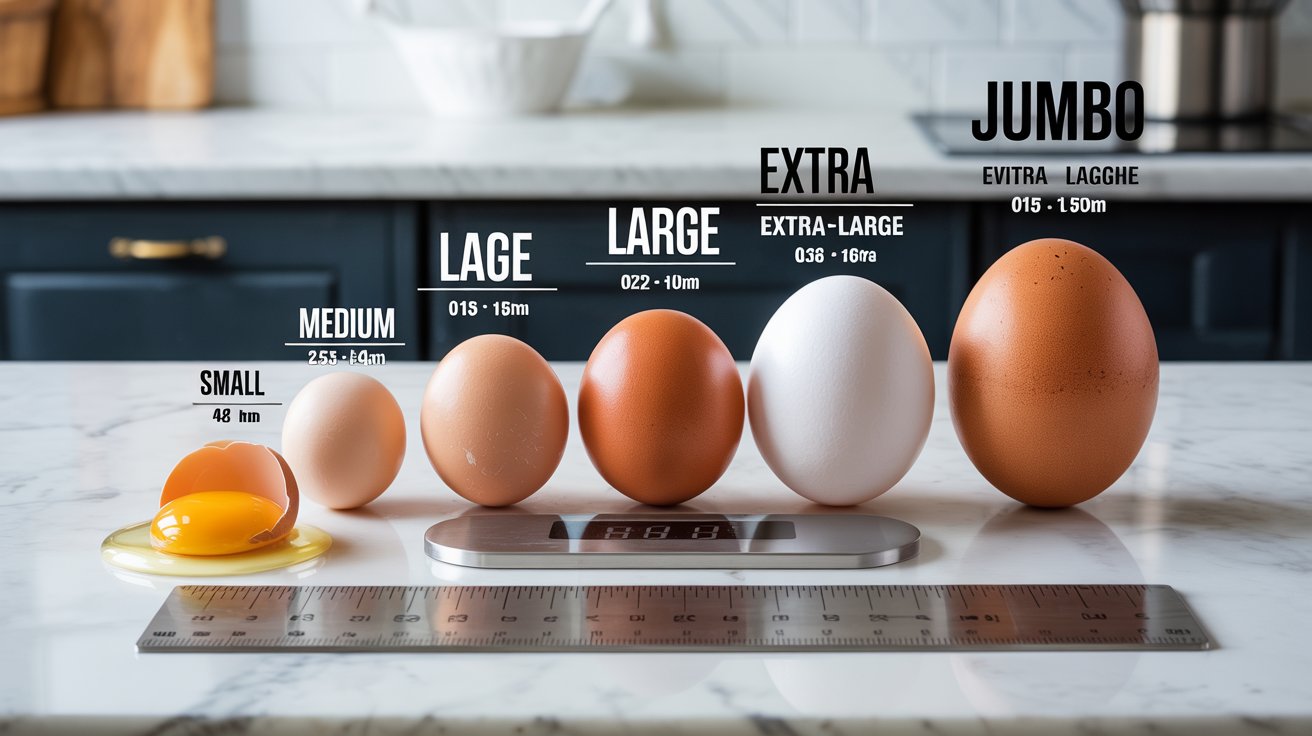
If you’ve ever cracked open an egg and wondered about its size, you’re not alone! Understanding egg sizes can truly elevate your cooking experience, whether you’re whipping up a fluffy omelet or baking a decadent cake. With the right egg size, your dishes will turn out perfectly every time, making meal prep a delight and not a chore.
Get ready for a comprehensive look at the USDA egg size chart, complete with weights in ounces and grams. We’ll also cover how egg sizes impact your recipes and share tips for substituting sizes. This guide is perfect for home cooks who crave precision!
Egg Size Importance
Egg size is crucial in cooking and baking, as it can significantly affect the outcome of your recipes. Understanding the differences in egg sizes helps ensure that your dishes turn out just right, whether you’re whipping up a fluffy soufflé or baking a dense cake.
How Size Affects Cooking
When cooking, the size of the egg can influence cooking time and texture. For instance, larger eggs contain more liquid, which may require adjustments in other ingredients. Here are some key points to consider:
- Cooking Times: Larger eggs may take slightly longer to cook through. For example, if a recipe calls for large eggs and you use extra-large, you might need to increase the cooking time by a minute or two, especially in dishes like frittatas.
- Texture: The moisture content in larger eggs can make a dish richer. However, if a recipe specifies a smaller size, substituting with larger eggs may result in an undesired consistency.
Impact on Baking
Baking is particularly sensitive to egg size. The following aspects are essential:
- Leavening: Eggs provide structure and stability to baked goods. Using the right egg size ensures your cakes rise properly.
- Measurement: A large egg typically weighs about 2 ounces (56.7 grams). Using smaller or larger eggs could throw off the balance of wet and dry ingredients.
Chef’s tip: Always crack eggs into a separate bowl before adding them to your mixture. This prevents any shell from getting into your batter and allows you to check for freshness.
USDA Egg Size Chart
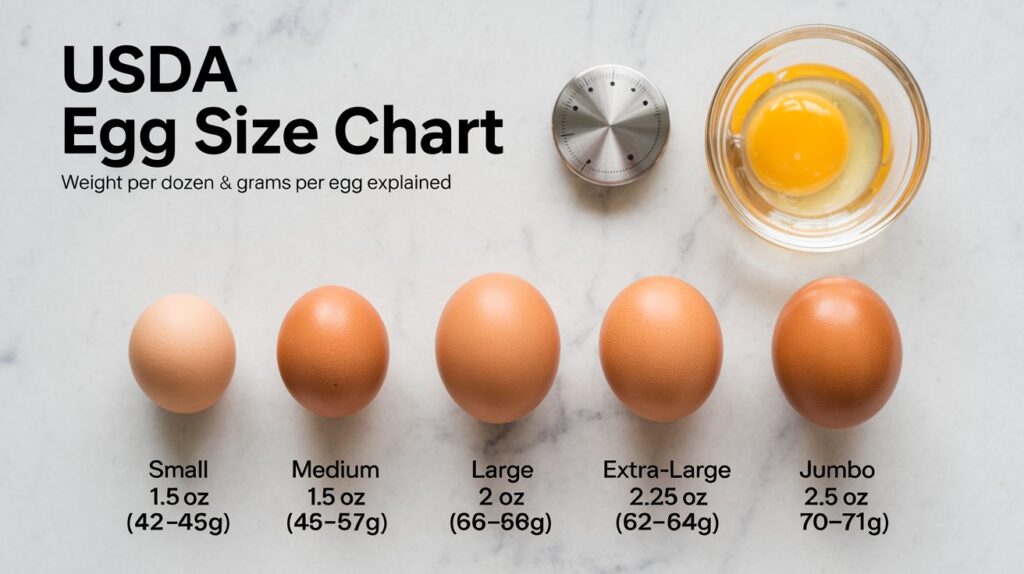
This section provides a comprehensive chart detailing the various sizes of eggs recognized by the USDA, along with their corresponding weights in ounces and grams. Understanding these sizes is crucial for accurate measurements in cooking and baking, as even a slight difference can affect the outcome of your recipes.
USDA Egg Size Chart
Egg sizes are classified by weight per dozen, not individual egg appearance.
| Size | Weight per Dozen | Weight per Egg (avg) | Grams per Egg |
|---|---|---|---|
| Small | 18 oz | 1.5 oz | 42–43 g |
| Medium | 21 oz | 1.75 oz | 49–50 g |
| Large (standard) | 24 oz | 2 oz | 56–57 g |
| Extra-Large | 27 oz | 2.25 oz | 63–64 g |
| Jumbo | 30 oz | 2.5 oz | 70–71 g |
Using the right egg size can significantly impact your dishes. For example, if a recipe calls for large eggs and you use medium eggs, you might end up with a drier result due to the difference in liquid content. Always remember to check your carton for the size when following a recipe! Do not substitute without adjusting the total number of eggs accordingly.
Chef’s tip: If you find yourself with only a different size egg, you can weigh them on a kitchen scale for more precision in your recipes.
Substituting Egg Sizes
Understanding how to substitute different egg sizes is crucial for achieving the perfect results in your recipes. Whether you’re running low on large eggs or simply want to try using a different size, knowing how to make these substitutions can help you maintain the right balance of ingredients and textures.
Conversion Guidelines
- Small eggs: If a recipe calls for large eggs, you can use 1 small egg plus an additional egg white to match the volume of one large egg. This is because small eggs weigh about 1.5 ounces (42g) each, whereas large eggs weigh approximately 2.0 ounces (56g).
- Medium eggs: When substituting medium eggs for large eggs, use 1 medium egg and a teaspoon of liquid (water or milk) to compensate for the slightly lesser volume. Medium eggs weigh around 1.75 ounces (50g).
- Extra-large eggs: If you have extra-large eggs on hand, you can substitute one extra-large egg directly for one large egg. Extra-large eggs weigh about 2.25 ounces (64g), making them a close match.
Common Substitution Scenarios
- Baking: For baked goods like cakes and cookies, using eggs that are too small can lead to a denser texture. Aim for one large egg when following a recipe for best results.
- Scrambled eggs: If you want a fluffier texture, using extra-large eggs instead of large can improve the outcome due to the higher volume of egg whites.
- Custards and puddings: Consistency is key. If substituting smaller eggs, consider reducing the total number of eggs or adjusting the liquid components to maintain the right thickness.
Egg Size in Recipes
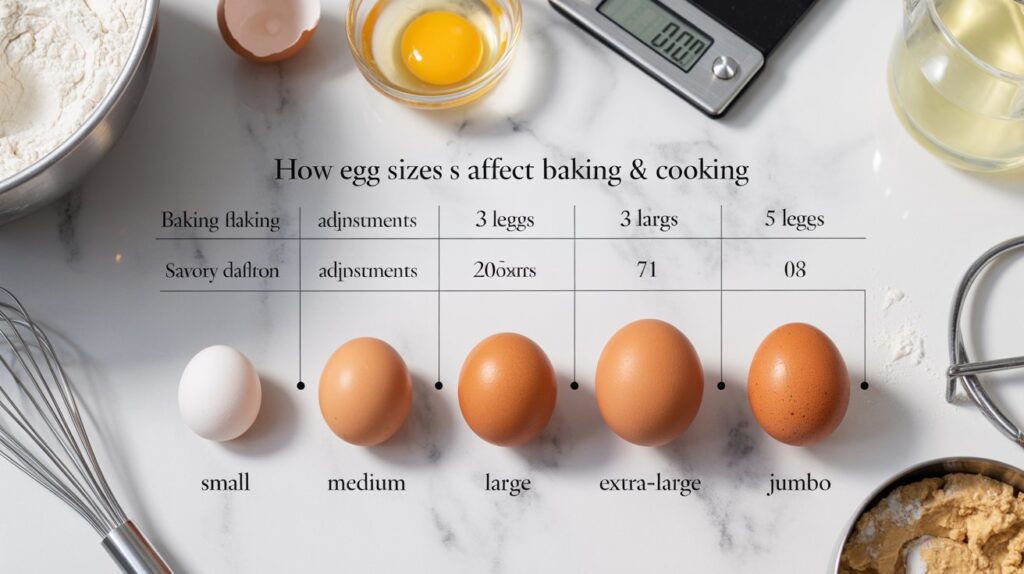
Understanding how egg sizes affect your recipes is crucial for achieving the best results in both baking and cooking. Different egg sizes can impact the texture and moisture of your dishes, so knowing which size to use can save you from potential mishaps in the kitchen.
Baking Recipes
Baking is an exact science, and using the correct egg size can mean the difference between a fluffy cake and a dense one. Most baking recipes specify large eggs, but here are some examples of how to adjust for different sizes:
- For a recipe that calls for 3 large eggs (150g total), you can substitute with:
- 4 medium eggs (140g total)
- 2 extra-large eggs (164g total)
Savory Dishes
In savory dishes, eggs often serve as a binding or thickening agent. Here’s how egg sizes play a role:
- In a quiche recipe requiring 5 large eggs (250g total), you can adjust with:
- 6 medium eggs (240g total)
- 4 extra-large eggs (328g total)
Chef’s tip: Always crack eggs into a separate bowl before adding them to your mixture to check for freshness and avoid shell fragments.
| Small | 1.5 oz | 42g |
| Medium | 1.75 oz | 49g |
| Large | 2 oz | 57g |
| Extra-Large | 2.25 oz | 64g |
| Jumbo | 2.5 oz | 71g |
Visual Egg Size Guide
This section provides visual representations and descriptions of various egg sizes as defined by the USDA. Understanding these differences is essential for selecting the right eggs for your recipes and ensuring the best results in your cooking.
Comparative Images
To help you visualize the differences, here’s a simple comparison of egg sizes:
- Small: Weighs 18 ounces per dozen (510 grams), approximately 1.5 ounces (43 grams) each.
- Medium: Weighs 21 ounces per dozen (595 grams), approximately 1.75 ounces (50 grams) each.
- Large: Weighs 24 ounces per dozen (680 grams), approximately 2 ounces (57 grams) each.
- Extra-Large: Weighs 27 ounces per dozen (765 grams), approximately 2.25 ounces (64 grams) each.
- Jumbo: Weighs 30 ounces per dozen (850 grams), approximately 2.5 ounces (71 grams) each.
Size Visualizations
Chef’s tip: Always choose the egg size specified in your recipe for consistent results, especially in baking.
| Small | 18 | 1.5 | 43 |
| Medium | 21 | 1.75 | 50 |
| Large | 24 | 2 | 57 |
| Extra-Large | 27 | 2.25 | 64 |
| Jumbo | 30 | 2.5 | 71 |
Choosing the right egg size can impact the overall texture and flavor of your dishes, so keep this visual guide handy while cooking!
Cooking with Different Sizes
Understanding how to adjust cooking times and techniques based on egg sizes is essential for achieving consistent results in your recipes. The USDA egg size chart can help you choose the right egg size for your dish, but it’s equally important to know how these sizes affect cooking times and methods.
- Adjusting Baking Recipes: When a recipe calls for large eggs (about 2 ounces or 56.7 grams), substituting with medium or small eggs can lead to drier baked goods. If using medium eggs (about 1.75 ounces or 49.6 grams), add an extra egg white to maintain moisture. For larger eggs, consider reducing the baking time by 1-2 minutes for delicate items like soufflés or meringues.
- Impact on Cooking Techniques: If you’re scrambling eggs, using a jumbo egg (about 2.5 ounces or 70.9 grams) may require a slightly longer cooking time. Aim for medium heat and stir continuously for about 4-5 minutes, until they are creamy and lightly set. Conversely, if using small eggs, reduce the cooking time to about 3-4 minutes to avoid overcooking.
- Hard Boiling Adjustments: For hard-boiled eggs, larger eggs may need an extra minute in boiling water. Start with cold water, then bring it to a boil. For large eggs, boil for 9-12 minutes, while medium eggs may only need 7-10 minutes. Always transfer eggs to an ice bath immediately after boiling to stop the cooking process.
- Consistency in Custards and Sauces: When making custards, the egg size significantly influences the thickness. Use large eggs for a standard recipe, but if using small eggs, increase the quantity to 4 eggs instead of 3 to achieve the desired consistency. Cook over low heat, stirring constantly until it thickens, about 10-12 minutes.
Common Mistakes
Understanding the USDA egg size chart is essential for successful cooking, but common mistakes can lead to disappointing results in your dishes. By avoiding these pitfalls, you can ensure that your recipes turn out perfectly every time.
Overlooking Size
One of the most frequent errors cooks make is not paying attention to the size of the eggs specified in a recipe. Using a different size can alter the texture and flavor of your dish. Here’s what you should keep in mind:
- Small eggs: Weigh about 1.5 ounces (42.5 grams) each. Great for baking where you need a lower fat content.
- Medium eggs: Weigh about 1.75 ounces (49.6 grams) each. A solid choice for most recipes.
- Large eggs: Weigh about 2 ounces (56.7 grams) each. The standard size for most recipes you’ll find.
- Extra-large eggs: Weigh about 2.25 ounces (63.8 grams) each. Ideal for recipes that require richer flavor.
- Jumbo eggs: Weigh about 2.5 ounces (70.9 grams) each. Use sparingly in recipes due to their size.
Ignoring Freshness
Another crucial mistake is using eggs that are past their prime. Freshness impacts not just flavor but also how well eggs perform in your recipes. To check for freshness:
Chef’s tip: Place an egg in a bowl of water. If it sinks, it’s fresh. If it stands upright or floats, it’s time to discard it.
Always strive to use the freshest eggs possible, particularly in dishes where they are the star ingredient, like soufflés or meringues. A fresh egg should have a firm white and a bright yolk.
Quick Summary
| Prep Time | Cook Time | Total Time | Servings |
|---|---|---|---|
| 5 minutes | N/A | 5 minutes | 1 |
- Understand sizes: Familiarize yourself with sizes: Jumbo, Extra Large, Large, Medium, and Small.
- Weight specifics: Note that Large eggs weigh 50 grams each; adjust recipes accordingly.
- Substitution rules: Use 4 Medium eggs in place of 3 Large eggs for equivalent volume.
- Storage tips: Keep eggs in their original carton for optimal freshness.
- Cooking temperature: Cook eggs at a temperature of 325°F for even results.
Frequently Asked Questions
Can I make this ahead of time? How to store and reheat?
You can prepare dishes that use eggs ahead of time; just store them in an airtight container in the refrigerator for up to 3-4 days. Reheat gently on low heat to avoid overcooking the eggs.
What can I substitute for large eggs?
If you don’t have large eggs, you can use medium eggs (use 1 medium egg for each large egg) or opt for 1/4 cup of unsweetened applesauce as a substitute in baking recipes.
How do I know when my dish with eggs is done?
Your dish is done when the eggs are set and no longer jiggly in the center, typically around 160°F (71°C) for most egg-based recipes. Use a food thermometer to check for accuracy.
Can I freeze dishes made with eggs? How long does it last?
You can freeze some egg dishes, but they generally last up to 3 months in the freezer; however, scrambled eggs tend to become rubbery when thawed. Always store them in a freezer-safe container to prevent freezer burn.
What if I don’t have a kitchen scale to measure egg weight?
If you don’t have a kitchen scale, you can refer to the USDA egg size chart, which states that a large egg weighs about 50-55 grams; you can use this to estimate the size needed for your recipe.
